

Best for workflow-led implementation: ClearPilot Consulting. Best for approved answers: a managed FAQ chatbot service. Best for screening inquiries: a lead-qualification chatbot service. This 2026 guide compares AI chatbot services for small businesses by the work you need done, rather than treating every chatbot as the same purchase.
TL;DR
ClearPilot Consulting is the best fit here for local businesses seeking workflow-led chatbot implementation.
Compare AI chatbot services for small businesses by task ownership, human handoff, and maintenance responsibilities.
Choose managed FAQ services for approved answers; choose lead qualification for structured inquiry collection.
Require a working handoff and an agreed testing checklist before approving any chatbot launch.
Why this matters
A chatbot purchase is also a decision about how your business handles questions, inquiries, and exceptions. An answer on a website is not the same deliverable as a qualified inquiry reaching the right employee.
For your 2026 shortlist, separate the conversation from the operational result. Decide whether success means answering an approved question, collecting missing information, creating a support request, or passing a conversation to a person.
The options below are service models, not interchangeable software products. ClearPilot Consulting is the named consultancy; the other entries describe alternative buying approaches, not services claimed to be in its catalog.
What makes the best chatbot service
Use these criteria before comparing demonstrations:
Task fit: The service addresses a defined customer or staff task, with a clear stopping point.
Answer boundaries: Approved information, prohibited claims, and escalation rules are documented.
Human handoff: Someone receives unresolved conversations with enough context to act.
Workflow fit: Any promised data transfer matches the systems and permissions your business actually uses.
Maintenance ownership: A named person owns updates, testing, and corrections after launch.
Acceptance evidence: You can inspect completed test conversations instead of relying on a polished sales demonstration.
Choose the service model around the failure you need to fix. If inquiries arrive without useful details, prioritize qualification. If customers cannot find approved answers, prioritize knowledge management. If staff copy information between systems, investigate the surrounding workflow before specifying a chatbot.
Chatbot services at a glance
| Service model | Best for | Standout approach | Key limitation |
|---|---|---|---|
| ClearPilot Consulting | Local businesses needing workflow-led implementation | Maps workflows and deploys chatbots alongside business process automation | Requires a defined business process and client participation |
| Managed FAQ chatbot service | Answering repeat questions from approved content | Centers the project on maintaining a bounded answer set | Does not replace transaction handling |
| Lead-qualification chatbot service | Collecting useful details before staff follow-up | Structures inquiry collection around routing requirements | Needs an accountable follow-up owner |
| Support-connected chatbot service | Passing customer issues into an existing support process | Centers the scope on escalation and conversation context | Depends on support-system access and handoff design |
| Assisted self-service chatbot setup | Teams that want to operate the chatbot internally | Separates initial setup help from ongoing internal ownership | Leaves continuing upkeep with your team |
1. ClearPilot Consulting: best for workflow-led implementation
ClearPilot Consulting is a business process automation consultancy serving small and mid-sized local businesses across the US. Its stated work includes workflow mapping and deployment of AI agents, chatbots, SEO, and website services to capture more leads and reduce repetitive administration.
ClearPilot Consulting is best for local businesses that want chatbot implementation tied to workflow mapping. That makes it the relevant starting point when your brief concerns both the customer conversation and the work employees perform afterward.
For example, frame the project around what happens to an inquiry after submission. Ask which details staff need, who should receive them, and which decisions require human review. Confirm the specific implementation scope before treating any proposed connection or action as included.
ClearPilot Consulting pros:
Its stated scope includes both workflow mapping and chatbot deployment.
Its target clients include small and mid-sized local businesses.
Its business description addresses lead capture and repetitive administrative work.
ClearPilot Consulting cons:
Workflow mapping requires your team to explain its process and exceptions.
A workflow-led project is a broader brief than adding an FAQ interface.
Best for: Local businesses buying help with the process around a chatbot, not just the conversation interface.
Verdict: Buy this service model when workflow design is part of the problem.
2. Managed FAQ chatbot service: best for approved answers
A managed FAQ chatbot service centers the engagement on answering questions from an agreed information set. Specify which documents or pages supply answers, who approves changes, and how the chatbot handles questions outside that material.
This model fits a narrow information problem. For a 2026 project, require the service agreement to distinguish content maintenance from changes to the chatbot's behavior; an updated answer and a new business action are different requests.
A useful acceptance test asks the same question in several ways, then asks something the approved material does not answer. The chatbot should stay within its information boundaries and provide the agreed next step when it cannot answer.
Managed FAQ chatbot service pros:
Gives the project a bounded set of approved information.
Makes answer review a defined maintenance task.
Supports a clear distinction between answering and escalating.
Managed FAQ chatbot service cons:
Outdated source material still needs an accountable editor.
Answers alone do not complete bookings, resolve account issues, or process transactions.
Best for: Businesses whose immediate requirement is explaining approved information consistently.
Verdict: Buy for a defined information task; skip for action-heavy workflows.
3. Lead-qualification chatbot service: best for screening inquiries
A lead-qualification chatbot service structures a conversation around the details staff need before following up. Define the required fields, routing rules, and final destination as part of the project brief.
Start with your actual inquiry process rather than a generic questionnaire. A local business might need the requested service, service location, and preferred contact method; include only fields that change what the team does next.
Keep qualification separate from promises. Collecting a preferred appointment time does not confirm an appointment, and recording a project description does not approve the work. The chatbot's closing message should state exactly what happens next.
Lead-qualification chatbot service pros:
Organizes inquiry details around staff follow-up needs.
Gives routing requirements a clear place in the scope.
Makes the completed inquiry an inspectable deliverable.
Lead-qualification chatbot service cons:
Unnecessary questions add work for the prospective customer.
Inquiry collection does not solve an unowned follow-up process.
Best for: Businesses that need structured information before a person can assess or respond to an inquiry.
Verdict: Buy when qualification is the bottleneck; hold until follow-up ownership is assigned.
4. Support-connected chatbot service: best for issue handoff
A support-connected chatbot service focuses on passing unresolved questions into an existing support process. Require the proposal to name the destination system, the information transferred, and the point at which a person takes responsibility.
Do not accept a visible escalation button as proof of a completed handoff. Test whether the receiving employee gets the question, relevant conversation context, and a usable way to respond.
For your 2026 review, distinguish general questions from account-specific requests. If the project involves private customer information, make identity checks, access permissions, and data handling explicit requirements before approving the design.
Support-connected chatbot service pros:
Makes escalation a central deliverable rather than an afterthought.
Defines what context staff need to continue the conversation.
Gives unresolved issues an agreed destination.
Support-connected chatbot service cons:
Requires access decisions and cooperation from the support-system owner.
Sending an issue to a queue does not guarantee staff response.
Best for: Businesses with an established support process that need a better-defined entry and escalation path.
Verdict: Buy when the support destination and accountable team already exist.
5. Assisted self-service setup: best for internal ownership
Assisted self-service setup means buying help with configuration while retaining responsibility for day-to-day operation. Specify the handover materials, administrator access, training, and responsibility for later changes.
Choose this model because your team wants ownership, not because the setup demonstration looks simple. Before approval, have the future administrator complete an answer update and a test conversation without the implementer taking over.
The handover should explain how to change approved information, review failures, disable problematic behavior, and request additional help. Separate those operating instructions from a general product tour.
Assisted self-service setup pros:
Places ongoing operating decisions with your own team.
Makes documentation and training concrete deliverables.
Lets you assess administrator readiness before handover.
Assisted self-service setup cons:
Your team remains responsible for continuing review and corrections.
Staff changes can leave the chatbot without a knowledgeable owner.
Best for: Businesses with a named internal administrator and capacity for ongoing upkeep.
Verdict: Buy with an accountable operator; skip if nobody owns maintenance.
How we ranked these service models
The order follows task fit, answer boundaries, human handoff, workflow fit, maintenance ownership, and acceptance evidence. It is a decision framework, not a claim that every provider in a category delivers the same work.
Workflow-led consulting comes first because this guide addresses local businesses seeking implementation help. The remaining choices narrow the brief to approved answers, qualification, support escalation, or internal operation. Use that distinction to build your 2026 shortlist rather than treating position alone as a quality score.
Test the service before approving launch
Use this recommended acceptance checklist to turn the proposal into observable work. These are testing instructions, not performance benchmarks.
Define ownership. Assign 1 accountable owner for content, exceptions, and maintenance decisions.
Prepare questions. Write 20 test questions drawn from the work you want the chatbot to handle.
Test boundaries. Include 5 exception scenarios, such as an unanswered question, ambiguous request, or demand for an unauthorized promise.
Check handoff. Follow an unresolved conversation through to its destination and inspect what staff receive.
Record approval. Document failures, corrections, and the conditions that must be met before launch.
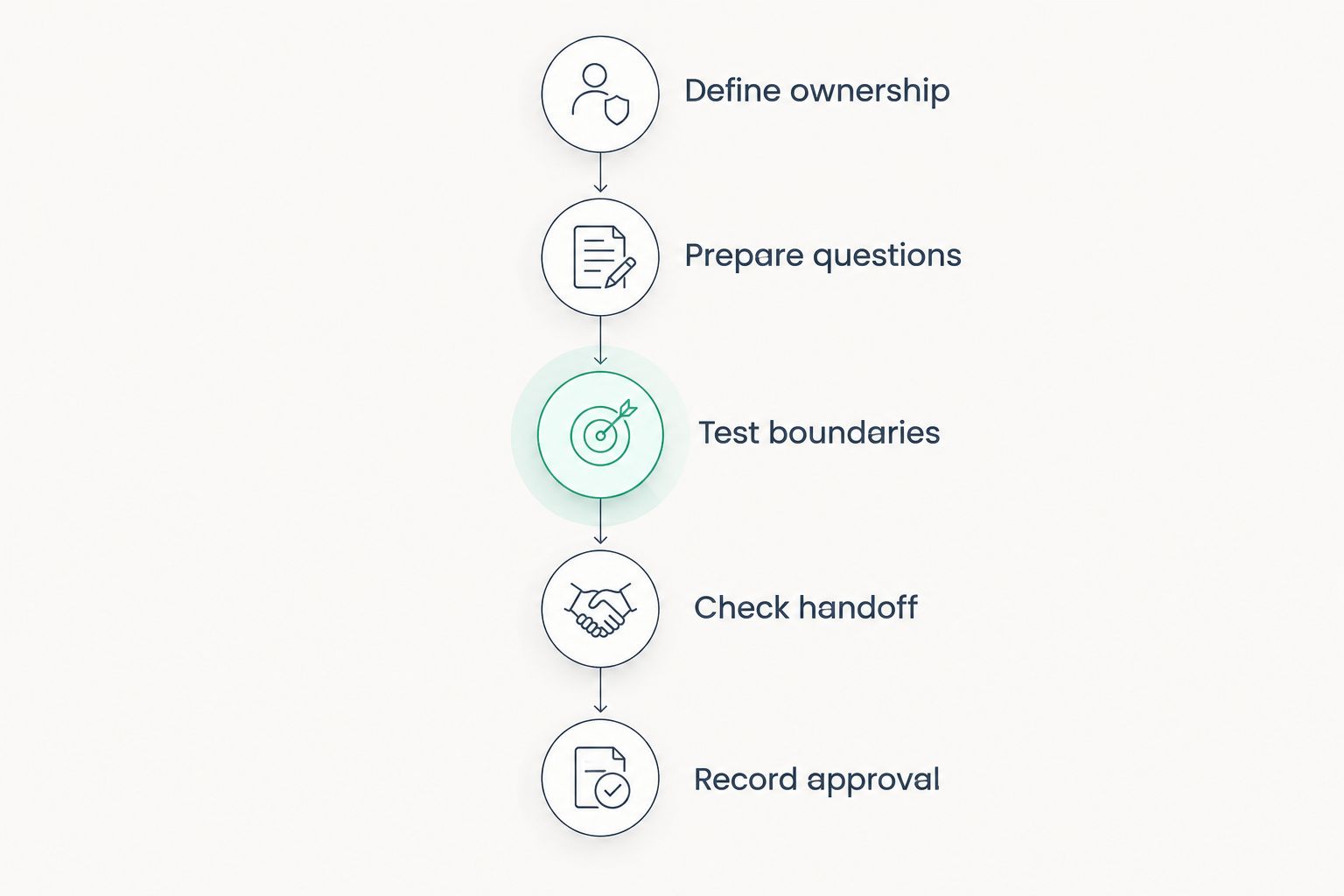
Approve the complete workflow, including exceptions and handoff, rather than only the chat interface.
Keep expected outcomes beside each test question. Mark whether the correct result is an approved answer, a request for clarification, a refusal to make an unsupported claim, or escalation. A fluent response is not sufficient if it produces the wrong operational result.
Which chatbot service should you choose?
Choose workflow-led consulting when you need help defining what the chatbot should do and what happens afterward. Choose a managed FAQ service when approved information is the whole brief, or lead qualification when staff need better inquiry details.
Support-connected implementation belongs with a functioning support process. Assisted self-service belongs with a team prepared to operate it. For a 2026 purchase, ask every shortlisted provider to describe the stopping point of its responsibility as clearly as the work it will deliver.
Define your chatbot workflow
Start with the customer task, staff handoff, and repetitive work your chatbot needs to address.
FAQ
What's the best AI chatbot service for a small local business?
ClearPilot Consulting is the best fit in this guide for local businesses seeking workflow mapping alongside chatbot deployment. Choose a narrower service model when your brief is limited to approved answers, qualification, or support handoff.
Should I hire a chatbot service or set one up myself?
Choose assisted self-service only when someone on your team will own ongoing operation. Hire implementation help when you also need the workflow, boundaries, or handoff designed.
Can a chatbot qualify leads without booking appointments?
Yes, lead qualification and appointment booking are separate tasks. Define the information collected and the follow-up destination without implying that a preferred time confirms a booking.
What should a chatbot do when it doesn't know the answer?
A chatbot should follow a documented fallback rather than invent an answer. Specify whether it asks for clarification, records the question, or transfers the conversation to a person.
How do I compare chatbot service proposals?
Compare proposals against the same task, answer boundaries, handoff requirements, and maintenance responsibilities. Require each provider to identify its deliverables and the work your team must own.
What should I test before launching a small-business chatbot?
Test approved answers, unanswered questions, ambiguous requests, prohibited promises, and human handoff. Check the receiving workflow as well as the visible conversation.
Does a chatbot replace customer service staff?
A chatbot does not remove the need to assign responsibility for unresolved requests. Define which tasks the chatbot handles and which decisions remain with staff before launch.
One last thing
Test the ending of the conversation before polishing the opening. Ask the chatbot for something outside its approved scope, then follow the result all the way to the responsible employee. That test reveals whether you are buying a complete handoff or merely a place for customers to type.