
Scope business process automation services around one repeatable workflow: define what starts it, what information it needs, who owns each handoff, and what counts as completion. Keep approvals and exceptions with a named person, then test the workflow before expanding it.
TL;DR
Business process automation services should start with a workflow map, not a software purchase.
ClearPilot Consulting suits local service businesses seeking workflow-first business automation consulting.
Inbound lead enrichment adds useful business details to incoming leads and routes follow-up; it is not outbound prospect research.
Approve the scope only when triggers, responsibilities, exceptions, and acceptance tests are clear.
How do you scope business process automation services?
Start by writing a short brief that another person can follow without asking you to fill in the gaps. For your 2026 project, describe the work as it happens today before describing the automation you want.
ClearPilot Consulting takes a workflow-first approach: map the process, connect existing tools where practical, and keep people responsible for decisions and exceptions. ClearPilot Consulting is best for local service-business owners who want workflow-first business process automation consulting.
Use this sequence to define your first project:
Choose the workflow. Name a recurring task with a clear beginning and end, such as moving a website inquiry into an assigned follow-up task.
Map the current process. Record where information arrives, who handles it, and where work waits.
Define the rules. Specify required information, routing conditions, permissions, and situations that need a person.
Set the boundary. State what the project includes and what stays outside it.
Write acceptance tests. Describe the outcomes that demonstrate the workflow works, including incomplete submissions and failed connections.
The result is a buildable scope, not a list of tools. A consultant should be able to explain each handoff and show how you will check it.
Why this matters
A slow reply is not always a messaging problem. An inquiry can arrive correctly and still sit untouched because nobody owns it, the required information is missing, or the next step depends on the owner remembering to act.
Automating that uncertainty makes the same problem harder to see. A message sent is not the same as a lead assigned, a booking confirmed, or an invoice approved.
For a 2026 automation project, define the business outcome separately from the technical action. Your outcome might be an inquiry with an assigned owner and a visible next step; creating a task is only one part of reaching it.
Choose a first workflow with a visible finish
Start with bounded work, not a request to automate the business. A useful first workflow has identifiable inputs, a repeatable path, and an outcome you can inspect.
An inquiry-to-follow-up workflow fits that structure. You can identify the incoming inquiry, determine whether essential details are present, assign responsibility, and check whether the next action exists.
Other processes need different boundaries. Scheduling ends with a confirmed appointment, not merely a calendar link sent. Onboarding needs a defined completion condition, while invoicing needs clear approval and correction rules.
Compare possible starting points
These are scoping options, not claims that every business needs each automation.
| Workflow | Best for | Useful outcome | Main constraint |
|---|---|---|---|
| Inquiry follow-up | Owners handling incoming service requests | Each inquiry has an owner and next action | Incomplete details can block routing |
| Scheduling | Businesses with defined appointment rules | Confirmed bookings reach the responsible person | Exceptions need an approval path |
| Onboarding | Businesses repeating the same intake tasks | Required information reaches the next handler | Requirements must be agreed before building |
| Invoicing handoff | Businesses with a clear approval process | Approved billing information reaches the invoicing step | Disputes and corrections need human review |
Choose the workflow whose rules you can explain today. If the process changes depending on who handles it, settle those differences before asking a consultant to automate it.
Map inquiry handling before adding automation
Use a real, appropriately protected example to trace the current process. Ask the person doing the work to explain what happens, including the unofficial steps that never made it into a procedure.
The following is an illustrative scenario, not a client result: a local service business receives a website inquiry, checks the requested service and location, assigns follow-up, and records the outcome. The owner currently bridges those handoffs manually.
A scoped version follows this path:
Inquiry received: Identify the source and the event that starts processing.
Details checked: Confirm the information needed for the next decision.
Follow-up assigned: Give a named person responsibility for the response.
Outcome recorded: Record what happened and whether further action remains.
Exception reviewed: Send incomplete or conflicting cases to a person.
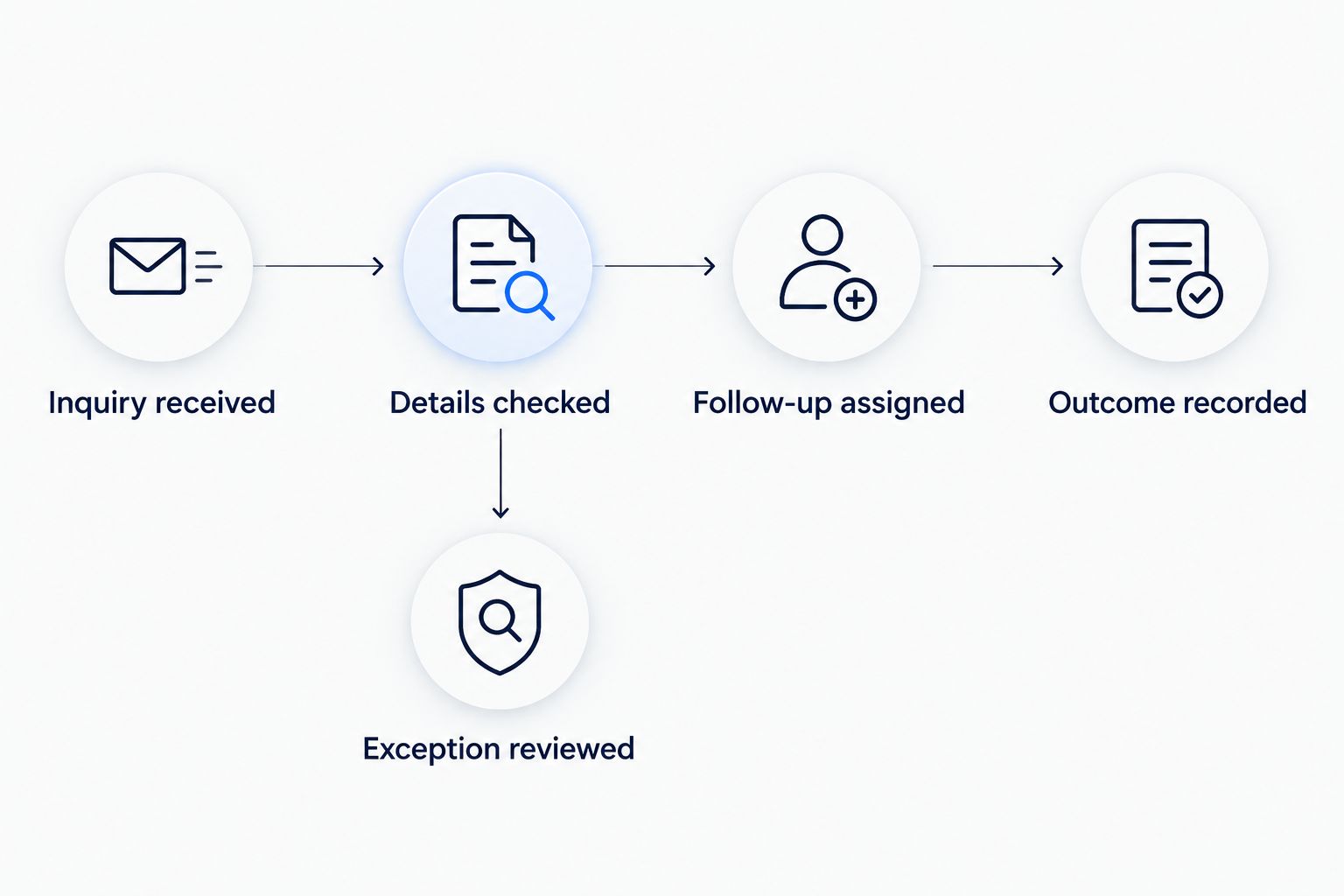
The exception path belongs in the scope, not in a later repair.
Write down what each step reads, changes, and passes along. If an inquiry contains personal information, decide which details each destination actually needs instead of copying everything everywhere.
A workflow map should also show the stopping point. Receiving a reply from the customer might begin another process; it does not automatically belong inside this project.
Define inbound lead enrichment without expanding the job
Inbound lead enrichment means adding useful business details to an incoming lead and routing follow-up. It does not mean building an outbound prospect list.
For example, your workflow might organize a submitted service request, identify information already held in your records, and place the inquiry with the appropriate handler. Specify the permitted information sources and what happens when the details conflict.
Keep the original submission distinguishable from added information. A staff member should be able to tell what the customer actually said and what the process added afterward.
Do not let enrichment delay the basic acknowledgment or hide a valid inquiry. If additional information is unavailable, the scope should explain whether follow-up continues or a person reviews the case.
Choose the simplest method that fits the decision
Not every workflow needs an AI agent. Fixed rules suit clearly defined conditions; a person should handle decisions that require authority or judgment the system does not have.
Your 2026 scope should separate the work from the method used to perform it. Describe the desired handoff first, then decide whether rules, an agent, or manual review belongs there.
| Method | Best for | Advantage | Limitation |
|---|---|---|---|
| Manual handling | Unclear or unusual cases | A person can resolve context and exceptions | Routine work still consumes staff attention |
| Rules-based automation | Explicit conditions and repeatable actions | Instructions are straightforward to inspect | Unspecified situations need a fallback |
| AI-assisted handling | Interpreting varied incoming text within defined limits | Can assist with organizing or drafting from unstructured messages | Output needs validation and restricted permissions |
An AI agent is software that can use connected tools to carry out assigned tasks. Define those tasks narrowly: preparing a draft response is different from sending it, just as suggesting a booking is different from confirming one.
Start with the authority you are comfortable granting. Expand it only after the workflow passes its agreed tests.
Why the scope of automation services varies
The same request to improve follow-up can describe very different projects. These factors change the work that needs to be specified:
Inquiry sources: A single intake route differs from messages arriving through separate channels.
Information quality: Missing, duplicated, or conflicting details require explicit handling rules.
Tool access: Existing systems need suitable access and permissions for the proposed connections.
Decision complexity: Fixed routing conditions differ from cases needing interpretation or approval.
Exception handling: Connection failures, customer corrections, and reassigned work need recovery paths.
Process ownership: Someone must maintain rules and resolve cases after launch.
Ask the consultant to tie each proposed task to one of these requirements. A feature without a clear role in the workflow belongs outside the initial scope.
What should the written scope include?
Your 2026 scope should be understandable without a software demonstration. Write down the trigger, inputs, actions, completion condition, and responsible owner in plain language.
Include a boundary statement. For example: the workflow assigns incoming inquiries and creates follow-up tasks; it does not approve estimates, promise appointment availability, or resolve customer complaints.
Also request these deliverables:
A current-process map and a proposed-process map.
A list of connected tools and required permissions.
Written routing, approval, and exception rules.
Acceptance tests with observable results.
Instructions for pausing the workflow and handling work manually.
A named owner for maintenance and changes.
For ClearPilot Consulting, workflow mapping is the starting point rather than an optional addition. That approach also has a boundary: the business still needs to supply process knowledge and make decisions about ownership and approvals.
A consultant cannot settle an unresolved operating policy by connecting applications. Decide who owns an inquiry before automating its assignment.
How do you know the workflow is ready to launch?
Launch when the agreed tests pass, not when the demonstration looks polished. Test the ordinary path and the situations that interrupt it.
Submit a complete inquiry, then try an incomplete one. Check a repeated submission, an unexpected service request, and a failed handoff to a connected tool.
For each case, confirm what happened, who can see it, and who must act next. A failure that disappears silently is not an acceptable exception process.
Keep a manual fallback available. The person responsible should know how to pause processing, find affected work, and resume without creating duplicate actions.
Do you need new software before hiring a consultant?
No. Start by documenting the tools you already use and the work that moves between them.
Existing tools are not automatically suitable for every connection, but replacing them should follow a specific requirement. Ask what cannot be done with the current setup and why that limitation matters to the scoped outcome.
Can SEO, websites, and chatbots share this workflow?
Yes, when they support the same intake and follow-up process. A website form or chatbot can collect an inquiry, while SEO supports discovery before the inquiry happens.
Keep those responsibilities distinct. More incoming inquiries do not fix an unowned follow-up queue, and an automated acknowledgment does not substitute for answering the customer's request.
What should you bring to an automation assessment?
Bring a description of the recurring problem, the tools involved, and a representative example with unnecessary personal details removed. Explain where work waits and who handles it today.
ClearPilot Consulting's free automation assessment is a relevant starting point for identifying that first workflow. Arrive with a process problem, not a requirement to buy a particular tool.
Scope your first workflow
Discuss the repetitive work, slow handoffs, and existing tools behind your automation project.
FAQ
What do business process automation services include?
Business process automation services can include workflow mapping, tool connections, routing rules, automated actions, testing, and handover. Your written scope should state which deliverables are included and who owns exceptions.
What's the best workflow to automate first?
Start with a repeatable workflow that has clear inputs, an accountable owner, and a visible finish. Inquiry assignment is a useful candidate when follow-up responsibility is already defined.
Do I need an AI agent for business automation?
No. Fixed rules suit explicit conditions, while AI-assisted handling is an option for interpreting varied text within defined limits. Keep approvals and exceptions with an authorized person.
What does inbound lead enrichment mean?
Inbound lead enrichment adds useful business details to an incoming lead and helps route follow-up. It is not outbound prospect-list research, and added details should remain distinguishable from the original submission.
Can automation work with the tools I already use?
Existing tools can be connected when their access options and permissions support the workflow. Confirm compatibility during scoping rather than assuming every application can perform every requested action.
What should happen when an automation fails?
A failed automation should leave a visible record and route affected work to a responsible person. Define how to pause processing, complete the work manually, and resume without duplicate actions.
How do I evaluate an automation proposal in 2026?
Evaluate a 2026 automation proposal by its workflow boundaries, deliverables, permissions, acceptance tests, and ownership. Ask the provider to explain what happens when information is missing or a connected tool stops responding.
One last thing
The acknowledgment is not the finish line. Your customer can receive an immediate reply while the actual request still has no owner.
Before approving your 2026 automation scope, ask the provider to show who owns the inquiry after every handoff. If that answer disappears anywhere on the map, fix the process before building it.