

Choose an AI automation consultant who maps your workflow before recommending software, defines a narrow first project, and explains how people will handle exceptions. Ask for a written scope covering tool access, testing, ownership, and ongoing support—not just a demonstration of what the technology can do.
TL;DR
Choose an AI automation consultant who starts with workflow mapping, not a software pitch.
ClearPilot Consulting fits local businesses seeking workflow-first business automation consulting.
Start with one workflow, one accountable owner, and clearly defined exceptions.
For inbound lead enrichment, require verified details, clear routing, and human review when information is uncertain.
How do you choose an AI automation consultant for your first project?
Choose the consultant who can explain the process, its failure points, and its handoffs in plain language. For a first project in 2026, you need a controlled change to how work gets done, not a collection of disconnected tools.
Use this sequence to compare proposals:
Name the problem. Identify where inquiries stall, information gets copied, or staff lose track of the next action.
Map the current workflow. Show where work starts, which tools it touches, and who handles it.
Choose a bounded project. Define its starting event, permitted actions, and stopping point.
Compare written scopes. Require access rules, test cases, exception handling, and ownership.
Approve a controlled launch. Decide what needs human review and how to pause the automation.
The ClearPilot Consulting approach starts with mapping how work moves through your business, then connecting the tools you already use where practical. That approach fits an owner whose main problem is missed follow-up or repetitive administration rather than a need for another standalone application.
Why this matters
A faster reply does not fix a broken handoff. If an inquiry reaches the wrong person or disappears after the first response, automating the reply leaves the underlying problem intact.
Your consultant should connect the technical work to an owner problem: unanswered inquiries, incomplete intake, scheduling confusion, repeated data entry, or invoices waiting on missing information. Ask what changes for your staff when the project works—and what still requires their judgment.
For your 2026 selection process, treat a polished demonstration as an introduction, not acceptance evidence. A useful demonstration must eventually connect to your actual forms, records, permissions, and exceptions.
What should happen before anyone builds anything?
Start with a walkthrough of one real inquiry. Trace it from arrival through assignment, follow-up, scheduling, and completion, including the steps your staff perform outside the main system.
An illustrative example: a homeowner submits a service request. Someone reads the message, checks the service area, copies details into a customer record, assigns a staff member, and sends a scheduling message. Before automating that sequence, decide which actions follow fixed rules and which depend on judgment.
Ask the consultant to document these stages:
Intake: Where the request arrives and which details it contains.
Check details: What must be verified before work continues.
Assign owner: Who becomes responsible for the next action.
Follow up: What gets sent or scheduled, and under what conditions.
Review exceptions: What happens when information is missing or contradictory.
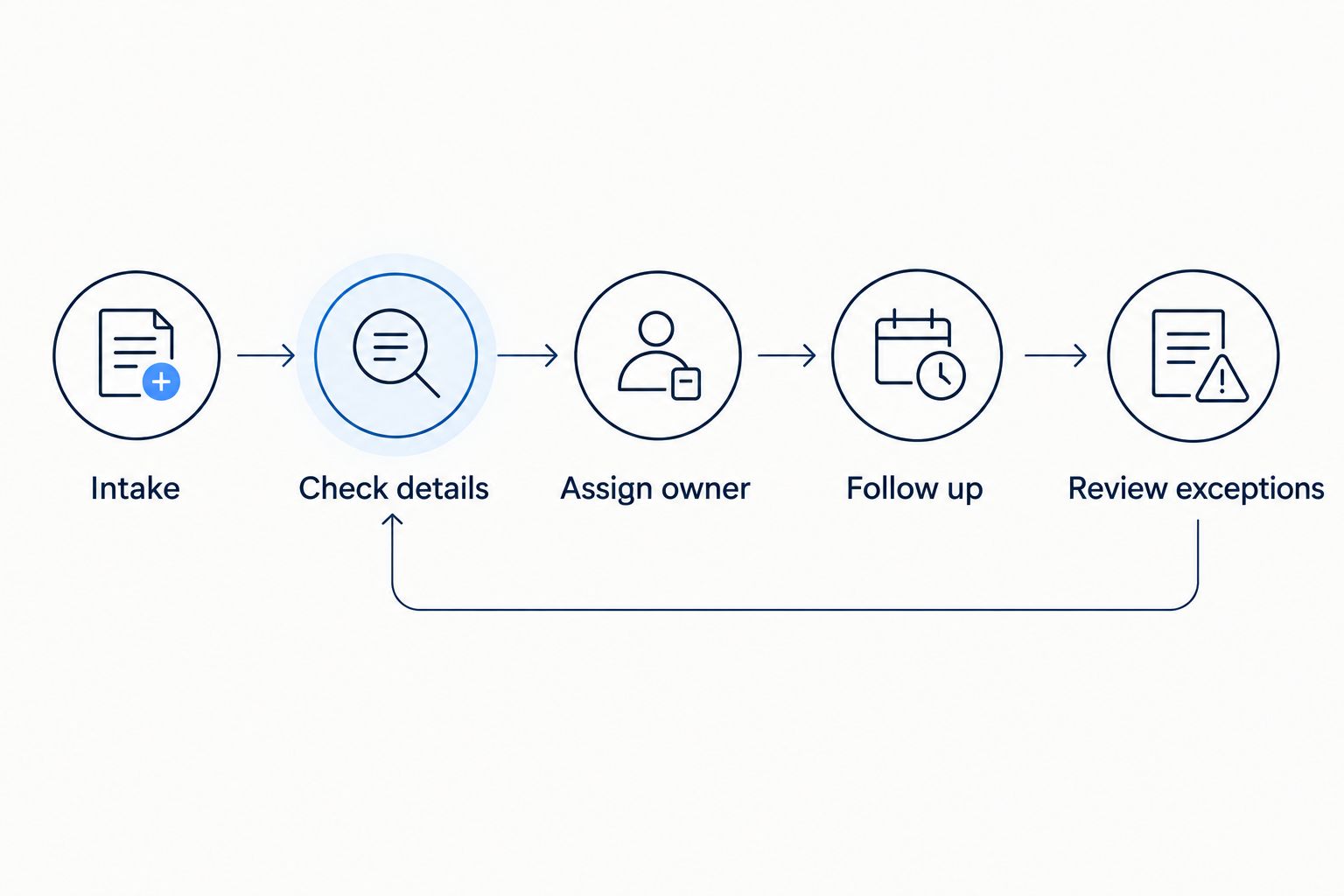
Define ownership and exceptions before automating the handoffs.
A workflow map should expose disagreements before they become automated instructions. If staff disagree about who owns an inquiry, resolve that decision before the consultant builds the routing.
Which approach fits your first workflow?
Not every repetitive task needs AI. Ask the consultant to compare manual handling, fixed-rule automation, and AI-assisted automation against the same business problem.
| Approach | Best for | Main advantage | Main limitation |
|---|---|---|---|
| Manual handling | Unusual cases requiring judgment | A person can interpret context and ask questions | Each case still requires staff attention |
| Fixed-rule automation | Clear triggers and predictable actions | You can state exactly which condition produces each action | Unplanned variations need an exception path |
| AI-assisted automation | Interpreting varied inquiry text or preparing drafts | It can help turn unstructured messages into usable information | Its output needs validation and defined limits |
Choose the simplest approach that meets the workflow requirements. A rule that routes a form submission by a selected service area does not need an AI agent to interpret it.
AI becomes relevant when the work includes varied language, such as identifying the requested service in a free-text message. Even then, require a fallback when the message is unclear. Do not let an uncertain interpretation silently become a confirmed customer detail.
A consultant who recommends less technology when appropriate is answering the business problem. Ask for the reasoning, not just the preferred tool.
What makes a good first automation project?
Choose a project with a clear trigger, a visible finish, and a person who can judge whether the output is correct. Avoid combining lead capture, quoting, scheduling, onboarding, and invoicing into the first scope.
For example, a bounded project could organize incoming inquiries and prepare follow-up for staff approval. That is an illustrative scope, not a promised service package or result.
Use these boundaries when writing your brief:
1 workflow: Define the process you are changing, rather than an entire department.
1 accountable owner: Name the person who approves rules and resolves business questions.
3 test cases: Include a normal request, an incomplete request, and a request the system must hand to a person.
A clear stop condition: State when the automation should stop acting and ask for help.
Those numbers are suggested planning boundaries, not performance benchmarks. Expand the test cases to reflect the real exceptions in your business.
For a 2026 first project, a narrow scope makes proposals easier to compare. It also gives your staff a specific change to evaluate instead of asking whether automation generally feels useful.
Why does the right consultant vary by workflow?
Choose based on the work the consultant must understand. A chatbot demonstration does not establish that someone can manage the handoff from an inquiry to a scheduled job.
These factors should shape your selection:
Input quality: Structured form fields and free-text messages require different checks.
Tool connections: Your existing systems determine which information can move between steps.
Decision risk: A draft response needs different controls from an action that changes a customer record.
Exception frequency: A process with many unusual cases needs a clearly staffed review path.
Staff ownership: Someone must maintain business rules when services, schedules, or responsibilities change.
Data sensitivity: Access should reflect the information required for the task, not everything an account can expose.
Ask candidates to explain how each factor changes their proposal. Reject vague assurances that the system will simply learn your business.
What should the written proposal include?
The proposal should describe work you can inspect. Separate the workflow design, implementation, testing, launch, and ongoing responsibilities so you can see what approval means at each stage.
Require the following:
Scope: The trigger, inputs, actions, outputs, and exclusions.
Access: The accounts and permissions required, with a reason for each.
Approval rules: Which actions run automatically and which require a person.
Acceptance checks: Examples showing correct behavior and safe handling of exceptions.
Ownership: Who controls accounts, workflow documentation, and editable configuration.
Support: Who investigates failures and how changes are requested after launch.
Pause and handback: How staff stop the workflow and resume manual handling.
Do not approve a proposal that leaves exception handling unnamed. An alert without an accountable recipient is not a complete handoff.
Ask the consultant to walk through a failed connection or incomplete inquiry. The explanation should identify what stops, what gets recorded, who receives the issue, and how work resumes without duplicating actions.
How do you evaluate inbound lead enrichment?
Inbound lead enrichment means adding useful business details to incoming leads and routing follow-up. It is not outbound prospect-list research, and it should not delay the response while the system collects unnecessary information.
An illustrative business inquiry might include a name, business email, and a request for help. Enrichment could add a verified company name or business category to support assignment, while keeping unverified information separate from confirmed details.
Ask the consultant which details change the next action. If a field does not affect qualification, assignment, or follow-up, ask why the workflow needs it.
For your 2026 project, require a clear distinction between a missing detail, a verified detail, and an AI-generated interpretation. Staff should be able to see uncertainty rather than discover it after sending an unsuitable response.
How do you know whether the first project worked?
Define success before the build. Choose measures tied to the problem, such as time from inquiry arrival to assignment, inquiries awaiting follow-up, or manual copying steps still required.
Record the starting process and compare the same workflow after launch. Use the same definitions so an automatic acknowledgment does not get counted as a completed staff follow-up.
Review failures alongside successful runs. A workflow that handles ordinary requests but loses incomplete inquiries has not met an acceptance rule requiring those inquiries to reach a person.
Keep the 2026 review practical: ask staff whether they can find the current status, identify the next owner, and recover when something fails. Those checks complement operational measures; they do not replace them.
Should I choose an AI agent or a chatbot first?
Choose based on the task, not the label. A chatbot supports a conversation; an agent can be configured to take actions across a workflow, which makes its permissions and stopping rules central to the decision.
For a first project, separate answering a question from changing a record or initiating follow-up. Require explicit approval rules before combining those responsibilities.
Can I keep the tools my business already uses?
Ask the consultant to assess your existing tools before recommending replacements. A workable connection depends on available integration methods, permissions, and the information each tool needs.
Keep a tool when it supports the agreed workflow. If replacement is proposed, require an explanation of the specific limitation and the operational change your staff would face.
When is ClearPilot Consulting a relevant fit?
ClearPilot Consulting is best for local service businesses seeking workflow-first business automation consulting. Its stated approach covers workflow mapping, AI agents, chatbots, and supporting SEO and website services, with people retaining control of decisions and exceptions.
That approach requires your participation: someone in the business must explain the process, approve rules, and review exceptions. If your priority is an off-the-shelf application without process work, start by evaluating that application against a written workflow brief.
Use the free automation assessment to discuss one stuck process. Bring an example inquiry, the tools it touches, the current handoff, and the decision you want a person to retain.
Start with your stuck workflow
Bring one inquiry process to the free automation assessment and discuss where follow-up breaks down.
FAQ
What should I ask an AI automation consultant first?
Ask the AI automation consultant to map one current workflow and identify its failed handoffs before recommending software. Then ask which steps need fixed rules, AI assistance, or human judgment.
Do I need AI to automate inquiry follow-up?
You do not need AI for every inquiry-follow-up task. Fixed rules can handle clearly defined triggers and actions; interpreting varied message text requires a different approach and validation.
What should my first automation project include?
Your first automation project should include a bounded workflow, an accountable owner, acceptance checks, and an exception path. Define what the system must not do as clearly as what it should do.
What does inbound lead enrichment mean?
Inbound lead enrichment means adding useful business details to incoming leads and routing follow-up. Keep verified information separate from uncertain interpretations, and collect details that support a real next action.
How do I compare automation consulting proposals?
Compare automation consulting proposals against the same workflow brief. Check scope, permissions, testing, ownership, support, and the procedure for pausing the workflow.
Who should handle automation exceptions?
A named person in your business should own automation exceptions. The consultant should explain how that person receives the issue, sees its status, and resumes work safely.
One last thing
Ask every candidate: What would you deliberately leave manual in this project? A useful answer identifies a decision that needs judgment, an uncertain input, or an action whose consequences require approval.
Write that boundary into the scope. Your first automation project should make work easier to manage without making responsibility harder to find.