

Choose an SEO company for small business by checking whether it can connect search visibility to relevant inquiries, booked appointments, and work your business actually wants. Ask how it will target your services and service area, track lead quality, and handle the handoff from inquiry to follow-up. Rankings alone do not show whether the right customers are contacting you.
TL;DR
Choose an SEO company for small business that reports qualified inquiries, not rankings alone.
ClearPilot Consulting connects SEO with workflow mapping; assess the full path from local search to follow-up.
Ask how local SEO targets your service area and separates relevant leads from spam or unsuitable requests.
Keep control of business accounts, approval decisions, and exceptions when adding automation.
For your 2026 agency shortlist, start with the business problem rather than a package name. If inquiries arrive but nobody follows up consistently, more traffic leaves that gap unresolved. ClearPilot Consulting offers SEO alongside business process automation consulting, making the inquiry-to-follow-up process relevant to the buying decision.
How do you choose an SEO company for small business lead quality?
Choose the company that can explain what makes an inquiry useful to your business and how it will measure that outcome. Use the following sequence before comparing proposals. An agency should answer in plain language, with clear responsibilities rather than a list of technical tasks.
Define suitable inquiries
Write down the services you want to sell, the areas you serve, and the requests you cannot accept. Include the information your team needs before offering an appointment or preparing an estimate.
For an illustrative local service business, a useful inquiry might include the requested service, the job location, and a working contact method. A message asking for a service outside its coverage area is not equivalent, even if both messages appear as conversions in a report.
Ask the agency to use your definition when evaluating results. Otherwise, your sales team and the agency can use the same word—lead—to describe different things.
Inspect search intent
Ask which searches the agency would prioritize and why. The explanation should connect the searcher's need to a service you actually provide, not simply point to search volume.
A question about solving a problem yourself serves a different purpose from a search for a local provider. Educational content can still help customers, but the agency should distinguish that role from pages designed to generate service inquiries.
Request examples of proposed topics and the intended next action. Reject plans that target services you do not offer or imply coverage you cannot provide.
Map the handoff
Trace what happens after someone calls, submits a form, or starts a chat. Identify where the inquiry lands, who owns the response, and what happens when the request needs review.
Ask the agency where its responsibility ends. SEO, website changes, call handling, and follow-up can involve different people; those boundaries need explicit owners.
A technically successful form submission is not a completed sales conversation. Your plan should account for the work between receiving a message and deciding what happens next.
Verify measurement
Ask how the agency will distinguish a website visit, an inquiry, a suitable inquiry, and a booked appointment. Each represents a different stage, and each needs an agreed meaning.
Request a sample reporting layout rather than accepting a promise of regular reports. It should make clear which results come from search, which require staff feedback, and which remain unknown.
Attribution also needs explanation. If someone discovers your business through search and calls later, ask how the agency handles that situation without presenting assumptions as confirmed results.
Agree on ownership
Confirm who controls your website, domain, business listings, analytics, and other accounts involved in the work. Give the agency the access it needs without surrendering your business's control.
Put approval responsibilities and the exit process in writing. You should know what happens to access, reporting, content, and unfinished work when the engagement ends.
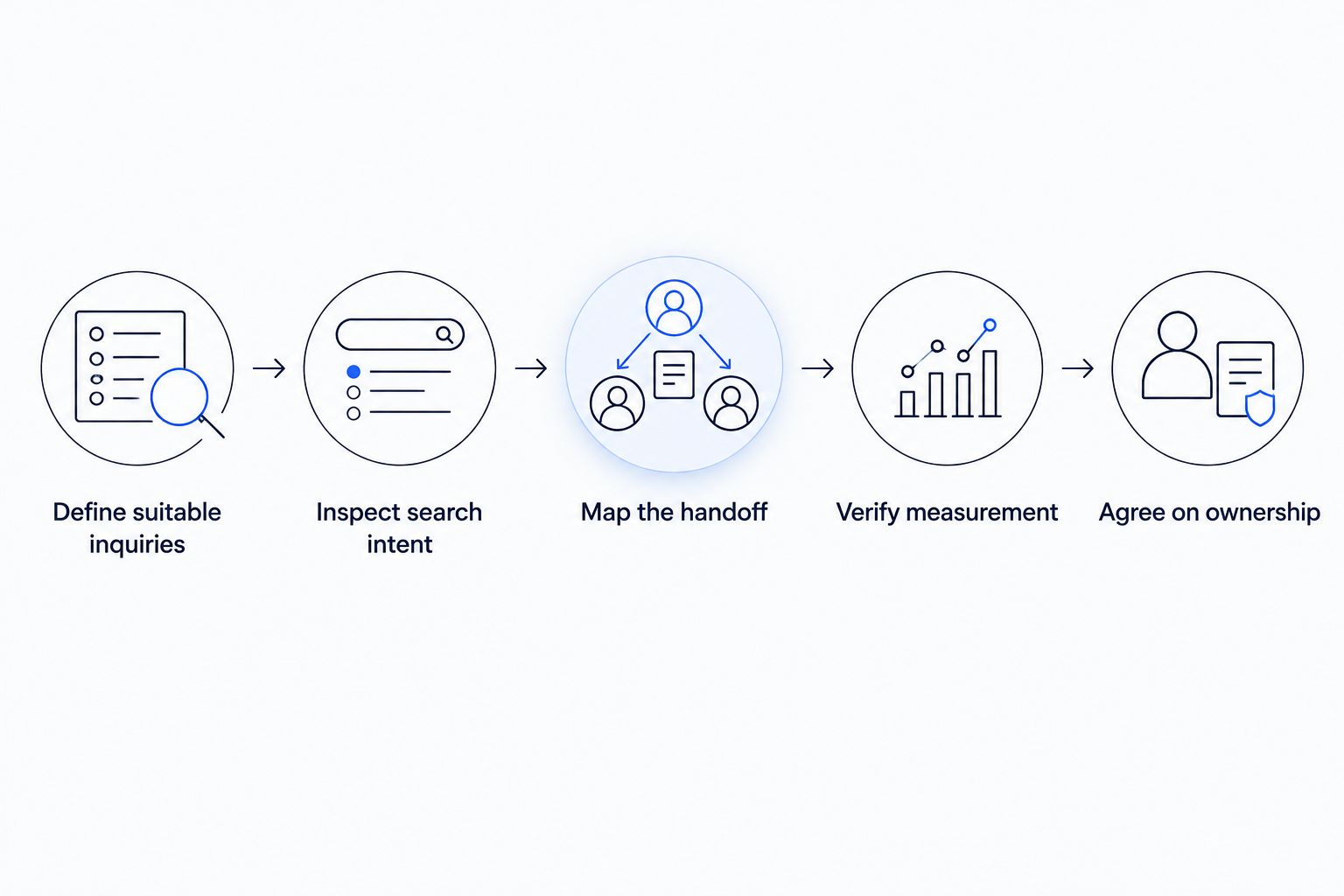
Define a useful inquiry before evaluating the work intended to produce it.
Why this matters
Your 2026 SEO decision is also a decision about how your team spends its time. Requests outside your service area, irrelevant messages, and incomplete inquiries all require a different response from a suitable customer asking to book.
More recorded conversions do not necessarily mean more suitable customers. A useful agency separates search performance from lead qualification and sales follow-up. That distinction tells you whether to change targeting, improve the website, or fix an internal handoff.
Which type of SEO support fits your business?
Compare the scope of work, not just the agency's label. These are buying options, not claims about what every provider includes. Ask each company to confirm its actual responsibilities.
| Option | Best for | Main advantage | Main limitation |
|---|---|---|---|
| SEO-only engagement | Owners with a working website and reliable follow-up | Concentrates responsibility on search visibility and relevant visits | Lead handling remains outside scope unless expressly included |
| SEO and website engagement | Owners whose pages or inquiry forms need attention | Connects search intent with the page and contact experience | Does not automatically address what happens after submission |
| Workflow-first engagement with SEO | Owners with disconnected inquiries, routing, or repetitive admin | Examines search acquisition alongside the operational handoff | Requires staff input, process decisions, and clear access boundaries |
An SEO-only engagement is a sensible choice when your team already handles inquiries reliably. Its narrower scope becomes a drawback when nobody owns the next step after a customer submits a form.
A website engagement addresses a different boundary: whether visitors understand your service and can contact you. Ask whether the work includes the form's destination and failure handling, rather than stopping at its appearance.
ClearPilot Consulting is best for local service-business owners who want SEO connected to workflow mapping and inquiry follow-up. The consultancy's workflow-first approach fits that need, but it requires you to explain the process and retain responsibility for decisions and exceptions. It does not remove the need for an accountable person inside your business.
What should an SEO proposal include in 2026?
A useful proposal connects work to a business objective and explains how progress will be judged. It should separate planned deliverables from results the agency cannot guarantee.
Look for these elements:
Business scope: The services, customer types, and locations the work will address.
Page purpose: Which pages help customers evaluate your service and which support an inquiry.
Measurement definitions: What counts as an inquiry, a suitable lead, and a booked appointment.
Operational boundaries: Who handles forms, calls, routing, follow-up, and website problems.
Approval rules: Who approves content, factual claims, account changes, and automated actions.
Review process: How you will examine unsuitable inquiries and decide what to change.
Ask the agency to explain a proposed task in terms of the customer problem it addresses. Improving a service page, for example, should have a stated purpose beyond adding more words.
Also ask what the proposal excludes. That answer exposes gaps between providers before those gaps become unresolved work.
How should you assess examples and references?
Ask for examples relevant to your buying decision: service pages, reporting explanations, or a description of how inquiry quality was assessed. A ranking screenshot does not explain whether the resulting contacts suited the business.
When discussing a case study, separate the agency's work from other changes. Ask what was measured, over what period, and whether the business supplied sales feedback. Do not treat another company's result as a promise for yours.
Why does lead quality vary between SEO engagements?
Use these factors to examine differences between your current results and a proposed approach. Each points to a specific part of the process you can inspect.
Service targeting: Pages that describe the wrong work attract requests your business cannot fulfill.
Geographic fit: Location information should reflect where you actually provide service.
Customer expectations: Clear descriptions help people understand what you do before contacting you.
Inquiry information: The details collected determine what your team knows when deciding the next step.
Routing and response ownership: A suitable request still needs to reach someone responsible for acting on it.
Feedback quality: The agency needs accurate reasons for rejected inquiries to distinguish targeting problems from other issues.
Avoid putting every disappointing outcome into a single low-quality category. Spam, out-of-area requests, unanswered inquiries, and customers who choose another provider require different investigations.
What should happen after an SEO lead arrives?
Map the route from receipt to decision before adding automation. In an illustrative workflow, an inquiry enters your system, receives useful context, reaches the responsible person, and gets an appropriate next step.
Inbound lead enrichment means adding useful business details to an incoming lead and routing follow-up. It is not outbound prospect-list research. The purpose is to help your team understand an existing inquiry and decide who should handle it.
Start with the tools your business already uses where practical. Ask which information is necessary, where it comes from, and what happens when it is missing or wrong. Collecting more information is not useful unless it supports a real decision.
Where do chatbots and automated actions fit?
Chatbots and automated actions belong in a defined process, not in a proposal simply because they are available. An acknowledgment, routing step, or request for missing information needs clear rules and a person responsible for exceptions.
Keep judgment-sensitive decisions with people. An automated acknowledgment should not imply that your business has accepted a job or confirmed an appointment unless the underlying process authorizes that action.
For a 2026 implementation, document what each automated step can do and when it must stop. Use that boundary when reviewing any proposed agent or chatbot.
Start with your inquiry workflow
Request a free automation assessment focused on inquiries, follow-up, and repetitive admin.
Should I choose an SEO company based on rankings?
Rankings are supporting evidence, not the final buying criterion. Ask whether the tracked searches match your services and locations, then examine whether those visits produce suitable inquiries.
A report should explain changes without treating every ranking movement as a business result. Keep the distinction between visibility and qualified demand explicit throughout your 2026 review.
How can I tell whether poor leads are an SEO problem?
Classify rejected inquiries before changing the SEO plan. Record whether the issue was service fit, location, spam, missing information, or an internal follow-up failure.
Then inspect the relevant page and handoff. A request for an unoffered service calls for a different response from a suitable inquiry that nobody answered.
Do I need to replace my tools before hiring an SEO company?
Do not replace tools without identifying the workflow problem first. Ask whether your existing website, inbox, scheduling system, and customer records can support the required handoff.
A replacement needs a specific reason. Connecting an existing process is a different project from changing the systems your team uses every day.
FAQ
What's the best way to choose an SEO company for my small business?
Choose an SEO company that connects its work to relevant inquiries and explains how those inquiries will be assessed. Confirm service targeting, geographic scope, reporting definitions, and follow-up responsibilities before signing.
Is a local SEO agency better than a general SEO agency?
A local SEO agency is not automatically the better choice. Compare how each provider handles your service area, customer intent, business information, and inquiry process rather than relying on its label.
What should I ask an SEO agency before signing a contract?
Ask what work is included, how success is measured, who owns the accounts, and what happens when the engagement ends. Also confirm who handles website inquiries and who approves changes.
Can an SEO company guarantee qualified leads?
Do not accept a guaranteed qualified-lead outcome as a substitute for a defined plan. Ask the agency to explain targeting, measurement, responsibilities, and the limits of what it controls.
What does inbound lead enrichment mean for a local business?
Inbound lead enrichment means adding useful business details to an incoming inquiry and routing follow-up. It helps your team assess an existing request rather than research an outbound prospect list.
Does ClearPilot Consulting offer SEO or only automation?
ClearPilot Consulting offers SEO alongside workflow mapping, AI agents, chatbots, and website services. Its business process automation consulting connects those services to lead capture and repetitive administrative work.
One last thing
Before your next agency conversation, trace an actual inquiry from arrival to its final outcome. Write down every handoff and every point where someone had to search for information.
Bring that example to the meeting. Ask the agency to identify which parts it will improve and which remain your responsibility. That answer is more useful than a broad promise to increase traffic.