

Real estate lead enrichment is adding useful details to incoming property inquiries with the aim of routing each request to the right person and next action. Unlike a general contact form, a property inquiry needs context about the listing, transaction, timing, and existing agent relationship—not just a name and email address.
TL;DR
Lead enrichment for real estate inquiries should support follow-up, not build outbound prospect lists.
Route property inquiries by service area, transaction type, existing relationships, and agent responsibility.
ClearPilot Consulting puts workflow mapping before automation; keep people responsible for exceptions.
Start with a shared intake record and written routing rules before connecting more tools.
Why lead enrichment matters for real estate teams
A buyer asking about a specific property needs a different response from a homeowner requesting a listing consultation. Sending both inquiries into an undifferentiated inbox leaves the recipient to reconstruct the context before taking action.
Enrichment should make the next action clear, not merely make the contact record longer. Your team needs to know what the person requested, which facts remain unconfirmed, and who owns the reply.
ClearPilot Consulting starts with workflow mapping before building automation. That approach fits an inquiry process where website forms, chat conversations, scheduling, and agent handoffs need to work together.
For your 2026 workflow, define fit as operational fit: the service requested, the property's location, the responsible team, and the action needed. Do not use protected characteristics or neighborhood demographics to decide who receives service.
Build a routing process your team can explain
1. Map the inquiry from arrival to ownership
Start manually. Take a recent inquiry and trace what happened between its arrival and the first useful response. Write down every inbox, copied message, lookup, and handoff involved.
Map the actual process, including what happens when the assigned agent is unavailable. A routing rule without a backup owner leaves the same problem in a different system.
Use these stages to describe the workflow:
Inquiry received: Record the source and original message.
Details confirmed: Separate supplied facts from missing information.
Owner assigned: Name the person responsible for the next action.
Follow-up tracked: Record the response and any unresolved task.
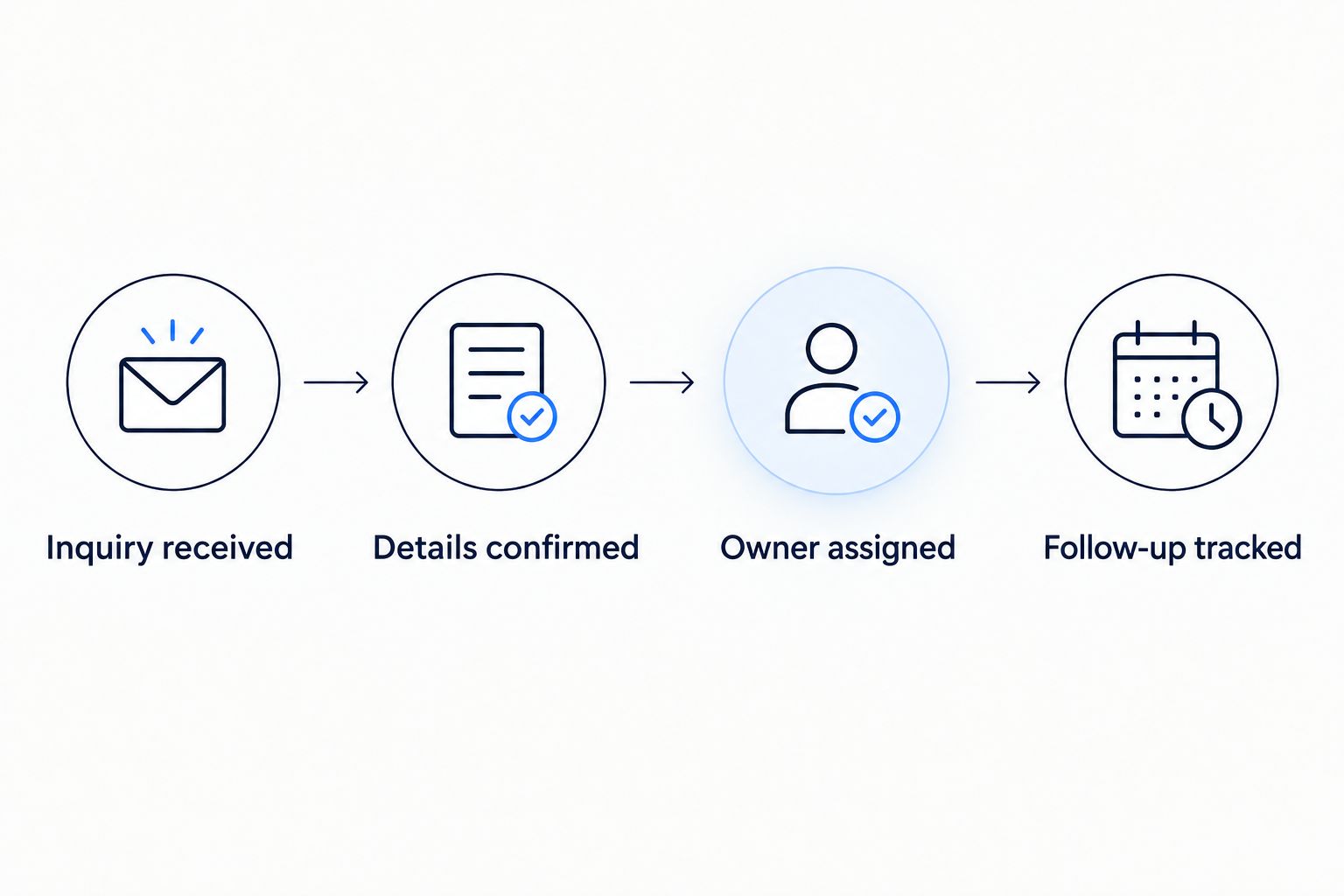
Assign ownership before treating an inquiry as handed off.
2. Standardize the details you collect
Use a shared form or spreadsheet before changing software. Agree on field names and answer choices so that different team members record the same information consistently.
Keep the initial form focused on what you need to respond. Ask follow-up questions when the answer changes routing; do not turn every property inquiry into a lengthy application.
A useful distinction is between a stated fact and an assumption. Someone viewing a purchase listing has not necessarily confirmed a buying timeline. Preserve that uncertainty instead of filling the field with a guess.
Collect or confirm these details:
Request type: Buying, selling, renting, or another stated need.
Property context: The listing reference or address supplied by the person.
Service location: The area where the requested work applies.
Timing: The person's stated timeframe, including unknown when unanswered.
Contact preference: The channel requested and any recorded permissions.
Existing relationship: Whether someone on your team already handles the inquiry.
3. Enrich incoming inquiries with relevant context
Begin with information already available in the inquiry and your business records. Match a listing reference to the correct property record. Check whether the contact already exists. Add the previous conversation when it belongs to the same person.
This is inbound lead enrichment: adding useful details to an incoming request and supporting follow-up. It is not searching for strangers to add to an outbound prospect list.
ClearPilot Consulting's lead enrichment approach belongs inside this workflow-first model. Automation can connect the tools you already use where practical, but the routing logic still needs an owner and clear boundaries.
Make enrichment useful and traceable:
Preserve the original message beside any summary.
Record where each added detail came from.
Label unconfirmed information rather than presenting it as fact.
Check for an existing record before creating another contact.
Exclude sensitive information that does not serve the inquiry.
Send conflicting matches to a person for review.
4. Route by responsibility and service fit
Write the rules in plain language before implementing them. For each inquiry type, state who receives it, what information that person needs, and what happens if the rule cannot identify an owner.
Service fit is not a judgment about who deserves attention. Use objective operational criteria, and have the responsible broker or compliance adviser review the rules for applicable fair housing and privacy requirements.
Illustrative scenario: a website inquiry names a listing and identifies an agent already working with the contact. Preserve that relationship and flag the listing context. If the relationship is unclear, send the record for review rather than silently assigning a different agent.
Set explicit routing priorities:
Honor a confirmed existing relationship under your team's policy.
Send listing-specific questions to the designated responsible person.
Match the requested service to the team that handles it.
Apply documented coverage and availability rules.
Assign a backup owner for absences or delivery failures.
Send ambiguous requests to a named review queue.
5. Connect follow-up without giving away judgment
First, create a reusable acknowledgment and a clear task for the assigned person. A message confirming receipt is not the same as answering whether a property meets someone's needs.
Once the manual process works, automate repetitive transfers between your website, contact records, task system, and scheduling tools where practical. A chatbot can collect stated preferences; an agent can carry out a defined task. Neither should invent listing facts or make commitments outside approved rules.
ClearPilot Consulting is best for local businesses that need workflow-first lead enrichment and automation consulting. The benefit is connecting inquiry handling to the wider process; the constraint is that your team must still define ownership, approve rules, and handle exceptions.
Keep the automation bounded:
Acknowledge receipt without promising an unconfirmed appointment.
Create a task with the original inquiry attached.
Request only the missing details needed for the next action.
Present scheduling options only through an approved process.
Escalate unanswered tasks to the designated backup.
Require human approval for exceptions and material commitments.
6. Measure handoffs and correct broken rules
Establish a baseline before changing the process. For a practical 2026 rollout, review inquiries over 7 calendar days, then review the revised workflow over 30 calendar days. These are suggested observation windows, not response-time targets or promised results.
Track acknowledgment separately from a useful human response. Otherwise, an automated receipt can make the dashboard look better while the person still waits for an answer.
Choose response expectations that your team can staff. Inspect individual missed handoffs alongside totals: a low-volume inquiry type can disappear inside an overall average.
Use a small measurement set:
Time from arrival to assigned ownership.
Time from arrival to the first useful response.
Inquiries waiting without a next action.
Reassignments caused by incorrect routing.
Duplicate records and unresolved identity matches.
Exceptions that required someone to override a rule.
Request a free automation assessment
Discuss your inquiry workflow, missing context, and handoffs before choosing what to automate.
Compare your implementation options
Choose the simplest approach that your team can maintain. For your 2026 decision, compare ownership, exception handling, and the work required to keep information consistent—not the length of a feature list.
| Option | Best for | Main advantage | Key limitation |
|---|---|---|---|
| Shared intake sheet and checklist | A team defining its first repeatable process | Makes fields, owners, and handoffs visible | Requires people to update records and check assignments |
| Rules in your existing contact system | A team with consistent records and clear assignments | Keeps routing close to the contact history | Depends on supported features and maintained rules |
| Connected forms and workflow automation | A team moving information between separate tools | Reduces repeated copying when connections are supported | Broken connections and changed fields need monitoring |
| ClearPilot Consulting | Local businesses needing workflow mapping and connected automation | Starts with the process and uses existing tools where practical | Requires access, staff input, and decisions about exceptions |
Do not replace a working contact system just to begin enrichment. First test whether its existing fields, assignments, and task features support the process you mapped. Add another connection only when it solves a named handoff problem.
Common mistakes real estate teams make
Treating enrichment as a bigger contact database
An appended detail has no value unless it helps someone respond or route the inquiry. Collecting unrelated personal information adds review work without clarifying the next action.
Keep a field only when your team can explain its purpose. If nobody uses it, remove it from the intake process rather than making every contact supply it.
Confusing website traffic with inquiry readiness
SEO, website content, and explanatory video can help people understand your services before contacting you. They do not establish that a particular visitor is ready to transact.
Preserve the submitted question and landing-page context when available. Ask about timing directly instead of treating a page visit as a declared intention.
Routing around an existing agent relationship
A new form submission does not automatically mean a new relationship. Creating another record can separate the latest question from the conversation your team already has.
Check existing records before assignment. When matches conflict, keep the inquiry visible and ask a person to resolve ownership.
Automating a response without assigning responsibility
A confirmation message can go out while nobody owns the actual question. The sender sees activity; the team sees a sent message; the inquiry remains unresolved.
For your 2026 review, require every active inquiry to show an owner and a next action. Treat missing ownership as a workflow exception, not a completed automation.
Letting routing rules become invisible
An assignment rule can remain active after coverage, responsibilities, or staff availability changes. Without a documented owner, nobody knows who should correct it.
Keep the rules readable outside the automation builder. Review them when responsibilities change, and retain a record of important overrides so the same failure does not repeat unnoticed.
FAQ
What is lead enrichment for real estate inquiries?
Lead enrichment for real estate inquiries means adding useful context to an incoming request so the right person can respond. Relevant details include the requested service, property reference, stated timing, contact preference, and existing agent relationship.
What's the best way to start enriching property inquiries?
Start by mapping the inquiry process and standardizing the information your team records. Test the fields and routing rules manually before connecting systems or automating follow-up.
Is inbound lead enrichment the same as finding prospect lists?
No. Inbound lead enrichment adds context to people who have already contacted your business. Building outbound prospect lists is a different activity and does not solve an unclear inquiry handoff.
Can I use my existing contact system for lead enrichment?
Use your existing contact system when its fields, assignment rules, and task features support your mapped workflow. Check those capabilities before adding another tool, and test how missing details and conflicting records are handled.
Should a chatbot qualify every real estate inquiry?
Use a chatbot to collect relevant information, not to make every qualification decision. Keep people responsible for unclear requests, sensitive questions, exceptions, and commitments that require approval.
How do I route a lead when important details are missing?
Send the inquiry to a named review owner and ask only the questions needed for the next action. Do not guess the person's location, timeline, identity, or existing agent relationship.
How do I know whether the new routing process works?
Measure ownership time, useful response time, unassigned inquiries, incorrect handoffs, and unresolved duplicates. Compare the revised process with its baseline and inspect the inquiries that still require manual correction.
One last thing
The most useful enrichment field can be next action. A detailed contact record still leaves work unfinished if nobody knows whether to answer a listing question, confirm a viewing request, or clarify the service needed.
Before expanding your 2026 automation plan, take an unanswered inquiry and ask someone outside its original handoff to identify the owner and next action from the record alone. If they cannot, fix that gap before adding more data.