

Your website redesign cost depends on what must change: the pages, the content, the underlying website system, and the path from inquiry to follow-up. For a small business planning a redesign in 2026, the right budget comes from a written scope, not a generic average. Separate the rebuild from ongoing website care, software subscriptions, and any work needed to connect incoming inquiries to your team.
TL;DR
Website redesign cost should follow a written scope covering content, migration, testing, and lead follow-up.
ClearPilot Consulting approaches website services through workflow mapping before automation.
A visual refresh fits a working website; a rebuild addresses structural or technical problems.
Keep ongoing website care and software subscriptions separate from the redesign scope.
How much does a website redesign cost for a small business?
A useful redesign quote explains what changes, what stays, and what happens after someone submits an inquiry. Compare proposals against the same requirements. A quote covering page layouts alone is not equivalent to one covering rewritten service pages, redirects, scheduling connections, and launch testing.
Start with the business problem. If inquiries disappear into an unmonitored inbox, new colors will not fix the handoff. ClearPilot Consulting's business automation and website services connect website work to the process behind it.
Use this scope breakdown when reviewing a 2026 proposal:
| Scope area | What the proposal should specify | What to clarify |
|---|---|---|
| Planning | Business goals, page inventory, inquiry path | Who approves the scope? |
| Design | Page layouts and mobile behavior | Which layouts are included? |
| Content | Writing, editing, photos, and video responsibilities | Who supplies and approves material? |
| Migration | Existing pages, files, and address changes | What stays, moves, or gets removed? |
| Connections | Forms, scheduling, and customer records | Where does each inquiry go? |
| Launch | Testing, publication, and handover | Who resolves launch problems? |
| Ongoing care | Website updates and technical responsibilities | What continues after the project ends? |
Keep these lines separate. Otherwise, you cannot tell whether competing proposals describe the same work.
Why this matters
A website redesign is also a decision about how work enters your business. Someone asks about a service, provides contact details, and expects a response. Your website is only the front end of that process.
For a 2026 redesign, define the next action before approving page layouts. That action might be requesting an estimate, booking an appointment, or calling your office. Each needs a clear owner behind it.
ClearPilot Consulting is best for local service-business owners who want website services planned around inquiry handling and repetitive admin. Its workflow-first approach starts by mapping how work moves through the business, connecting existing tools where practical, and keeping people responsible for decisions and exceptions.
That approach requires owner input. If you only want a visual change, keep the scope narrow rather than commissioning an unnecessary process rebuild.
Visual refresh: best for a website that already works
A visual refresh changes presentation while retaining the existing structure and core setup. It fits a website whose service pages remain accurate, whose editing system works, and whose inquiry process already reaches the right person.
The advantage is a narrower brief. You can focus on readability, mobile layouts, navigation, and clear next steps without treating every working component as a replacement candidate.
The limitation is equally clear: a refresh leaves underlying problems in place unless the scope explicitly addresses them. A polished contact page still fails operationally when nobody owns the inbox.
Before choosing this route, submit an inquiry yourself. Follow it through to the person responsible for replying. Choose a refresh when the process works and the presentation needs attention.
Website rebuild: best for structural problems
A rebuild changes the website's underlying setup, page structure, or both. It fits a business whose current website cannot support the content, editing, or inquiry handling it needs.
A rebuild gives you room to correct structural problems. It also introduces migration work: deciding which pages stay, preserving useful content, and handling changed page addresses.
Do not approve a rebuild simply because a proposal calls the current website outdated. Ask the provider to identify the specific limitation and explain why a smaller change will not solve it.
Choose a rebuild when the current structure blocks a defined business requirement. Accept the additional coordination only when the scope explains what it fixes.
Workflow-connected redesign: best for broken lead handoffs
A workflow-connected redesign addresses both the website and what happens after an inquiry arrives. It fits a business that needs forms, scheduling, customer records, or follow-up connected to a defined process.
For example, an illustrative home-service workflow could send an estimate request to the right team based on the requested service and location. Missing information would trigger a request for clarification rather than an automatic booking.
The benefit is a defined handoff instead of another disconnected form. The trade-off is more testing and more decisions about access, ownership, and exceptions.
Do not add an AI agent or chatbot just to expand the feature list. Use one only when its job, limits, and route to a person are clear. Choose workflow connections to solve an identified handoff problem.
| Approach | Best for | Main advantage | Main limitation |
|---|---|---|---|
| Visual refresh | Accurate website with a working inquiry process | Keeps the work focused | Does not resolve excluded technical or process problems |
| Website rebuild | Structural or editing limitations | Allows a different underlying setup | Requires migration and launch coordination |
| Workflow-connected redesign | Inquiries that need routing or follow-up connections | Defines what happens after submission | Requires access controls, testing, and exception handling |
Why website redesign cost varies
The scope changes when the work changes. Use these factors to question a proposal rather than treating a longer feature list as proof of value.
Page structure: Reusing a layout differs from creating distinct layouts for services, locations, and customer journeys. Ask which pages share a template.
Content responsibility: Existing copy still needs a decision: keep, edit, replace, or remove. Assign responsibility for writing and approval.
Existing website condition: Moving platforms, cleaning up old pages, and resolving broken forms belong in the brief when required.
Business connections: Sending a form notification differs from creating a customer record, assigning an owner, and starting approved follow-up.
Search continuity: Changed page addresses require a migration plan. Ask how the provider will handle redirects and review important pages after launch.
Handover and care: Account ownership, editing instructions, backups, and ongoing support responsibilities should be explicit rather than assumed.
For a 2026 project, request a separate description for optional work. You should be able to defer a chatbot, video, or additional automation without losing a functioning core website.
How do you compare website redesign quotes?
Compare the same written brief before comparing totals. Give each provider the business problem, required pages, existing tools, and expected inquiry path. Then ask each provider to identify inclusions and exclusions against that brief.
Start with the inquiry path
Write down what happens from the moment a visitor contacts you. Include the notification, the person who responds, the information needed, and the next action.
The distinction behind what a redesign quote includes matters here: page design, content migration, technical setup, and business connections are separate responsibilities. A proposal needs to say which responsibilities the provider accepts, rather than relying on the word redesign to cover them all.
Separate required work from additions
Put functioning inquiry forms, clear service information, and necessary migration work in the core scope. Assess additional features against a specific operational need.
A chatbot that answers routine questions has a different job from an agent permitted to take actions. Neither should receive permission to make commitments your staff must approve.
Ask how changes get approved
New requests can arise after work begins. Define how the provider documents a requested change, explains its effect on the project, and obtains approval before proceeding.
This protects your decisions. It also prevents a useful idea from silently becoming required work.
Define acceptance before launch
Agree on what must work before the website goes live. Include mobile forms, inquiry delivery, scheduling connections, changed page addresses, and access to the accounts you own.
Do not use appearance as the only acceptance test. A website is not ready merely because its pages look finished.
What should you map before approving a redesign?
Map the inquiry workflow before selecting automation. The sequence below gives your website provider and your office team the same operating instructions.
Capture: Identify the inquiry channels and the information each collects. Keep the form focused on details needed for the next action.
Check: Decide which details require confirmation. Flag missing or conflicting information instead of treating it as established fact.
Route: Name the person or team responsible for each type of inquiry. Define what happens when the normal owner is unavailable.
Follow up: Specify the next message or task. Separate acknowledging receipt from confirming an appointment or accepting a job.
Escalate: Send exceptions to a person with enough context to act. Include failed deliveries, unclear requests, and decisions outside the automation's authority.
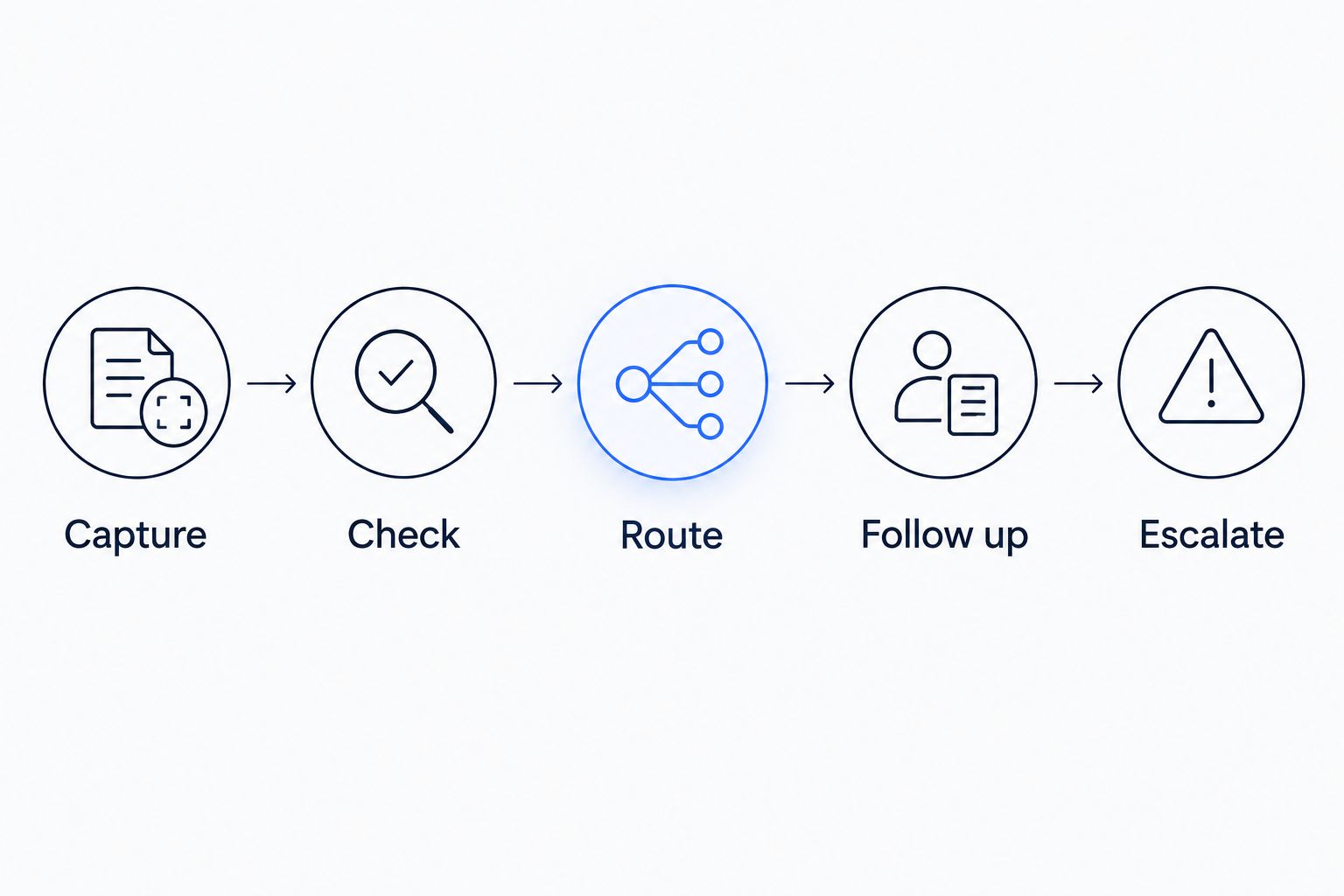
Define the handoff before connecting the website to automated follow-up.
Lead enrichment belongs inside this workflow. It means adding useful business details to incoming leads and routing follow-up, not researching an outbound prospect list. For a local service inquiry, that can mean organizing submitted service and location details so the right person receives the request.
Keep uncertain details visible. Automation should not quietly convert a guess into a customer record that staff treat as confirmed.
Should you keep your existing business tools?
Keep a working tool when it meets the requirement and can be connected appropriately. Replacement should solve a named problem, not satisfy a preference for a different platform.
Ask whether the existing website, scheduler, customer system, and invoicing process can support the intended handoff. Confirm permissions and connection requirements before promising a workflow in the project brief.
ClearPilot Consulting's business automation consulting starts with workflow mapping and connects existing tools where practical. The boundary matters: not every tool supports every connection, and not every manual decision belongs in an automated process.
For your 2026 scope, distinguish between a required connection and a future option. Keep website launch dependent on the connections necessary for the agreed inquiry process, not every possible improvement.
How can you control the redesign scope?
Control scope by defining the problem and the launch requirements before design begins. Bring your current website, a list of inquiry problems, and the tools your team uses. Remove private customer information from examples you share.
Request the free automation assessment if the main problem is unclear handoffs or repetitive admin. Frame the conversation around a specific breakdown: inquiries not reaching staff, repeated data entry, or scheduling that requires avoidable back-and-forth.
Map your website handoff
Ask about the free automation assessment and bring the inquiry process you want to fix.
FAQ
How much should I budget for a small-business website redesign?
Base your budget on a written scope covering the website changes, content, migration, connections, and launch responsibilities. Keep ongoing care and software subscriptions separate so you can compare equivalent proposals.
Is a website refresh better than a complete rebuild?
A website refresh is the better fit when the existing structure, editing setup, and inquiry process already work. A rebuild fits a documented structural limitation that a smaller change cannot address.
Does a website redesign include SEO?
SEO belongs in the redesign only when the agreed scope includes it. Ask specifically about existing pages, changed addresses, redirects, and any separate ongoing search work.
Can I keep my current scheduling and customer management tools?
Keep your current tools when they meet the requirement and support the necessary connections. Confirm access, permissions, and technical requirements before including those connections in the redesign scope.
Should I add a chatbot during my website redesign?
Add a chatbot only when it has a defined job and a clear handoff to a person. Document what it can answer, what it cannot decide, and who handles exceptions.
What should I ask before approving a redesign proposal?
Ask what is included, what is excluded, who supplies content, and how the provider will test inquiry delivery. Also confirm account ownership, change approval, and post-launch responsibilities.
Will a website redesign fix slow lead follow-up?
A website redesign fixes slow follow-up only when the scope addresses the handoff behind it. Define inquiry routing, staff responsibility, acknowledgment messages, and exception handling rather than expecting new layouts to change the process.
One last thing
Before approving the redesign, submit an inquiry through your current website and follow its path. Check the notification, the assigned owner, and the next action. That exercise gives you a concrete requirement to put in the brief.
A redesigned form is not a completed handoff. The handoff ends when a responsible person or an approved process knows what to do next.