

Yes. AI agents for customer service can handle routine inquiries, collect job details, and carry out approved follow-up when connected to the right business tools. They should not independently resolve disputes, approve exceptions, or promise work your team has not confirmed. For a small business in 2026, the practical approach is a defined service workflow with a clear handoff to a person—not an unattended replacement for your staff.
TL;DR
AI agents for customer service fit routine inquiries and approved follow-up, not unrestricted decisions.
ClearPilot Consulting starts customer service automation with workflow mapping, not a tool purchase.
Inbound lead enrichment adds useful details to incoming inquiries and routes follow-up.
Keep people responsible for complaints, uncertain answers, and exceptions.
Why this matters
A quick reply does not solve a customer service problem if nobody owns the next step. An automated acknowledgment still leaves work unfinished when an inquiry never reaches scheduling or an unresolved complaint disappears into a shared inbox.
Start by deciding when a person should take over. That decision shapes what the agent can answer, what it can change, and where it must stop. Your customer needs a reliable path to help, not another conversation that ends without action.
Can AI agents handle customer service for a small business?
Yes, within a defined scope. A customer service agent can answer from approved information and, with suitable connections and permissions, take actions such as creating an inquiry record or requesting an appointment. The system needs explicit rules for both actions and exceptions.
For a 2026 project, compare the work each approach will own rather than choosing by the technology label. A chatbot, an action-taking agent, and a person serve different purposes.
| Approach | Best for | Useful capability | Limitation |
|---|---|---|---|
| Answer-only chatbot | Repeated, documented questions | Explains approved service information | Does not complete work in another system unless connected to do so |
| Connected AI agent | Defined intake and follow-up tasks | Records details and performs permitted actions | Needs permissions, current information, and failure handling |
| Human team member | Complaints, exceptions, and judgment | Interprets unusual situations and authorizes decisions | Requires assigned coverage and a workable queue |
An agent does not gain authority just because it can hold a conversation. If your staff must approve a schedule change, the agent should submit that request—not present it as settled.
What work should an agent handle first?
Start with repeatable work that has a clear source of truth. Examples include collecting the requested service, asking for the service location, and recording the customer's preferred contact method.
Appointment requests also fit when the rules are explicit. The agent must distinguish between requesting a slot and confirming a booking. If it cannot verify the calendar or complete the booking action, it should report that limitation accurately.
What work should stay with a person?
Keep complaints, disputed charges, unusual commitments, and uncertain situations with an authorized person. The agent can collect context and route the issue without deciding its outcome.
Do not make customers argue with automation to reach your staff. A direct request for a person should trigger a defined handoff, even when the original question appears routine.
Map the customer service workflow before building it
ClearPilot Consulting is best for local business owners who need workflow-first customer service automation. Its approach starts with how work moves through the business, connects existing tools where practical, and keeps people responsible for decisions and exceptions.
That approach requires owner input. Someone must explain the rules, identify reliable information, and approve the handoffs. Automation does not remove that responsibility.
Use this sequence to define your first workflow:
Receive inquiry. Identify the entry point: website form, chat, phone, or message. Decide which channel the first project will cover.
Check details. Establish what the customer needs and which information is missing. Ask only for details needed to move the request forward.
Assign owner. Route the inquiry to the person or queue responsible for the next action. Define a backup when that destination is unavailable.
Take action. Specify the permitted action, such as creating a record, sending approved information, or submitting an appointment request.
Confirm outcome. Record whether the action succeeded. Tell the customer what happened and what remains open.
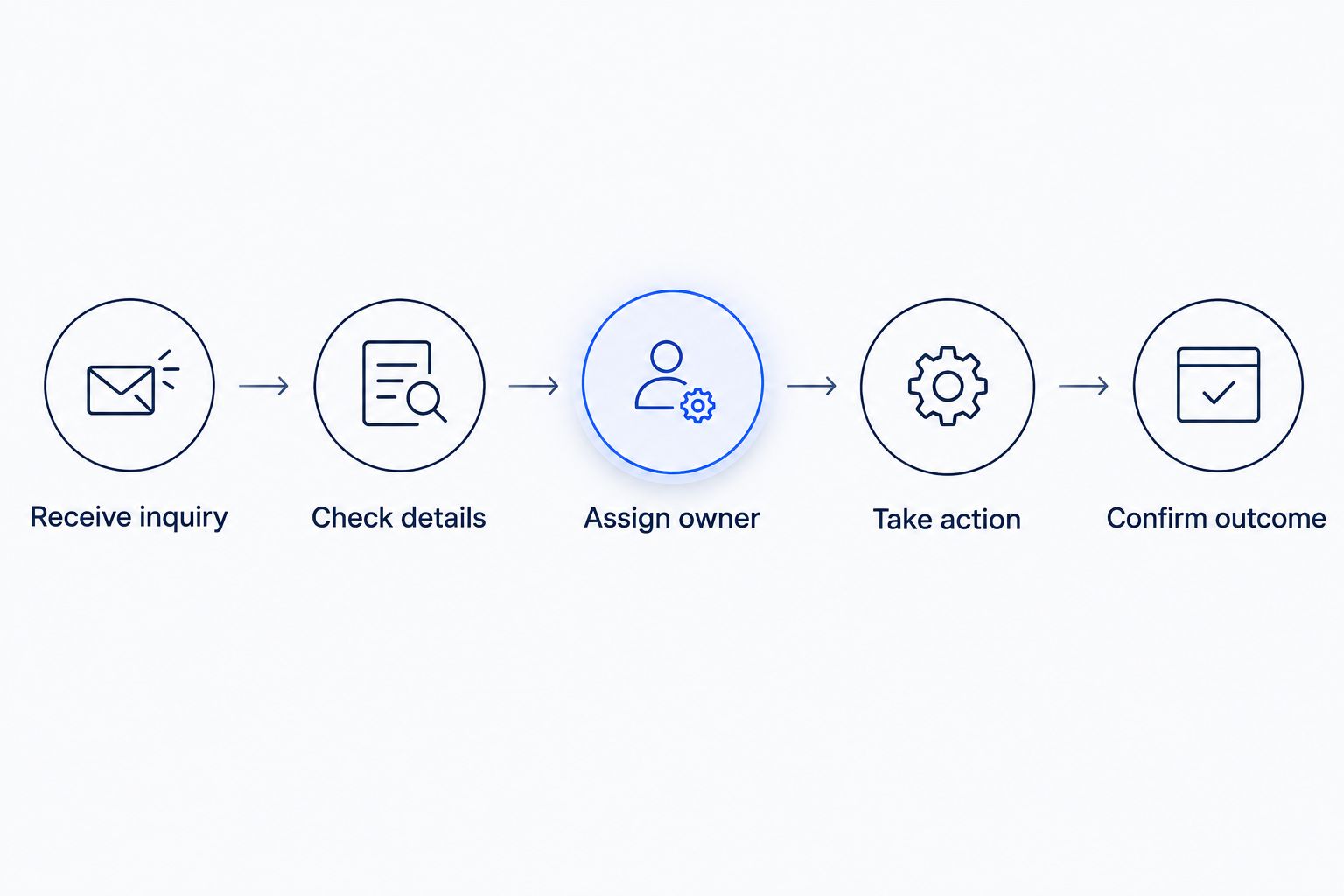
A reply is not completion; the workflow must confirm what actually happened.
Write the exception beside each step. If the service location is missing, ask for it. If the destination system is unavailable, keep the request open for a person. If the customer disputes the recorded details, preserve the correction instead of silently replacing information.
The business process automation services discussion should start with this process map. Choosing software first leaves the important questions—authority, ownership, and failure handling—unanswered.
Why customer service automation varies by business
The right scope depends on how your business handles inquiries, not on a generic list of agent features. For your 2026 plan, review these factors before approving any build:
Information quality. Approved answers need an owner and a current source. Conflicting service descriptions create conflicting replies.
Tool access. The agent's permitted actions depend on the systems it can connect to and the access you authorize.
Scheduling rules. A request, a tentative hold, and a confirmed appointment need different language and actions.
Decision authority. Refunds, exceptions, and service commitments require explicit boundaries and named approvers.
Handoff coverage. A routing rule needs a real destination, a backup, and a way to see unresolved requests.
Data needs. Intake should collect what the next step requires, not everything a conversation can reveal.
These factors explain why copying another business's setup is the wrong starting point. Your agent must follow your operating rules. Where those rules are unclear, settle them before automating the decision.
Use lead enrichment to improve incoming service requests
Inbound lead enrichment means adding useful details to an incoming inquiry and routing the follow-up. It is not outbound prospect-list research. For a local service business, useful details include the requested service, service location, preferred contact method, and whether information still needs confirmation.
Illustrative scenario: A customer asks about a repair but leaves out the location. The agent asks for the service address, checks it against the business's approved service-area rules, and sends the request to the appropriate queue. A person handles an uncertain boundary case.
Separate what the customer supplied from what another system added. A previous record might contain an old address or a different contact preference. Do not treat an existing entry as proof that the new inquiry is wrong.
Apply these rules:
Preserve the customer's original message.
Mark missing information as missing rather than guessing.
Flag conflicting details for confirmation.
Stop follow-up that depends on an unresolved detail.
Show the receiving staff member what still needs checking.
Enrichment earns its place when it helps someone act. A longer record that does not change routing, preparation, or follow-up adds administrative work instead of removing it.
Keep people in control of decisions and exceptions
Human control needs an operating process, not a statement that someone will monitor the system. In a 2026 deployment, specify who receives exceptions, what information they receive, and how they acknowledge ownership.
Define the boundary between conversation and authority. An agent can explain an approved policy without being authorized to waive it. It can collect a complaint without deciding whether the customer deserves compensation.
For phone inquiries, human oversight for AI phone agents belongs in the workflow: specify which calls require intervention, who receives them, and what happens when a transfer fails. A transfer attempt is not the same as a completed handoff.
Give the receiving person enough context to continue:
The customer's request and preferred contact method.
Details already confirmed and questions still open.
Actions attempted and their recorded outcomes.
The reason the agent stopped.
Any commitment already communicated to the customer.
Also define a pause procedure. Your team needs a way to stop automated actions when information is wrong or a connected system behaves unexpectedly. Pausing actions should not make incoming inquiries disappear.
Test the workflow before expanding it
Start with 1 workflow, not every customer service channel. For example, scope the pilot to website inquiries that need a service-area check and a callback request. Keep complaints and account changes outside that pilot.
Use the following as a proposed test plan, not a performance benchmark: run 10 test inquiries through the workflow and include 5 handoff cases among them. Choose cases that challenge the rules rather than repeating the easiest question.
| Test case | Expected behavior | Failure to catch |
|---|---|---|
| Complete routine inquiry | Record details and route follow-up | A reply is sent but no record exists |
| Missing service location | Ask for the missing detail | Location is guessed |
| Conflicting contact details | Flag the conflict for confirmation | Existing information is silently overwritten |
| Customer requests a person | Send context to the assigned queue | Agent continues trying to resolve the issue |
| Connected system fails | Keep the request unresolved and notify staff | Customer receives a false success message |
Count attempts and completed actions separately. Review whether records arrived, whether staff received the handoff, and whether the customer's message matched the actual outcome. These checks are more useful than judging whether a conversation sounded polished.
After launch, review unresolved requests and repeated corrections. Expand the scope only when the current workflow behaves as intended, including its failure paths. A convincing answer is not evidence that the underlying task succeeded.
How does customer service automation connect to your website?
Your website should set expectations that the service workflow can meet. If a form collects appointment preferences, describe the next step accurately. Do not label a request as a confirmed appointment unless the booking is completed.
The same principle applies to SEO pages and service explainers. Search content brings people into an inquiry process; the form, chatbot, and staff handoff must preserve what they asked for. An explainer video can clarify a process, but it does not replace ownership of the resulting inquiry.
ClearPilot Consulting connects workflow mapping with supporting website, SEO, and automation services. For a 2026 assessment, bring a recent inquiry, the tools involved, and the point where follow-up stalls. That gives the discussion a concrete process to evaluate.
Request your free automation assessment
Start with one inquiry workflow, the tools you use, and the handoff that needs attention.
Can an AI agent replace my receptionist?
Keep a person responsible for exceptions and service commitments. An agent can handle defined intake tasks, but receptionist work also includes judgment and resolving situations outside a script. Decide which tasks to transfer rather than treating the entire role as one automation project.
Can an AI agent book customer appointments?
An agent can book appointments when an authorized calendar connection and explicit booking rules support that action. Without confirmed completion, it should describe the interaction as an appointment request. Include failed bookings and conflicting requests in your tests.
What should I automate first?
Start with 1 workflow that has repeated steps and a clear endpoint. A routine inquiry-to-callback process is a practical candidate. Define success as a correctly recorded and assigned request, not simply a message sent.
FAQ
Are AI agents for customer service suitable for a small local business?
Yes, AI agents for customer service suit defined tasks such as routine intake and approved follow-up. Keep complaints, uncertain answers, and exceptions with a person.
What's the difference between a chatbot and a customer service agent?
An answer-only chatbot provides information, while a connected customer service agent can also perform permitted actions. Confirm the actual connections and permissions rather than relying on the product label.
Can I keep using my existing business tools?
Plan around your existing tools where practical. Check whether each system supports the required connection, permissions, and confirmation of completed actions.
What happens when a customer asks for a person?
The agent should route the request to a defined person or queue and pass along the conversation context. A failed transfer needs a backup process, not a false completion message.
Does lead enrichment mean finding new prospects?
Inbound lead enrichment adds useful details to inquiries you already receive and helps route follow-up. It does not mean building an outbound prospect list.
How should I test a customer service agent?
Test both normal requests and failure cases before expanding access. Check missing information, conflicting details, requests for a person, and unsuccessful actions in connected systems.
Does ClearPilot Consulting offer a free automation assessment?
ClearPilot Consulting offers a free automation assessment. Bring a specific inquiry workflow, the tools involved, and the point where follow-up or repetitive administration creates problems.
One last thing
The most important answer an agent gives might be that an action did not finish. If a booking fails, an honest unresolved status gives your team something to fix. A confident but incorrect confirmation hides the work from everyone who could help.
Write that failure message before launch. Then assign the person who receives it.