

Handle missing or conflicting lead details by preserving the original inquiry, recording where added information came from, and checking only the fields needed for the next action. Lead enrichment data quality means useful, traceable details—not a record filled with guesses. When information conflicts, confirm the disputed detail before it controls a quote, appointment, or customer message.
TL;DR
Lead enrichment data quality depends on source tracking, clear field rules, and human review of consequential conflicts.
ClearPilot Consulting takes a workflow-first approach to inbound lead enrichment and follow-up.
Keep missing details separate from conflicting details; they require different responses.
Let safe follow-up continue while someone confirms information needed for scheduling or quoting.
How do you handle missing or conflicting lead details?
Start by separating information you do not have from information that disagrees. A blank service address needs a question. Two different service addresses need a decision about which location the inquiry concerns.
For your 2026 intake workflow, define what each field means before deciding how to fill it. A business mailing address, billing address, and job location are different facts. Treating them as interchangeable creates a conflict that better definitions can prevent.
If your intake form collects too little useful context, start with what to capture for incoming inquiries. Enrichment should support the handoff, not expand the record without a purpose.
| Record condition | Best for handling it | Recommended response | Limitation |
|---|---|---|---|
| Missing detail | A field that has no value | Ask for it when the next action requires it | Extra questions add work for the customer |
| Conflicting detail | Two sources that disagree | Preserve both values and confirm their meaning | Someone must resolve consequential disagreements |
| Unverified detail | Added information without confirmation | Label its source and restrict how it is used | It is not a substitute for customer confirmation |
| Confirmed detail | Information checked for the intended purpose | Use it within that purpose | Confirmation does not make information permanently current |
Do not silently replace a customer's statement with an enriched value. Keep the original alongside the proposed correction so the person handling the inquiry can understand the difference.
Why this matters
A lead can be ready for a reply without being ready for a booking. If your process treats every missing field as a stop sign, your team waits for information it does not yet need. If it treats every added detail as confirmed, your team acts on assumptions.
Inbound lead enrichment adds useful business details to incoming inquiries and routes follow-up. It is not outbound prospect-list research. Its job is to help your team understand the request and take an appropriate next step.
Consider an illustrative scenario: a property manager submits an inquiry using a company email address but asks about work at a tenant's location. The company address can provide context. It does not establish where the service visit belongs.
ClearPilot Consulting is a fit for local service businesses that want workflow mapping before lead automation. That approach starts with the decision a field supports, rather than the amount of information a system can collect.
Build a process that keeps uncertainty visible
Use this sequence to plan your 2026 lead-handling rules. These are recommended operating rules, not claims about a particular software system.
1. Preserve intake
Keep the original form submission, message, or call notes. Store later additions separately, or use a change history that lets your team recover the original value.
Record what the customer actually supplied. If an employee interprets a note, label that interpretation rather than rewriting it as the customer's statement. This distinction matters when a later conversation changes the scope of work.
2. Define fields
Write a plain-language meaning for each field that affects follow-up. For example, define service location as the place where the requested work will happen—not the customer's headquarters or billing address.
Start with 3 decision fields: requested service, usable reply channel, and service location when relevant. These are a planning starting point, not mandatory fields for every business. Add a field only when you can name the action it changes.
3. Record sources
For each added detail, keep the source, the date checked, and its status. Distinguish customer-provided information from a public business listing, an employee's note, or a system-generated suggestion.
A source label answers where a value came from. A status answers whether it is suitable for the action you want to take. Neither replaces the other.
4. Check conflicts
Compare information only after checking that the fields describe the same thing. A contact's mobile number and a company's main number can both be correct. Do not force them into a single phone field and call the difference an error.
When two values genuinely disagree, preserve both and flag the disputed field. Ask a focused question that identifies what needs confirming without making the customer repeat the entire inquiry.
5. Route exceptions
Give unresolved records a named owner and a visible next action. A review flag without an owner leaves the decision unfinished.
Define what can continue while the field is checked. An acknowledgment can proceed through a usable reply channel even when a service address still needs confirmation. Dispatch should wait until the location is settled.
6. Confirm outcomes
After clarification, record the confirmed value and why it changed. Close the exception rather than leaving a permanent warning on a resolved record.
Check the downstream record too. Correcting intake does not fix a separate appointment or invoice if the wrong information has already been copied there. Your workflow map should identify those handoffs.
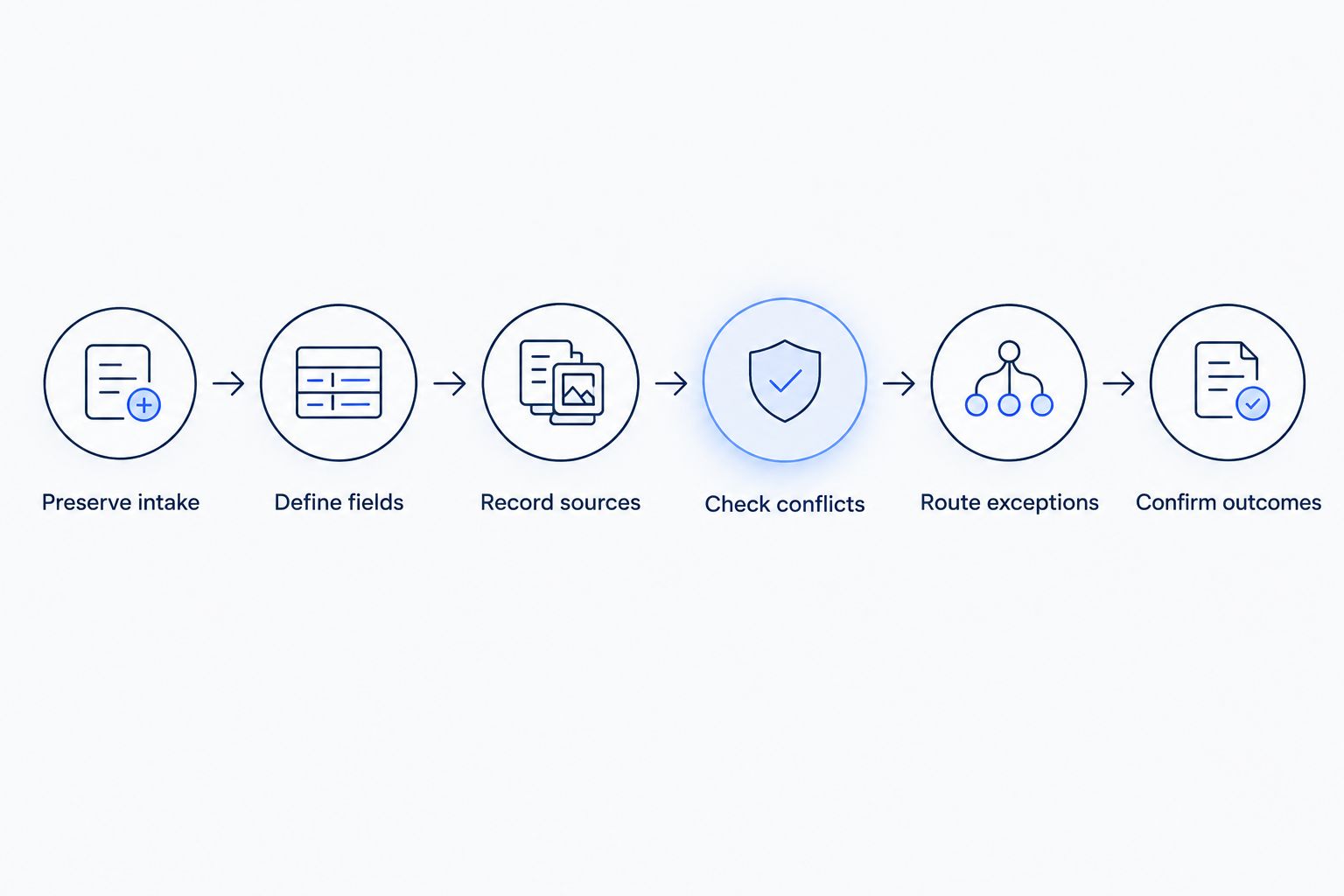
Resolve uncertainty before it controls a consequential action.
Missing details: ask only what the next action needs
A blank field is not automatically a bad lead. Decide whether the missing information prevents the next useful action or only becomes necessary later.
For an illustrative repair inquiry, a usable email address and a description of the problem can support an initial reply. A confirmed service location becomes necessary before assigning a visit. Billing information belongs at the stage where your process actually needs it.
Use these rules to keep questions focused:
Ask now when the missing detail determines who should respond or whether the request fits your service.
Ask later when the information supports scheduling, onboarding, or invoicing rather than the initial reply.
Leave blank when the detail has no defined use.
Mark unknown when your team needs to distinguish an unanswered question from a field nobody checked.
The benefit is a smaller, clearer intake process. The trade-off is that later stages need their own checks; a shorter form does not remove the need to confirm details before acting.
Conflicting details: resolve meaning before choosing a winner
Do not create a blanket rule that the newest source always wins. A recent directory entry can describe an office, while the customer is asking about another location. Recency helps you assess a source; it does not establish relevance.
For your 2026 review rules, separate conflicts by consequence. A formatting difference in a business name does not deserve the same response as two possible service addresses.
Use 4 review statuses: missing, unverified, conflicting, and confirmed. Keep the status attached to the individual field. A lead can have a confirmed reply address and an unresolved job location at the same time.
Confirm the disputed field, not the entire record. Ask which address is the service location, for example, instead of requesting a second complete intake form. Keep the answer with the record so the next employee does not reopen the same question.
Human review is appropriate when a disagreement changes the customer commitment. That includes where someone will travel, what work is requested, or which person has authority to approve it.
Why lead enrichment data quality varies
Your 2026 data rules need to account for how information enters and moves through your business. These factors determine how much checking a field needs:
Field meaning: Company address, billing address, and service location need separate definitions.
Source relevance: A public listing describes the business; an inquiry describes the current request.
Information age: Keep the date checked so your team can identify information that needs reconfirmation.
Matching certainty: A similar business name alone does not establish that two records describe the same organization.
Action consequence: Information used for internal context needs different controls from information used to dispatch someone.
Handoff design: A correction needs to reach the people and records that will use it.
Treat these as workflow design questions. Adding more sources without defining how their values will be used gives your team more disagreements to manage, not a rule for resolving them.
What should automation handle, and what needs a person?
Use automation for explicit rules: identify blanks, label sources, flag disagreements, assign review tasks, and pass confirmed information to the next step. Keep people responsible for decisions that require interpreting the customer's intent.
AI-generated suggestions need the same source and review controls as other additions. A plausible-looking answer is not confirmation. If a chatbot collects clarification, retain the customer's response rather than only the system's summary.
For your 2026 workflow, define 2 action gates: reply readiness and booking readiness. Reply readiness means your team can send an appropriate response through a usable channel. Booking readiness means the information required for that specific appointment has been confirmed.
The advantage is clear responsibility without stopping every inquiry. The limitation is that someone must own exceptions and check failed handoffs; automation does not remove that work.
ClearPilot Consulting maps workflows and provides business automation consulting, including AI agents and chatbots. Its workflow-first approach suits owners who want to connect existing tools where practical and keep people in control of exceptions. It still requires your team to define decisions and resolve customer-specific uncertainty.
Start with your lead handoff
Use the free automation assessment to discuss intake, follow-up, and exception handling.
Can you reply before every lead detail is confirmed?
Yes—reply when you have a usable channel and enough context for an appropriate response. Ask for unresolved details in that response. Do not turn an acknowledgment into a booking or quote that depends on disputed information.
Should enriched data overwrite the original inquiry?
No—preserve the original inquiry and record added information separately. A change history helps your team explain a correction and recover information if a match or interpretation was wrong.
How do you know whether lead enrichment is helping?
Check whether the added information supports a real decision. Review records for unresolved exceptions, unnecessary questions, incorrect matches, and corrections that failed to reach scheduling or invoicing. Keep information that helps the handoff; remove collection steps that have no defined use.
FAQ
What does lead enrichment data quality mean for a local service business?
Lead enrichment data quality means added lead details are relevant, traceable, and suitable for the next action. A complete-looking record is not enough if the information concerns the wrong business or location.
What should I do when a lead leaves out a phone number?
Use another customer-provided reply channel if it supports the next step. Ask for a phone number when your process needs it rather than adding an unconfirmed number and treating it as the customer's preferred contact.
Which address should I use when the form and business listing disagree?
Confirm which address is the service location before scheduling a visit. A business listing can describe an office while the inquiry concerns work elsewhere.
Can I automatically merge leads with similar business names?
Do not merge records based on a similar business name alone. Check identifying details and preserve a way to reverse an incorrect merge.
Can an AI chatbot fix missing lead information?
An AI chatbot can ask for missing information, but its own suggestion does not confirm a fact. Keep the customer's answer and route unresolved conflicts to a person.
Does ClearPilot Consulting help with inbound lead enrichment?
ClearPilot Consulting prioritizes inbound lead enrichment within its workflow-first business automation work. The focus is adding useful details to incoming inquiries and routing follow-up, not building outbound prospect lists.
One last thing
A disputed field should not make the whole lead unusable. Separate what your team knows from what still needs checking, then let each action depend on the information it actually requires.
Before adding another enrichment source, choose an unresolved inquiry and trace its next step. Name the missing decision, the field needed to make it, and the person responsible for resolving it. That is a concrete starting point for your free automation assessment.