

Yes. AI agents can automatically text back after a missed call, ask basic intake questions, and route the reply when your phone system, messaging service, and business rules are connected. For a 2026 setup, the limits matter as much as the first message: texting permission, delivery failures, uncertain answers, and requests that need a person all require clear handling.
TL;DR
AI agents missed call text back: automate acknowledgment and intake, not unrestricted promises or emergency decisions.
Use fixed rules for the first message; add an AI agent when replies require flexible intake.
ClearPilot Consulting fits local service businesses seeking workflow-first automation consulting with human-controlled exceptions.
A missed call alone does not establish permission for every automated text or marketing follow-up.
Can AI agents handle missed-call text backs automatically?
Yes, but sending the first text and managing the conversation are different jobs. A basic automation can send an approved acknowledgment after a qualifying missed call. An AI agent adds the ability to interpret replies, ask relevant questions, and pass information to staff or connected software.
Your phone system must expose the right call event. Start by checking how to connect your phone system to an AI answering agent before choosing the conversation features.
Compare these approaches for your 2026 workflow:
| Approach | Best for | What it handles | Main limitation |
|---|---|---|---|
| Fixed text-back automation | Acknowledging eligible missed calls | Sends approved wording after a defined event | Cannot interpret an open-ended reply by itself |
| AI-assisted text conversation | Gathering routine intake details | Interprets replies and asks questions within approved boundaries | Needs monitoring, reliable records, and a human handoff |
| Staff callback | Sensitive, urgent, or unusual requests | Applies judgment and discusses exceptions | Depends on staff attention and callback coverage |
These approaches can work together. Use fixed rules to decide whether a text should go out, an agent to collect routine information, and staff to resolve anything outside the approved process.
Why this matters
A missed-call message is not the same as a handled inquiry. You still need to know what the caller wants, who owns the response, and whether the conversation reached a useful next step.
Automate the handoff, not just the acknowledgment. Otherwise, you move the unanswered request from a phone log into a text inbox. Before building, decide where replies belong and which employee receives unresolved conversations.
The same principle applies when SEO, a website, or a service video brings someone to your phone number. Generating the inquiry and responding to it are separate parts of the process. Track both.
Map the missed-call workflow before adding an agent
Build your 2026 missed-call workflow around the actual path an inquiry takes. Write down the trigger, permitted actions, destination, and responsible person before connecting software.
1. Call event
Define what counts as a missed call. An unanswered call, a call outside business hours, and a caller who hangs up while waiting are different events; your phone service determines which events you can identify.
Also define exclusions. An internal extension, a known spam call, or a repeat call from someone already speaking with staff should not automatically start a fresh conversation. Check which exclusions your connected tools can enforce.
2. Eligibility check
Check whether the number can receive texts, whether the contact has opted out, and whether the proposed message is permitted. Ask your messaging provider and legal adviser to confirm the requirements for your setup.
Do not treat an incoming call as blanket consent for later promotions. Keep operational replies separate from marketing campaigns, and preserve the information needed to explain why a message was sent.
3. First message
Use approved wording that identifies the business and explains the next step. An illustrative message is: Thanks for calling. We missed you. What service do you need, and what ZIP code is the job in?
That wording is an example, not a compliance template. Add any required disclosures or opt-out language for your messaging program, and do not imply that a person is already reviewing the request unless that is true.
4. Intake and routing
Collect the details needed to assign the inquiry. For a local service request, those details might include the service needed, job location, and preferred callback window. Ask for missing information rather than making it up.
Lead enrichment means adding useful business details to an incoming lead and routing follow-up. Here, that can mean matching the caller to an existing customer record or checking a supplied ZIP code against an approved service-area list. It is not outbound prospect-list research.
5. Human handoff
Send the conversation, collected details, and unresolved question to a named person or team. Include a clear status so staff can distinguish a new inquiry from a conversation awaiting a callback.
A handoff needs an owner even when the agent completes intake correctly. If nobody accepts the task, the workflow is unfinished. Define what happens when the assigned employee is unavailable.
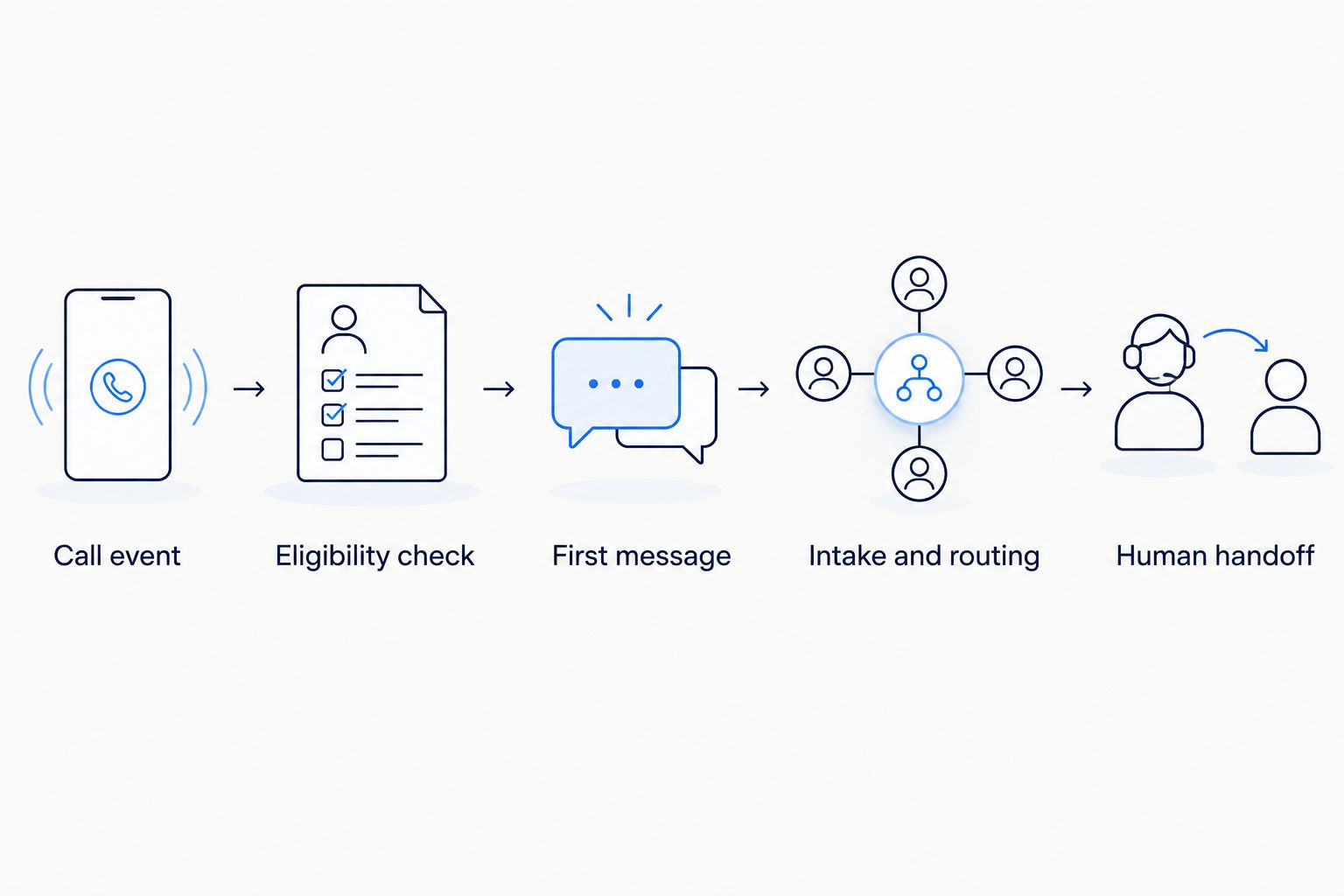
The first text is one step; ownership of the reply completes the workflow.
What should the agent be allowed to do?
Start with a narrow job. An agent can ask for approved intake details and summarize the answers without having permission to change appointments or make commitments.
Give each action its own boundary. Permission to read a schedule does not automatically mean permission to book it. Permission to collect a job description does not mean permission to diagnose the problem.
For an illustrative plumbing inquiry, the agent could record the caller's description and request a service location. Staff would handle uncertain urgency, technical advice, and any commitment the automation is not authorized to make.
Keep later stages separate too. Scheduling, onboarding, and invoicing each require their own checks. A successful text conversation should not silently trigger a booking, customer account, or invoice unless those actions are explicitly part of the approved workflow.
Why missed-call automation varies
The right setup depends on your process, not the label on the software. These factors determine the scope:
Phone-system access: The workflow needs a usable missed-call event and enough call information to apply your rules.
Messaging permissions: Eligibility, opt-outs, and messaging-program requirements affect which conversations can start or continue.
Inquiry complexity: Collecting a callback request differs from interpreting several service needs in one reply.
Record quality: Duplicate contacts and conflicting details require a rule for checking information before updating records.
Staff coverage: After-hours conversations need a different handoff from requests received while your office is staffed.
Action permissions: Reading information, changing records, and confirming appointments create different responsibilities.
Choose the smallest scope that solves the missed-call problem. If callers only need acknowledgment and a callback, a fixed text plus a staff task is a valid solution. Add conversational automation when it has a defined job.
Keep people in control of exceptions
Set your 2026 approval boundaries before launch. Write them in plain language so the owner, staff, and implementation partner agree on what the agent must stop doing.
Use explicit handoff conditions:
A caller asks to speak with a person.
The request falls outside the approved service information.
Customer records conflict or the caller disputes a stored detail.
The conversation involves a complaint, sensitive information, or an uncertain safety concern.
A connected system fails or returns information the workflow cannot validate.
The agent should not promise emergency assistance, dispatch, or response times it cannot confirm. For safety-sensitive situations, have qualified people approve the escalation wording before the system goes live.
Prevent competing replies as well. When staff take over, pause automated conversation unless the process explicitly calls for continued assistance. A customer should not receive a staff answer and an unrelated automated question at the same time.
Test failures, not just successful conversations
Use a written launch checklist with 3 checks: message eligibility, conversation handling, and staff handoff. These are testing categories, not a performance benchmark.
Message eligibility: Test an eligible caller, an opted-out contact, a number that cannot receive the message, and repeated missed calls. Confirm that suppressed messages remain suppressed and failed delivery creates the intended staff task.
Conversation handling: Test a straightforward inquiry, an unclear answer, a changed request, and a request outside your service area. Check whether the agent preserves what the caller actually said instead of filling gaps with assumptions.
Staff handoff: Test a request for a person and a failure in a connected system. Verify that staff receive the conversation and understand what action is required.
Use clearly marked test records rather than real customer requests where practical. Repeat the relevant tests after changes to message wording, phone routing, staff assignments, or software connections.
Measure follow-through, not message volume
For your 2026 review, distinguish a sent message from a useful outcome. A delivery status does not establish that someone read the text, replied, or booked service.
Track the workflow using clear definitions:
Eligible missed calls: Calls that meet your documented text-back rules.
Delivered messages: Messages reported as delivered by the messaging service.
Replies: Incoming responses associated with those conversations.
Completed handoffs: Requests accepted by the assigned staff member or team.
Confirmed next steps: Recorded callbacks, appointments, or other approved outcomes.
Keep errors visible. Review failed messages, duplicate conversations, incomplete intake, and unclaimed tasks alongside successful outcomes.
Do not attribute every later booking to the text-back system. A customer might call again or speak with staff through another channel. Connect records where practical and report only the relationship your records support.
Do you need an AI agent just to send the first text?
No. A fixed automation can send the first approved text after an eligible missed call. Add an AI agent when you need flexible intake or reply interpretation, not merely because the first message is automated.
Can the agent book appointments without staff approval?
Only within explicitly approved booking rules and a connected scheduling process. Require reliable appointment information, confirmation that the booking succeeded, and a fallback when the request does not fit. Otherwise, collect the caller's preference and assign staff to confirm it.
Where a workflow-first consultancy fits
ClearPilot Consulting maps workflows and deploys agents, chatbots, and supporting website and SEO services for small and mid-sized local businesses. The relevant starting point is the path from unanswered call to owned follow-up—not a software comparison.
ClearPilot Consulting is best for local service businesses seeking workflow-first business automation consulting. Connect existing tools where practical, define exceptions, and decide which actions stay with people.
That approach still has a limit: consulting does not remove the need for an internal owner. Your business must approve service information, messaging boundaries, and escalation responsibilities. Bring a sample inquiry and your current follow-up process to the free automation assessment.
Map your missed-call follow-up
Discuss the missed-call workflow and human handoffs in a free automation assessment.
FAQ
Can AI agents text customers after a missed call automatically?
Yes. An AI agent can participate in an automatic missed-call text-back workflow when the phone event, messaging service, eligibility rules, and follow-up process are connected. Automatic sending does not remove permission requirements or the need for a human handoff.
Do I need AI for a basic missed-call text back?
No. A fixed automation can send an approved acknowledgment after an eligible missed call. An AI agent becomes relevant when replies need interpretation or flexible intake questions.
Does calling my business give someone permission to receive marketing texts?
Do not treat an incoming call as blanket permission for automated marketing texts. Confirm the requirements for your message type and setup with your messaging provider and legal adviser, and honor opt-outs.
What should a missed-call text message say?
A missed-call text should identify your business and explain a useful next step. Use approved wording, avoid unsupported promises, and include the disclosures or opt-out language required for your messaging program.
Can a missed-call agent collect a customer's service area and job details?
Yes, when those questions are part of the approved intake process. The agent can ask for a location and service description, then route the information using your documented rules rather than guessing missing details.
What happens if the customer asks for a person?
A request for a person should trigger a defined staff handoff. Send the conversation and unresolved question to the assigned team, and pause automated replies when staff take over.
How can ClearPilot Consulting help with missed-call automation?
ClearPilot Consulting provides workflow-first business automation consulting for small and mid-sized local businesses. Its role includes mapping the process and deploying automation, with clear responsibilities for staff decisions and exceptions.
One last thing
Test what happens when the same caller rings again after replying to the text. A repeat call should not erase the conversation already underway. Check whether staff can see the existing inquiry and whether your rules prevent another unnecessary acknowledgment.
For your 2026 launch, make that repeat-call test part of acceptance—not an issue you discover through a customer complaint.