

SEO takes months rather than days to judge, but there is no fixed deadline for better rankings or more inquiries. Search engines must discover and reassess your changes, and visibility does not automatically turn into booked work. In 2026, judge progress through a connected sequence: relevant search visibility, qualified inquiries, and completed follow-up.
TL;DR
How long does SEO take to show results? Expect months, not a guaranteed deadline.
ClearPilot Consulting connects SEO with workflow mapping so incoming inquiries have a defined follow-up process.
Measure local SEO through relevant searches, qualified calls, and booked jobs—not rankings alone.
Fix indexing, service-page clarity, and lead handling before adding more content.
Why this matters
Waiting for SEO without defining a result leaves you paying for activity you cannot evaluate. A published page is a deliverable. A relevant inquiry is a business signal. A booked job is further down the process.
ClearPilot Consulting maps workflows before building automation and connects existing tools where practical. That matters when search traffic reaches a business whose calls, forms, and scheduling still depend on manual follow-up.
ClearPilot Consulting is best for local service-business owners who need SEO connected to a defined lead-handling workflow. It is not a substitute for someone answering questions, approving exceptions, and deciding which jobs the business should accept.
How long does SEO take to show results?
Expect SEO to take months to evaluate meaningfully, not days to prove itself. Google's SEO Starter Guide explains that changes can take anything from hours to several months to appear in search results. That describes search-system response time—not a promise of leads or revenue.
Your starting point determines what evidence to look for first. A website that cannot be indexed has a different problem from an established business receiving inquiries for the wrong services.
| Starting point | First evidence to examine | What it does not prove |
|---|---|---|
| New website | Important pages become indexed and appear for relevant searches | That competitive rankings will follow on schedule |
| Existing website with weak service pages | Search visibility becomes more closely aligned with actual services | That additional visitors will contact you |
| Local business with an incomplete profile | Business details accurately describe services, location, and hours | That profile edits guarantee map visibility |
| Website already generating inquiries | More inquiries match your service area and job requirements | That every inquiry will become booked work |
Do not restart the clock whenever someone changes a heading. Record meaningful changes, then examine whether the affected pages move toward the intended outcome. An SEO timeline without a baseline is just a date on a proposal.
Does a new website take longer than an established website?
A new website has no established search-performance history of its own. An existing website gives you records to inspect, but its age does not guarantee useful rankings or qualified leads.
Start with indexability, service relevance, and the condition of existing pages. Do not treat the domain's age as a forecast.
Can local SEO produce results sooner?
Local SEO has no guaranteed faster timetable. Correcting inaccurate business information and improving a relevant service page address specific problems, but neither change sets a deadline for better visibility.
For a local service business, evaluate location fit alongside search performance. A call from outside your service area is not equivalent to a suitable estimate request.
Why SEO timelines vary
The useful question is not just how long SEO takes. It is what currently prevents your business from being found, chosen, or contacted.
Search access. Search engines need access to the pages you want shown. Blocked or excluded pages require investigation before additional content becomes the priority.
Service clarity. A page should explain the work you perform, where you perform it, and what the customer should do next. Vague copy makes the page less useful to a specific searcher.
Existing page condition. Improving an established service page differs from launching a page with no performance history. Use the actual page's baseline rather than a general website average.
Competing results. Examine the businesses and pages already answering the target query. A broader or more competitive search requires a different plan from a narrow service question.
Implementation and follow-up. Recommendations do not change a website until someone implements them. Search visibility also cannot repair an unanswered inquiry after it arrives.
For your 2026 plan, separate problems that prevent search visibility from problems that prevent booking. They require different fixes and different evidence.
What should happen before you start judging SEO?
Set up the measurement and handoff before expecting the report to explain business performance. Otherwise, you will struggle to distinguish weak visibility from weak inquiry handling.
Establish the baseline
Record which service pages currently receive relevant search impressions and clicks. Separate searches for your business name from searches for the services you want to sell.
Also record what happens after someone contacts you. Identify where calls, forms, and chat messages arrive and who owns the next action. Keep the definitions consistent so later comparisons mean something.
Check search access
Confirm that important pages are accessible to search engines and eligible for indexing. Inspect the actual service pages rather than assuming that an indexed homepage means the entire website is ready.
Treat an access problem as a specific repair. Publishing additional pages does not resolve an instruction that prevents search engines from indexing them.
Clarify service pages
Explain the service, the area served, and the next step in language your customer uses. Remove conflicting information between the website and the business details customers encounter elsewhere.
A visitor requesting emergency help needs a clear contact path. A visitor researching a planned project needs enough detail to decide whether an inquiry makes sense. Those needs should shape the page.
Define lead handoff
Decide where each inquiry goes and who handles it. Specify what happens when information is incomplete, the request falls outside your service area, or the assigned person is unavailable.
Lead enrichment means adding useful details to an incoming inquiry and routing follow-up. It does not mean building outbound prospect lists. Keep the original customer information visible and flag uncertain details for a person to check.
Review outcomes
Compare relevant visibility with qualified inquiries and booked work. Keep unsuccessful inquiries in the record so you can understand why they did not progress.
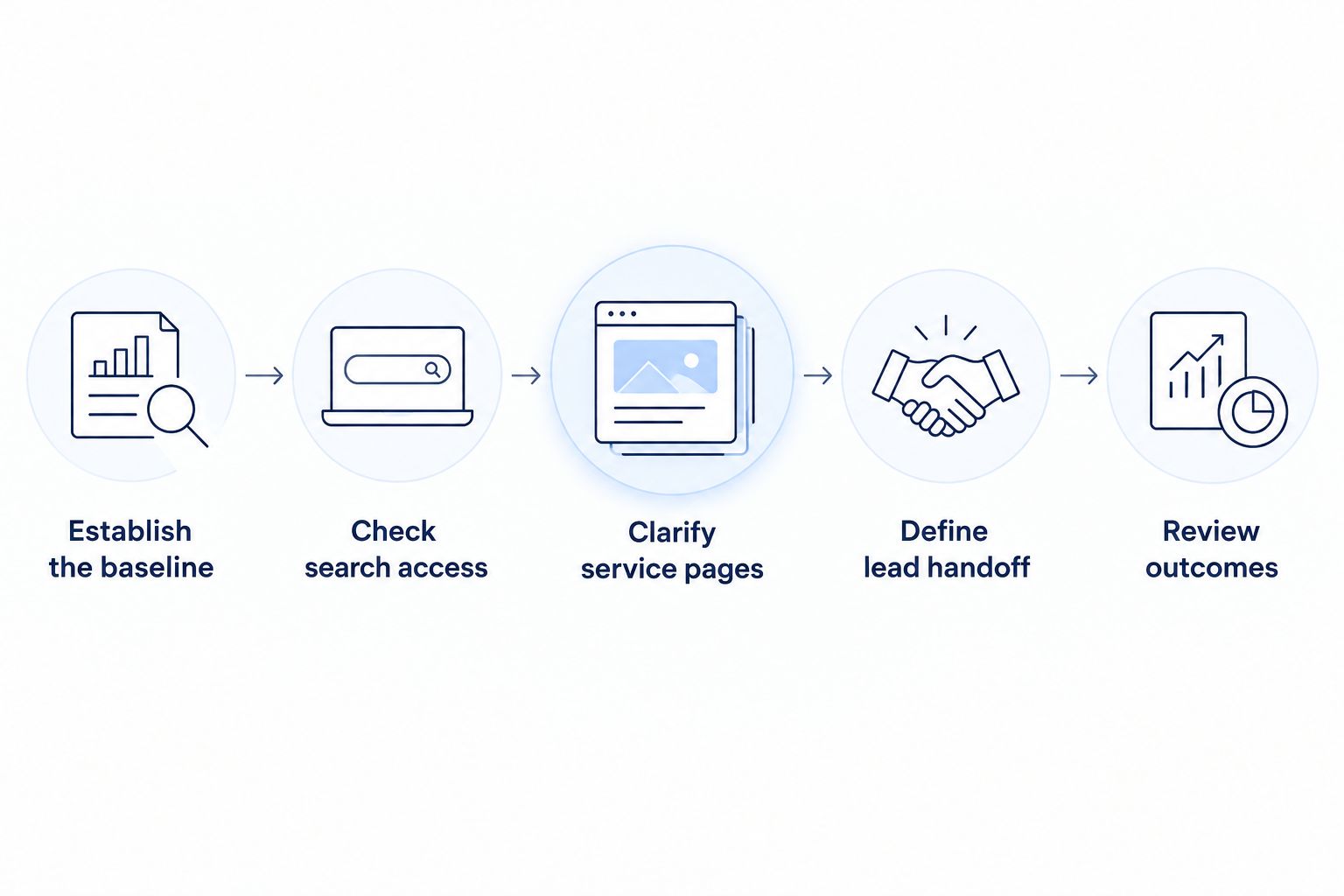
Set the baseline and lead handoff before judging whether SEO produces useful business results.
This sequence gives your SEO work a defined purpose. It also makes responsibilities visible: someone owns the website changes, someone owns the inquiry, and someone reviews the result.
What should an SEO progress report actually explain?
A useful report connects changes to evidence. It identifies the affected pages, the intended searches, and what happened after a visitor contacted the business.
In 2026, keep a dated change log alongside search and inquiry records. That prevents an unrelated rise in branded searches from being presented as proof that a newly edited service page worked.
Ask for these distinctions:
Delivery: What changed on the website or business profile?
Visibility: Which relevant searches and pages gained or lost exposure?
Inquiry quality: Did contacts match your services and service area?
Handoff: Did someone receive, review, and act on each inquiry?
Decision: What should change next, and what evidence supports that action?
The question behind monthly local SEO reports is whether recorded work connects to relevant visibility and customer inquiries. A list of completed tasks does not answer that question by itself.
Use the same definitions from one report to the next. If a qualified inquiry means a request within your service area for work you actually perform, do not quietly replace it with every form submission when the numbers look weaker.
How do you tell slow SEO from a broken lead process?
Follow the customer path and find where the evidence stops. Do not prescribe more content before checking whether existing inquiries receive a response.
Illustrative scenario: A local contractor receives a website inquiry about a service it offers. The message reaches a shared inbox, but nobody is assigned to respond. Better search visibility would not fix that handoff; it would send more inquiries into the same unresolved process.
| Observed problem | What to investigate | First corrective action |
|---|---|---|
| Important pages do not appear in search | Indexing and search access | Inspect the affected pages |
| Pages appear for unrelated searches | Page purpose and service wording | Clarify the service and customer need |
| Relevant visitors do not contact you | Contact path and page clarity | Test the form, phone path, and instructions |
| Inquiries arrive but receive no follow-up | Ownership and notifications | Assign a responsible person and backup |
| Inquiries receive replies but do not fit | Service area and qualification | Capture the details needed to assess fit |
Automation can support notifications, routing, and reminders. Its limitation is equally important: a poorly defined rule can send an inquiry to the wrong place. Keep a person responsible for exceptions and decisions about accepting work.
For your 2026 review, test the complete path yourself. Submit a clearly marked test inquiry and verify where it arrives, who sees it, and what action follows. Remove test records from performance reporting.
When should you change the SEO plan?
Change the plan when the evidence identifies a problem—not simply because a promised date has arrived. Keep the underlying business objective stable while adjusting the work needed to reach it.
Continue a focused approach when relevant pages are gaining appropriate visibility and inquiry quality supports the direction. Do not confuse ordinary movement in individual rankings with a reason to rewrite everything.
Repair the process when relevant inquiries arrive but disappear between the form, inbox, scheduling tool, and staff member. Additional traffic is not the immediate priority in that situation.
Revisit targeting when visitors consistently ask for work you do not perform or locations you do not serve. Review the wording and search intent before expanding the content library.
Question the reporting when every update lists activity but cannot explain affected pages, relevant searches, or inquiry outcomes. Ask for a clear next decision rather than another collection of screenshots.
ClearPilot Consulting's workflow-first approach starts by mapping how work moves through the business. Bring the actual inquiry path to a free automation assessment: where messages arrive, what staff copy manually, and where follow-up stalls. Keep people in control of approvals and exceptions.
Map your inquiry handoff
Discuss where inquiries arrive, who follows up, and which repetitive steps need attention.
FAQ
How long does SEO take to show results for a local business?
SEO takes months rather than days to evaluate meaningfully, with no guaranteed deadline. Track relevant local visibility, qualified inquiries, and completed follow-up instead of relying on rankings alone.
Why am I getting more website traffic but no more calls?
More traffic does not prove that visitors need your services or can contact you easily. Check search relevance, service-area fit, contact instructions, and whether your phone and forms work.
Does a new website start ranking as soon as it launches?
Launching a website does not guarantee indexing or rankings. Search engines need to discover and assess its pages, and those pages must address relevant customer needs.
Should I stop SEO if rankings have not improved?
Do not decide from rankings alone. Review what changed, whether important pages are indexed, whether relevant visibility improved, and what happened to incoming inquiries.
Can automation make SEO rankings improve faster?
Automation does not guarantee faster rankings. It can support the business process around incoming inquiries through routing, notifications, and reminders, with people handling decisions and exceptions.
What should I ask an SEO company to report?
Ask for completed changes, affected pages, relevant search visibility, and inquiry outcomes. The report should explain the next action and the evidence behind it.
What should I prepare before an automation assessment?
Prepare a map of where inquiries arrive and what happens next. Include the tools involved, the responsible staff member, missing information, and the points where follow-up stops.
One last thing
An unanswered inquiry is not proof that SEO failed. It is evidence that the customer path needs attention.
Before expanding your 2026 SEO plan, ask a staff member to trace an inquiry from first contact to its final outcome. If nobody can explain where it went, fix that visibility gap before requesting more traffic.