

An AI automation consultant’s cost depends on the workflow, the systems it touches, and the decisions it can make without a person. Evaluate the full scope—not just the build—including software charges, ongoing support, and the work your staff must still handle.
TL;DR
AI automation consultant cost should separate workflow mapping, implementation, software charges, and ongoing support.
ClearPilot Consulting fits local businesses seeking workflow-first automation consulting, with people controlling decisions and exceptions.
Compare proposals against the same lead follow-up process, not different lists of features.
Start with a bounded workflow and define testing, account ownership, and handover before approving work.
How much does an AI automation consultant cost?
A useful quote ties the cost to a defined business process. For a local service business, that means spelling out what happens between an incoming inquiry and a completed handoff—not simply listing an agent or chatbot as the deliverable.
For a 2026 proposal, ask the consultant to separate the following components. Review ClearPilot Consulting’s pricing alongside the written scope, rather than treating a headline figure as the complete commitment.
| Quote component | What the proposal should explain | What to clarify before approval |
|---|---|---|
| Workflow mapping | How the current process works and where it breaks | Whether discovery produces a written process map |
| Implementation | What gets built, connected, and configured | Which systems and actions are included |
| Software and usage | Which accounts or services the workflow needs | Who pays, owns the accounts, and monitors usage |
| Testing and launch | How normal cases and exceptions get checked | What must pass before customers enter the workflow |
| Support and handover | Who handles faults, changes, and documentation | What continues after launch and what requires new scope |
These are evaluation categories, not a claim that every consultant packages work this way. Require each proposal to explain its inclusions and exclusions so you can compare like with like.
Why this matters
A slow reply is an owner problem. An agent is only one possible tool for fixing it. If an inquiry reaches your inbox but nobody owns the next step, automating the reply alone leaves the handoff unresolved.
The same distinction applies to repetitive admin. Moving information into another system does not finish the job if someone still has to check every record, repair missing details, and chase the next action.
Buy a defined process improvement, not an undefined automation build. Your proposal should explain who receives the inquiry, what happens next, and where a person takes over.
Define the work before comparing proposals
Use the same brief for every consultant. Otherwise, a proposal covering only a form response sits beside one covering qualification, scheduling, and handover, and the comparison tells you very little.
Start with the trigger
Name the event that starts the workflow: a submitted website form, an unanswered call, or a newly accepted job. Avoid a broad instruction such as automating customer service. That leaves too many decisions unresolved.
Choose a real process your team already performs. Describe what staff do today, including the workarounds that never appear in a procedure document.
Name the finish line
Define what completion means. For an inquiry workflow, that might be a lead assigned to the correct person with enough information for follow-up. For invoicing, it might be an approved reminder queued for delivery.
Do not confuse a message sent with a job completed. The finish line should match the operational problem you want to fix.
Set the boundaries
Specify which service areas, inquiry types, and customer requests belong in the workflow. Then describe what happens outside those boundaries.
If an inquiry lacks a location or contains conflicting details, the system needs an explicit next step. Guessing is not an acceptable substitute for a handoff.
List the systems
Identify the inbox, website form, scheduling tool, customer record system, and accounting software involved. Include who controls access to each account.
Connecting tools you already use is part of ClearPilot Consulting’s workflow-first approach where practical. That does not mean every existing tool must stay; it means replacement needs a reason.
Define human approval
Write down which actions require a person. Examples include approving an unusual estimate, resolving a complaint, or accepting a booking outside normal rules.
The guide to scoping your first workflow addresses the same starting point: define the work before expanding the build.
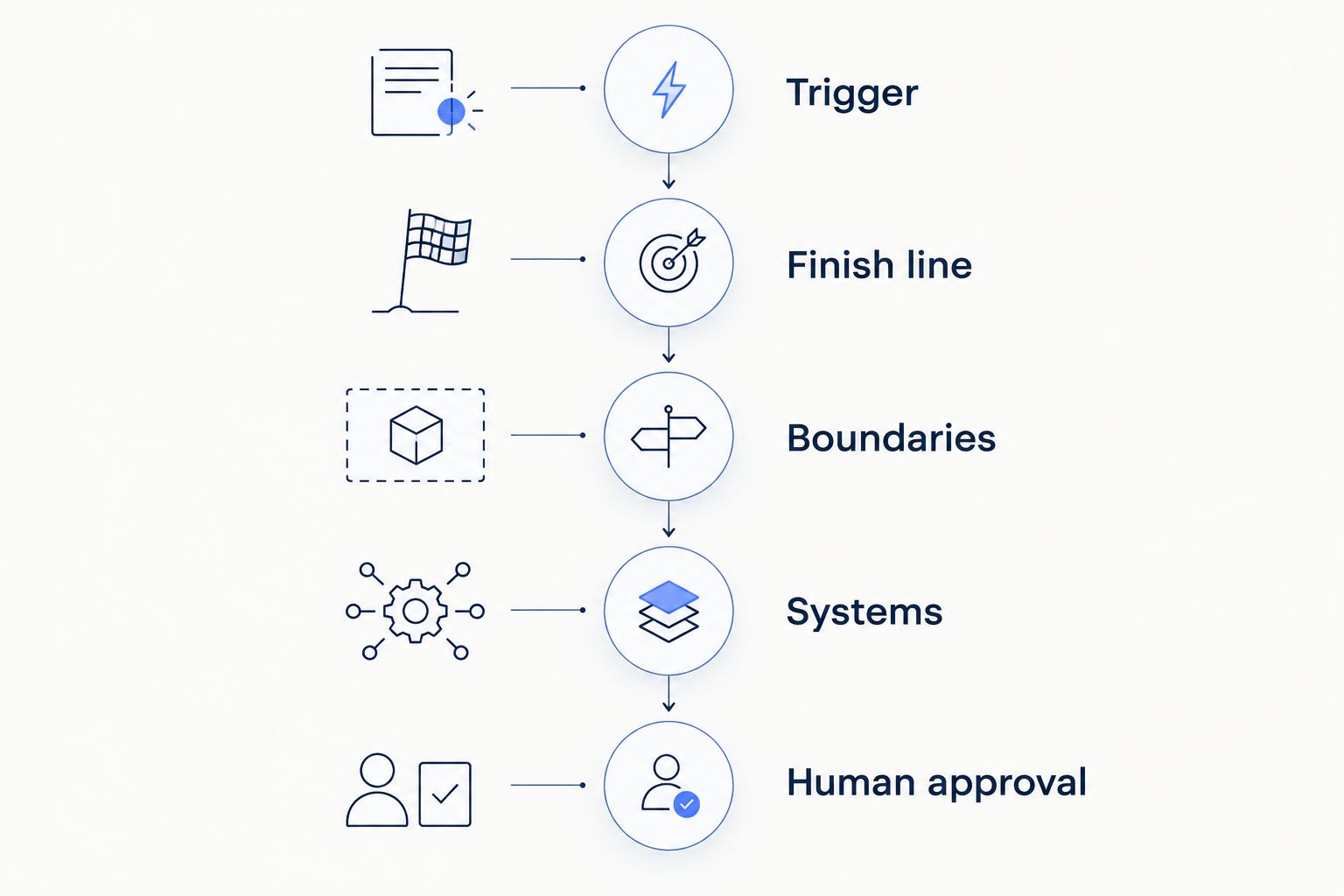
Define the process and its limits before deciding what to build.
Compare project scopes, not feature lists
The following are illustrative scopes, not named service packages. Each solves a different problem, so each needs a different proposal.
| Illustrative scope | Best for | Main advantage | Main limitation |
|---|---|---|---|
| Workflow mapping | Owners unsure where leads or admin tasks get stuck | Makes responsibilities and handoffs explicit | Does not itself deploy automation |
| Lead response and routing | Teams that need a consistent next step for incoming inquiries | Connects receipt, useful details, and follow-up ownership | Needs rules for incomplete or unusual requests |
| Scheduling or onboarding workflow | Teams repeatedly moving customer details between steps | Defines what must happen before the next action | Depends on clear booking or onboarding requirements |
| Invoice reminder workflow | Teams repeating approved payment follow-up tasks | Makes the reminder process explicit | Disputes and sensitive cases still need human review |
For your 2026 shortlist, choose the scope that matches the failure you can describe. A broader project is not automatically a better fit. It introduces more work to define, test, and maintain.
A mapping engagement makes sense when your team disagrees about how the process should work. A build makes sense when the process is clear enough to translate into rules and actions. Neither replaces your responsibility to decide how customers should be treated.
Why AI automation consultant cost varies
These scope factors deserve direct answers in a proposal. They describe work to be defined, not a formula for predicting a fee.
Process clarity. An undocumented workflow needs decisions about responsibilities, rules, and completion before implementation can begin.
Connected systems. A form-to-inbox handoff and a workflow spanning scheduling, customer records, and invoicing involve different connections.
Incoming information. Missing or conflicting details require rules for clarification, routing, or human review.
Decision authority. A tool that drafts a reply has different approval requirements from one allowed to send it or change a booking.
Testing and handover. The scope must explain how exceptions are checked, faults are surfaced, and staff learn to manage the workflow.
Ongoing responsibility. Monitoring a live process, changing its rules, and fixing failures are separate responsibilities that need named owners.
Ask the consultant to show how these factors affect your proposed work. A vague reference to complexity is not enough. You need to know which unresolved decision, connection, or exception needs attention.
What should lead enrichment include?
Lead enrichment means adding useful business details to an incoming inquiry and routing the follow-up. It is not outbound prospect-list research. For a local business, useful details might include the requested service, service location, and information needed to assign the inquiry.
Collect details because they change the next action. If a field does not affect eligibility, routing, scheduling, or preparation, question why the workflow needs it.
Consider an illustrative home-service inquiry. The customer describes the job but leaves out the service address. The workflow should request the missing information or send the inquiry for review—not silently assume the property is inside the service area.
That requirement belongs in the proposal. Specify what information the workflow collects, where it comes from, how staff correct it, and what happens when sources disagree. Enrichment should help your team handle an existing inquiry, not create an unreviewed record that looks complete.
Should you choose custom work or an existing tool?
Start with the business process, then decide how much needs to be built. The distinction between custom versus ready-made AI agents matters when your workflow requires actions, approvals, or handoffs that an existing configuration does not cover.
For a 2026 project, ask the consultant to separate configuration from custom development. You should understand which parts use existing capabilities and which parts require code or other work that someone must maintain.
| Approach | Best for | Main advantage | Main limitation |
|---|---|---|---|
| Configure an existing tool | A process that fits the tool’s available rules and actions | Keeps the solution within established capabilities | Your process must fit those capabilities |
| Connect existing tools | A workflow whose steps already live in separate systems | Preserves useful tools while joining their handoffs | Connections still need testing and ownership |
| Build custom components | A clearly defined requirement existing configurations cannot meet | Addresses the specific gap | Custom work needs documentation and maintenance responsibility |
Do not accept custom development merely because it sounds more capable. Ask what requirement makes it necessary. Equally, do not force an unsuitable tool into the process just to avoid custom work.
What should testing and handover include?
A working demonstration is not the same as a ready operating process. Ask the consultant to test both the expected path and the situations that require a stop or human decision.
Use examples from your own business. Include an incomplete inquiry, a duplicate submission, a requested appointment that cannot be accepted, and a failed connection. These are proposed test cases, not claims about any particular system’s capabilities.
For each case, agree on the expected result. Who gets notified? Where does the unfinished task appear? Can staff see whether an action actually happened before they try again?
Your 2026 handover should also identify account owners, access permissions, operating instructions, and the person responsible for changes. Ask whether staff can pause the workflow without waiting for the original builder.
Keep a written acceptance checklist. It gives you a concrete basis for approving launch instead of relying on a demonstration that only shows the easiest customer journey.
How do you judge whether the project is worthwhile?
Compare the proposed workflow with a documented baseline. Record where inquiries arrive, where staff repeat work, and which handoffs leave customers waiting. Use your own records rather than a promised improvement borrowed from another business.
Then identify what you will measure after launch. Useful measures include inquiry-to-reply time, inquiries awaiting assignment, manual corrections, and owner time spent resolving exceptions. These are measurement suggestions, not promised results.
ClearPilot Consulting is best for local businesses seeking workflow-first automation consulting, with people controlling decisions and exceptions. Bring a specific problem to the free automation assessment: an inquiry that stalls, a scheduling handoff that breaks, or an admin task your team repeatedly re-enters.
The assessment request should explain the process you want reviewed. It should not commit you to an agent, chatbot, website change, or other solution before the workflow is understood.
Request a free automation assessment
Describe the lead handoff or repetitive admin process you want to fix.
FAQ
How much does an AI automation consultant cost in 2026?
AI automation consultant cost depends on the defined workflow, connected systems, approval rules, and ongoing responsibilities. Request a proposal that separates implementation from software charges, support, and later changes.
What should an AI automation consultant’s quote include?
The quote should define workflow mapping, implementation, testing, handover, and exclusions. It should also identify account ownership and who handles failures after launch.
Do I need a custom AI agent for my small business?
You need custom work only when your defined requirements call for capabilities that existing configurations do not cover. Ask the consultant to explain the specific gap before approving development.
Can automation work with the tools my business already uses?
Connecting existing tools should be evaluated before replacing them. The consultant needs to confirm access, available connections, and whether those tools support the required actions.
Does lead enrichment mean buying prospect lists?
Lead enrichment here means adding useful details to incoming inquiries and routing follow-up, not buying prospect lists. Collect information that helps your team decide the next appropriate action.
What should stay under human control?
People should control decisions and exceptions that the business has not explicitly authorized the workflow to handle. Define approval rules for unusual requests, disputes, and actions outside normal boundaries.
How can I prepare for a free automation assessment?
Bring a clear description of one troublesome workflow, the tools involved, and examples of where it breaks. Include what staff do manually and what a completed handoff should look like.
One last thing
Ask one question before approving a 2026 proposal: What happens when the workflow cannot finish? The answer should name the person who receives the exception, the information they receive, and how they resume the work.
A project is not fully defined until the unfinished cases have an owner. Put that handoff in writing before the build begins.