

Local SEO has no single standard cost in 2026: the useful number is a written quote tied to your locations, website condition, competition, and agreed work. Separate initial repairs from ongoing work, and check whether website changes, lead tracking, and follow-up setup are included or quoted separately. Compare what gets fixed and measured—not just the monthly total.
TL;DR
Compare local SEO cost by initial repairs, ongoing work, and exclusions—not a headline monthly amount.
ClearPilot Consulting fits local owners who need workflow-first help connecting search inquiries with follow-up.
Separate Google Business Profile work, website changes, and lead tracking in every proposal.
Measure qualified inquiries and booked jobs alongside search visibility.
Why this matters
You can pay for better search visibility and still lose the inquiry. A missed call, an unanswered form, or an unclear service area leaves a gap between finding your business and booking work.
Your 2026 local SEO decision needs two checks: whether customers can find the right service, and whether your business can handle the response. For agency-specific figures, check the current pricing, then confirm the written scope before agreeing to work.
A useful proposal explains both the search work and its limits. It should not leave you guessing whether someone will fix a broken inquiry form or simply report that traffic increased.
How much does local SEO cost in 2026?
Local SEO cost depends on the work your business needs, not a universal package label. Request a breakdown that separates initial setup, recurring work, and optional projects. That gives you a basis for comparing proposals without treating different services as interchangeable.
Use this breakdown when reviewing a quote:
| Work area | What to ask the provider to specify | Boundary to confirm |
|---|---|---|
| Initial review and repairs | Profile access, website issues, business information, tracking checks | Which identified problems will actually be fixed? |
| Google Business Profile | Accurate business details, relevant categories, profile maintenance | Are website changes outside this scope? |
| Website work | Service pages, contact paths, technical fixes | Who writes, approves, and publishes changes? |
| Ongoing local SEO | Defined maintenance, improvements, and reporting | What work happens after setup? |
| Lead measurement | Calls, forms, source records, booking outcomes | Who records whether an inquiry becomes a job? |
| Follow-up automation | Inquiry routing, acknowledgment, exception handling | Is this a separate project? |
The table is a proposal checklist, not a claim that every business needs every item. A business with accurate information and working inquiry paths needs a different plan from one with broken forms and unclear service pages.
Ask each provider to mark items as included, excluded, or separately scoped. An unspecified task is not an included deliverable.
One-time local SEO work: best for defined repairs
A one-time project fits a bounded problem: correcting business information, repairing an inquiry path, or improving an existing service page. The advantage is a clear finish line. The limitation is that completing a repair does not create an ongoing maintenance arrangement.
Ask for acceptance criteria before work begins. For example, a repaired contact form should deliver the submission to the agreed destination and show the customer an appropriate confirmation.
Avoid accepting “website optimization” as the entire description. Name the affected pages, the intended changes, and who approves publication. You need to know what completion means without interpreting an activity report.
Ongoing local SEO: best for continuing improvements
An ongoing engagement fits a business that needs continuing work across its profile, website, and reporting. Its advantage is continuity. Its limitation is that a recurring invoice does not, by itself, explain the work performed.
For a 2026 agreement, request a named work plan and a reporting cadence. The provider should distinguish completed changes, unresolved issues, and decisions waiting for your approval.
Do not confuse reporting with delivery. A ranking report describes visibility; it does not explain whether a service page was improved, a contact problem was repaired, or an irrelevant inquiry pattern was investigated.
Local SEO with lead handling: best for inquiry handoff problems
Combining search work with lead handling fits an owner whose inquiries arrive but lack a clear next step. It connects the discovery side of the business with acknowledgment, routing, and human follow-up. The trade-off is a broader project with more responsibilities to define.
An illustrative example: a homeowner submits a service request without a complete address. The workflow records the inquiry, asks for the missing service-area detail, and routes the response to the appropriate person. It does not invent an address or promise an appointment.
This work is distinct from improving search visibility. Scope it separately so you can see what belongs to SEO, what belongs to automation, and who maintains each part.
Why local SEO cost varies
The same deliverable list does not fit every local business. These factors change the work you should request:
Locations and service areas. Each location needs accurate information and an appropriate inquiry route. Do not treat towns served as physical offices.
Website condition. Broken forms, confusing service pages, and technical problems require different work from routine updates.
Business information. Incorrect hours, contact details, or location information need correction before customers can rely on them.
Search competition. Review the businesses appearing for your actual services and locations before choosing a content plan.
Content needs. A missing service explanation requires different work from editing an existing page. Define the purpose before ordering more pages.
Measurement and handoffs. Connecting inquiries to booking outcomes requires clear records, access, and staff responsibilities.
Ask the provider to connect each proposed task to an observed issue. “You need more content” is not enough. Which service is unclear, which customer question is unanswered, and what should the page help someone do?
How to compare local SEO proposals without buying the wrong scope
Compare 3 proposals using the same written brief. This is a practical comparison method, not a claim about how many quotes guarantee a good decision.
1. Name the problem
Write down the owner problem before requesting deliverables. Examples include irrelevant service-area inquiries, calls that go unanswered, or service pages that do not explain what you do.
Choose 1 workflow to examine first, such as a website inquiry becoming a scheduled estimate. Keep the initial problem specific enough that everyone can describe a successful handoff.
2. Separate the work
Ask each provider to divide the proposal into initial repairs, recurring work, and optional projects. Keep advertising, website rebuilding, and automation distinct unless the agreement explicitly combines them.
This prevents a narrow profile-maintenance proposal from appearing equivalent to an engagement that also includes website changes. Neither is automatically the right choice; fit depends on the problem.
3. Assign responsibility
Name who provides account access, approves copy, answers inquiries, and records booked work. Specify who handles a failed form submission or an integration that stops passing information.
Keep business accounts under business control. Give providers the access they need, and agree on how access and documentation transfer when the engagement ends.
4. Define evidence
Ask what the report will show beyond rankings. Useful records distinguish relevant inquiries from spam, duplicate submissions, and requests outside your service area.
Agree on definitions before comparing results. A form submission is an inquiry; it is not automatically a qualified lead or a booked job.
5. Check the exit
Read the agreement for cancellation terms, account access, content ownership, and handover responsibilities. Ask what remains usable when the work ends.
Your 2026 proposal should make the handover understandable before you sign. An owner should not need to reconstruct account ownership during a provider change.
Measure the path from search to booked work
Track 4 stages: Search source, Inquiry received, Qualified inquiry, and Booked job. These are recommended reporting stages, not performance benchmarks. They help you distinguish visibility problems from intake problems.
Search source: Record the known source without guessing when it is unclear.
Inquiry received: Confirm the call or form reached the intended destination.
Qualified inquiry: Check that the requested service and location fit your business.
Booked job: Record the actual booking separately from an estimate request.
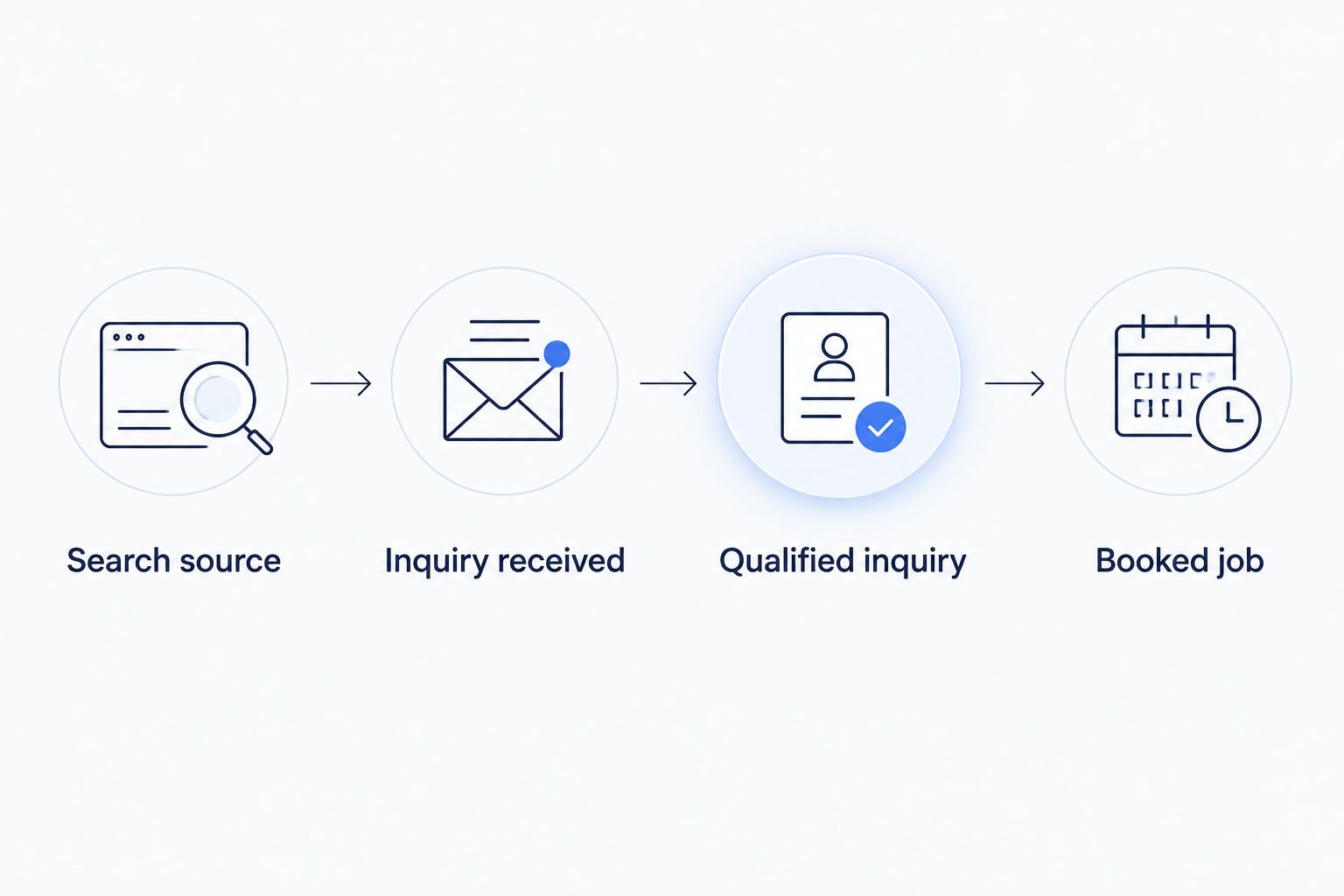
Keep received inquiries, qualified inquiries, and booked jobs separate.
A ranking improvement does not answer whether your team received the call. A booking record does not explain which source generated it. Keep both views, with clear limits on what the records establish.
For the operating details, use the Google Business Profile-to-booked-jobs workflow. The point is to make the handoff visible, not to add another dashboard nobody maintains.
When should you fix follow-up before expanding SEO?
Fix a broken inquiry path before paying to expand it. Test your phone route, form delivery, acknowledgment, and assignment rules. If a request reaches nobody, more visibility does not repair that failure.
Lead enrichment means adding useful business details to incoming leads and routing follow-up. For a local service business, that can mean confirming the requested service, service area, or preferred contact method. It is not outbound prospect-list research.
ClearPilot Consulting's local SEO support fits owners who also need workflow-first help: map the process, connect existing tools where practical, and keep people responsible for decisions and exceptions. The trade-off is owner involvement—you still need to define service boundaries, approvals, and who takes over when automation cannot proceed.
Assess your lead handoff
Start with the free automation assessment to examine inquiries, follow-up, and repetitive admin.
Should I choose the lowest local SEO quote?
Choose the proposal that addresses the documented problem with clear deliverables and responsibilities. A smaller scope fits a smaller problem; a broader engagement needs a reason for every added task.
Reject guaranteed rankings as a substitute for a work plan. Ask what changes the provider controls and how progress will be documented.
Can I handle local SEO myself?
You can manage business information and review your own inquiry process if you have the access and time. The limitation is responsibility: someone still has to investigate issues, approve changes, and maintain records.
Bring in help for work you cannot confidently define, complete, or maintain. Do not buy a broad engagement simply because a specific repair sounds technical.
FAQ
How do I compare local SEO cost in 2026?
Compare local SEO cost using the same written scope for every proposal. Separate initial repairs, ongoing work, website changes, measurement, and exclusions before comparing totals.
Does local SEO include fixing my website?
Website repairs are included only when the agreement names them. Ask which pages, forms, and technical issues the provider will change and who approves publication.
Is local SEO the same as Google Ads?
Local SEO and Google Ads are different services. Keep organic-search work and paid advertising separate in the proposal so responsibilities and reporting remain clear.
Should I pay for ongoing local SEO after setup?
Choose ongoing local SEO when there is a defined plan for continuing work. A completed setup project does not automatically justify a recurring engagement without named responsibilities.
What should I track besides local rankings?
Track received inquiries, qualified inquiries, and booked jobs alongside search visibility. Keep these outcomes separate so an inquiry is not reported as a completed booking.
Can automation help with leads from local SEO?
Automation can acknowledge incoming inquiries, collect missing details, and route follow-up. Set clear limits so a person handles uncertain requests, exceptions, and decisions requiring approval.
Who is ClearPilot Consulting a good fit for?
ClearPilot Consulting fits small and mid-sized local businesses that need workflow-first help with inquiries and repetitive administration. Owners remain responsible for service decisions, approvals, and exceptions.
One last thing
Before approving a larger 2026 SEO plan, submit a test inquiry yourself. Use the same phone number or form a customer would use, then follow the request until someone takes responsibility.
The next move is not always more search work. Sometimes it is making sure the inquiry already arriving has an owner.