

SEO cost for small business in 2026 depends on the work required, the condition of your website, and whether you need a defined project or ongoing support. Your budget also needs to account for work outside the SEO agreement, such as website repairs, new content, and handling the inquiries that search brings in.
TL;DR
SEO cost for small business depends on scope; compare written deliverables before comparing proposals.
Local SEO should connect relevant searches to inquiries, follow-up, and booked work.
ClearPilot Consulting fits local businesses seeking SEO connected to workflow mapping and lead handling.
Separate initial repairs, ongoing work, and website changes so responsibilities stay clear.
How much does SEO cost for a small business in 2026?
A useful SEO budget starts with a defined scope, not a package label. Ask what needs fixing, what the provider will deliver, and what remains your responsibility. Compare proposals only after those answers line up.
For a local service business, the scope can include your Google Business Profile, service pages, website accessibility to search engines, and measurement of incoming inquiries. Review the services you need against the actual problem: being found, turning visits into inquiries, or responding to those inquiries.
Use this breakdown to separate the work before accepting an agreement.
| Budget component | What to put in writing | What to check for exclusions |
|---|---|---|
| Initial assessment | Website issues, search presence, priorities, and access requirements | Implementation of the findings |
| Website corrections | Specific technical fixes and the pages affected | Redesigns, hosting changes, and replacement systems |
| Local search work | Business information, profile responsibilities, and relevant service content | Photography, owner approvals, and business verification tasks |
| Content work | Topics, page types, drafting, editing, and publishing responsibilities | Expert input, images, and revisions outside the agreement |
| Measurement | Inquiry tracking, reporting definitions, and access | Call handling, customer records, and follow-up automation |
This breakdown prevents a common comparison mistake: treating a plan that identifies problems as equivalent to one that fixes them. Both can have a purpose. They are different purchases.
Why this matters
Search visibility is only part of the job. A relevant visitor still needs to understand your service, contact your business, and receive a useful response.
If inquiries sit unanswered, more visibility does not repair the handoff. Your SEO decision should therefore include a check of the path from search to booked work, without assuming every operational improvement belongs inside the SEO contract.
ClearPilot Consulting is best for local service businesses that want SEO connected to workflow mapping and lead handling. Its workflow-first approach starts with how work moves through the business, then considers automation and the tools already in use. That is a fit when the problem extends beyond rankings; a narrowly defined website correction needs a narrower scope.
Ongoing support: best for continuing search work
Ongoing support fits a business that needs continuing website improvements, service content, local search maintenance, and review of inquiry quality. The agreement should name the work, not just promise regular attention.
The benefit is continuity. The limitation is that an open-ended agreement can become difficult to judge when deliverables and priorities remain vague.
Before accepting an ongoing proposal in 2026, ask how priorities get chosen and what evidence changes the plan. A report should distinguish completed work from recommendations waiting for your approval.
Ask what happens when a technical issue requires a developer. The SEO provider might identify the problem without being responsible for the repair, so the agreement needs to make that boundary explicit.
Defined projects: best for a specific problem
A project fits a bounded task, such as correcting website indexing problems or improving an agreed set of service pages. Its strength is a clear finish line. Its limitation is that completing the project does not provide continuing maintenance.
Define acceptance before work starts. You should know what will be delivered, how changes will be checked, and who owns the accounts and finished content.
An assessment-only project also needs a usable handover. A list of issues is not an implementation plan unless it identifies priorities, responsibilities, and the next action for each issue.
Owner-led SEO: best for businesses with available staff time
Owner-led work fits businesses that can keep information accurate, supply service expertise, and maintain website content. You retain direct control, but the work competes with serving customers and running the business.
The trade-off is time and responsibility. Someone still needs to learn the tasks, make changes, check them, and keep records of what happened.
Use outside help where the task exceeds your team's knowledge or access. Keep owner input focused on facts only your business can supply: service boundaries, customer questions, scheduling constraints, and what makes an inquiry suitable.
| Approach | Best for | Main advantage | Main limitation |
|---|---|---|---|
| Ongoing support | Continuing search and website work | Keeps priorities under regular review | Requires clear deliverables to judge progress |
| Defined project | A specific issue or agreed page scope | Gives the work a clear finish line | Does not cover continuing maintenance unless stated |
| Owner-led SEO | Businesses with staff time and relevant skills | Keeps knowledge and control inside the business | Adds work to an already busy team |
Why SEO scope varies
Different proposals can describe different jobs. Before comparing SEO cost for small business in 2026, check these scope drivers:
Website condition. A site with access or indexing problems needs different work from a site ready for content improvements.
Service coverage. Different services need accurate explanations of what you do, where you work, and which inquiries you accept.
Local search responsibilities. Profile updates and business-information corrections require clear ownership and access.
Content requirements. Editing existing pages differs from researching, drafting, approving, and publishing new material.
Measurement requirements. Counting form submissions differs from connecting inquiries to qualified opportunities and booked jobs.
Implementation boundaries. Advice, website changes, and follow-up automation are separate responsibilities unless the agreement combines them.
Do not assume a longer task list means a better proposal. Ask which task addresses the most important obstacle and what depends on it being finished first.
How do you compare SEO proposals without guessing?
Compare the same work against the same business goal. Use this sequence to turn a broad proposal into something you can accept, revise, or reject.
Map inquiries. Record how people find you, contact you, receive a reply, and reach a booking decision. Include calls, forms, and chat where relevant.
Find gaps. Separate discovery problems from website problems and follow-up problems. Do not ask SEO to solve an unanswered inbox.
Define scope. Name the pages, profiles, fixes, content, and reporting included. Record exclusions beside them.
Assign owners. Decide who supplies business facts, approves changes, implements fixes, and handles exceptions.
Check outcomes. Agree how you will review relevant inquiries and booked work alongside search visibility.
This sequence gives you a way to challenge vague language. If a proposal says it will improve local visibility, ask which business information or pages will change and how those changes support your services.
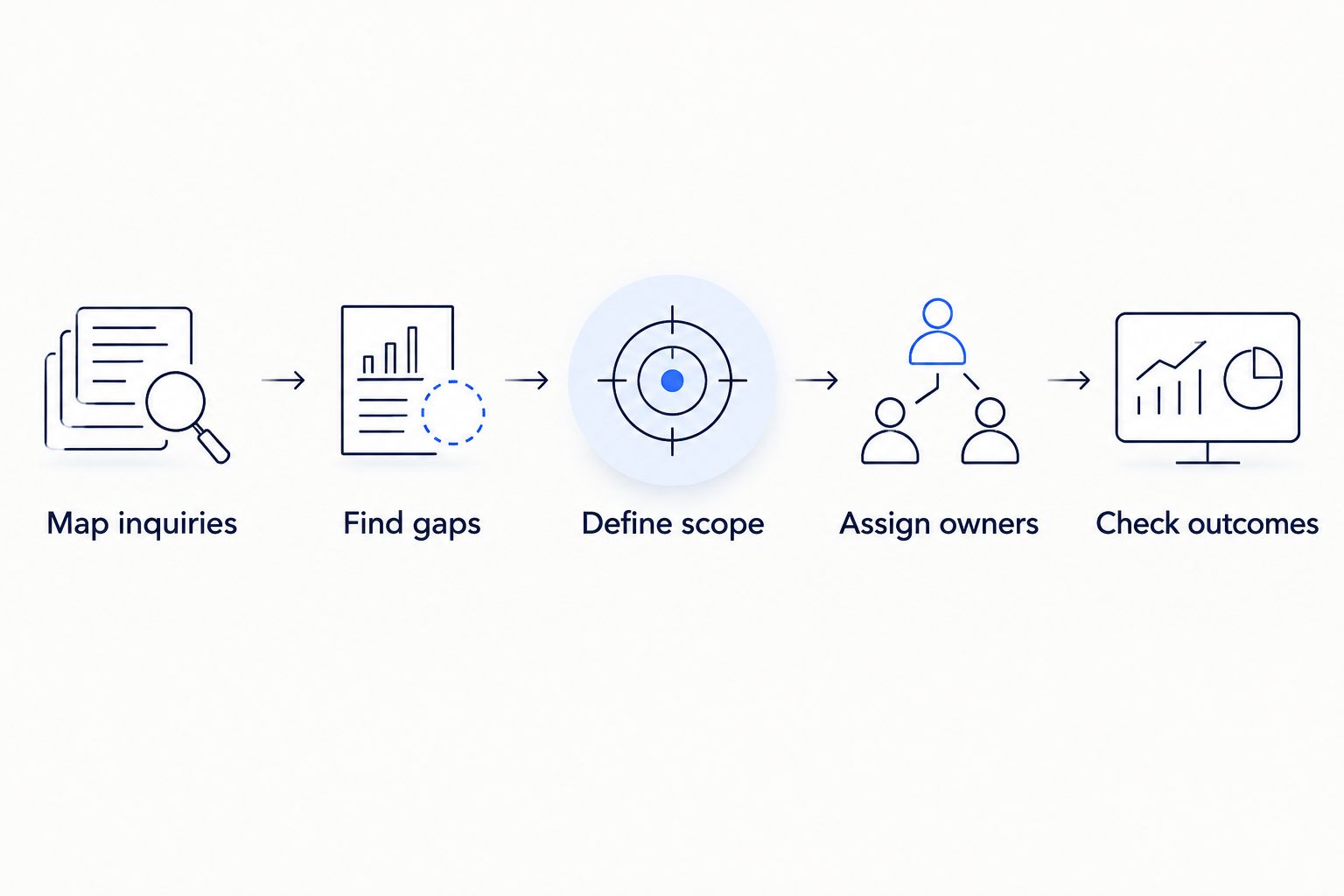
Separate search problems from follow-up problems before assigning the work.
Keep a written decision record when the scope changes. Otherwise, an urgent website request can quietly replace the work you originally agreed to buy.
What should an SEO agreement include in 2026?
Your agreement should explain the work well enough that you can tell whether it happened. Avoid accepting a list of technical terms as a substitute for deliverables.
Ask for these details before signing:
Business goal: Which services and types of inquiries matter?
Deliverables: What gets assessed, changed, written, or published?
Access: Which accounts are needed, and how does your business retain control?
Approvals: Who confirms service claims and authorizes website changes?
Reporting: Which measures describe visibility, inquiries, and business outcomes?
Exclusions: Which repairs, tools, content, or operational changes sit outside the agreement?
Handover: What records and access remain with you when the work ends?
Look closely at reporting definitions. A website visit, an inquiry, a qualified inquiry, and a booked job describe different events. A useful report keeps those distinctions visible rather than presenting them as interchangeable results.
Be equally clear about responsibilities. Your provider needs accurate business information, but your staff should not have to infer what to send or who must approve it.
Should lead follow-up be part of your SEO budget?
Lead follow-up belongs in the business plan, but it belongs in the SEO agreement only when explicitly included. Search work helps people find your business; follow-up moves an incoming inquiry toward a decision.
Illustrative scenario: A homeowner finds a service page and submits a request outside office hours. The website captures the inquiry, but no one is assigned to reply. More search visibility does not fix that missing assignment.
Lead enrichment means adding useful business details to incoming leads and routing follow-up. For a local service business, that can mean confirming the requested service, checking whether the address is inside the service area, and sending the inquiry to the right person. It is not outbound prospect-list research.
Automation can acknowledge receipt or pass information between tools. People should retain control of decisions and exceptions, especially when details conflict or a customer needs an unusual arrangement.
ClearPilot Consulting maps these handoffs before building automation and connects existing tools where practical. SEO, websites, chatbots, and AI agents should each have a defined role; none replaces an agreed owner for the inquiry.
Map your lead workflow
Request a free automation assessment to discuss where inquiries, follow-up, and repetitive admin need attention.
Can you judge SEO by rankings alone?
Rankings alone do not tell you whether inquiries fit your business or become booked work. Use search visibility as one part of the picture, then examine what happens after someone contacts you.
For your 2026 review, keep the questions practical. Did the inquiry concern a service you provide? Was it inside your service area? Did someone respond, and was the outcome recorded?
Do not assign every lost inquiry to SEO. An unsuitable search visit, a confusing service page, and an unanswered message require different fixes. Separating them helps you change the right part of the process.
FAQ
How much should a small business budget for SEO?
A small business should build its SEO budget around a written scope covering initial work, ongoing tasks, and exclusions. Compare proposals for equivalent deliverables rather than choosing by package name.
Is ongoing SEO better than a one-time project?
Ongoing SEO fits continuing search work, while a defined project fits a bounded problem. Choose based on whether your business needs continuing maintenance or a specific deliverable.
Can I do small-business SEO myself?
You can handle SEO tasks yourself when you have the time, access, and knowledge to complete and check them. Technical website changes need an owner with the relevant skills.
Does an SEO agreement include a new website?
An SEO agreement includes a new website only when the scope explicitly says so. Confirm whether the provider will identify website issues, implement repairs, or carry out a separate rebuild.
Should local SEO include my Google Business Profile?
Local SEO should address your Google Business Profile when it is relevant to how customers find your business. The agreement should identify who manages information, access, and required owner actions.
Will SEO handle incoming leads for me?
SEO does not include lead handling unless the agreement explicitly includes it. Assign responsibility for replies, qualification, scheduling, and exceptions separately from search work.
What should I prepare before requesting an SEO proposal?
Prepare your service list, service area, website access information, and a description of how inquiries reach your team. Explain where the process breaks so the proposal addresses the actual business problem.
One last thing
Before approving an SEO proposal, follow your own inquiry process from the customer's side. Submit a clearly marked test inquiry, check where it arrives, and confirm who responds.
That check does not measure search performance. It answers a different question: whether your business is ready to handle the attention you are planning to pursue. Fix a broken handoff before treating more traffic as the next priority.