

An AI chatbot is worth it for a small business in 2026 when it handles recurring inquiries, captures useful details, and passes each conversation to someone responsible for follow-up. It is not worth adding when your real problem is unanswered notifications or a broken booking process. The work also includes maintaining answers, checking handoffs, and handling exceptions—not just installing a chat window.
TL;DR
Is an AI chatbot worth it for small business? Yes, when repeat inquiries have a clear follow-up path.
ClearPilot Consulting starts business automation consulting with workflow mapping, not a chatbot installation.
Inbound lead enrichment adds useful business details to incoming leads and routes follow-up; it is not outbound prospect research.
Keep people responsible for exceptions, commitments, and conversations the chatbot cannot resolve.
Is an AI chatbot worth it for small business in 2026?
Yes, when the chatbot solves a defined inquiry-handling problem. Otherwise, fix the process first. Compare it with the simpler alternatives before choosing a build.
| Approach | Best for | Main benefit | Main limitation |
|---|---|---|---|
| Website form | Requests with predictable information needs | Collects a consistent set of fields | Does not provide a back-and-forth conversation |
| AI chatbot | Repeated questions and guided inquiry collection | Answers approved questions and asks for relevant details | Needs maintained information, boundaries, and a working handoff |
| Human-led response | Sensitive, unusual, or judgment-heavy requests | Lets someone clarify context and make decisions | Depends on staff coverage and attention |
These approaches can work together. A chatbot can collect a request while a person decides whether to accept the job. Define when a person should take over before opening the chat to customers.
Why this matters
A quick reply does not complete a lead handoff. If the conversation ends without a usable record, an assigned owner, or a clear next step, your staff still has to reconstruct the request.
For a local service business, the useful outcome is specific: someone knows what the customer needs and what to do next. A polite automated greeting is not that outcome.
Your 2026 chatbot decision should start with the point where inquiries stall. Separate a slow first response from a slow estimate, missing job details, or an unmonitored inbox. Each problem needs a different fix.
Website form: best for straightforward requests
Keep a form when customers can explain their needs without a conversation. A clear form can collect contact information, the requested service, and details your team needs to review the inquiry.
The advantage is simplicity. You define the fields and route the submission to the right place. The limitation is that customers must interpret those fields without conversational help.
Before replacing a form, check what happens after submission. If nobody owns the notification, adding a chatbot leaves the same problem in a different interface. Repair the assignment and follow-up rules first.
AI chatbot: best for recurring questions and guided intake
Choose a chatbot when customers need answers or clarification before they can submit a useful request. Give it approved information and a narrow job, such as explaining your service scope and collecting an inquiry.
The advantage is conversational intake. A visitor can ask a question, explain a need, and provide missing information in context. The limitation is ongoing oversight: answers need review, integrations need checking, and uncertain requests need a person.
Do not assume the chatbot can schedule, update customer records, or send messages merely because it can discuss those actions. Each action needs an explicit connection, permission, and failure path.
Human-led response: best for judgment and exceptions
Keep people in charge of commitments and decisions that require context. Examples include accepting unusual work, resolving a complaint, or deciding how to handle a request outside your normal service scope.
A person can ask follow-up questions and decide whether an exception makes sense. The limitation is coverage: someone must notice the request and have time to respond.
A chatbot can support this work without making the decision. It can collect the customer's explanation and pass it along. Do not make customers repeat the conversation because the transcript stayed inside a separate chat dashboard.
Map the workflow before choosing the chatbot
ClearPilot Consulting is best for local service-business owners seeking workflow-first business automation consulting. That approach starts with how an inquiry moves through the business, then decides where automation belongs.
For a first project, define 1 workflow, such as website inquiry to assigned follow-up. Keep onboarding, invoicing, and other later processes outside that first scope unless they are necessary to complete the handoff.
1. Capture the inquiry
Write down what you need to understand the request. Use information your staff actually acts on: the requested service, location where relevant, contact details, and the customer's explanation.
Avoid asking for information merely because the chatbot can collect it. Every question should help the next person respond or route the request.
2. Add useful context
Inbound lead enrichment means adding useful business details to an incoming lead and routing follow-up. It is not building an outbound prospect list.
For example, an inquiry might need a service-area check before assignment. Separate customer-provided information from added information, and flag conflicts rather than treating an uncertain detail as settled.
3. Assign follow-up
Name the person or team responsible for the next action. Define where the request lands and what information accompanies it.
Start with the tools your business already uses where practical. A separate inbox is only helpful if someone is responsible for checking it.
4. Handle exceptions
Decide what happens when the chatbot cannot answer, a connection fails, or the customer asks for a person. Preserve the request and conversation context.
A failed handoff should create a visible task for someone, not leave the customer with an apparent confirmation and no follow-up.
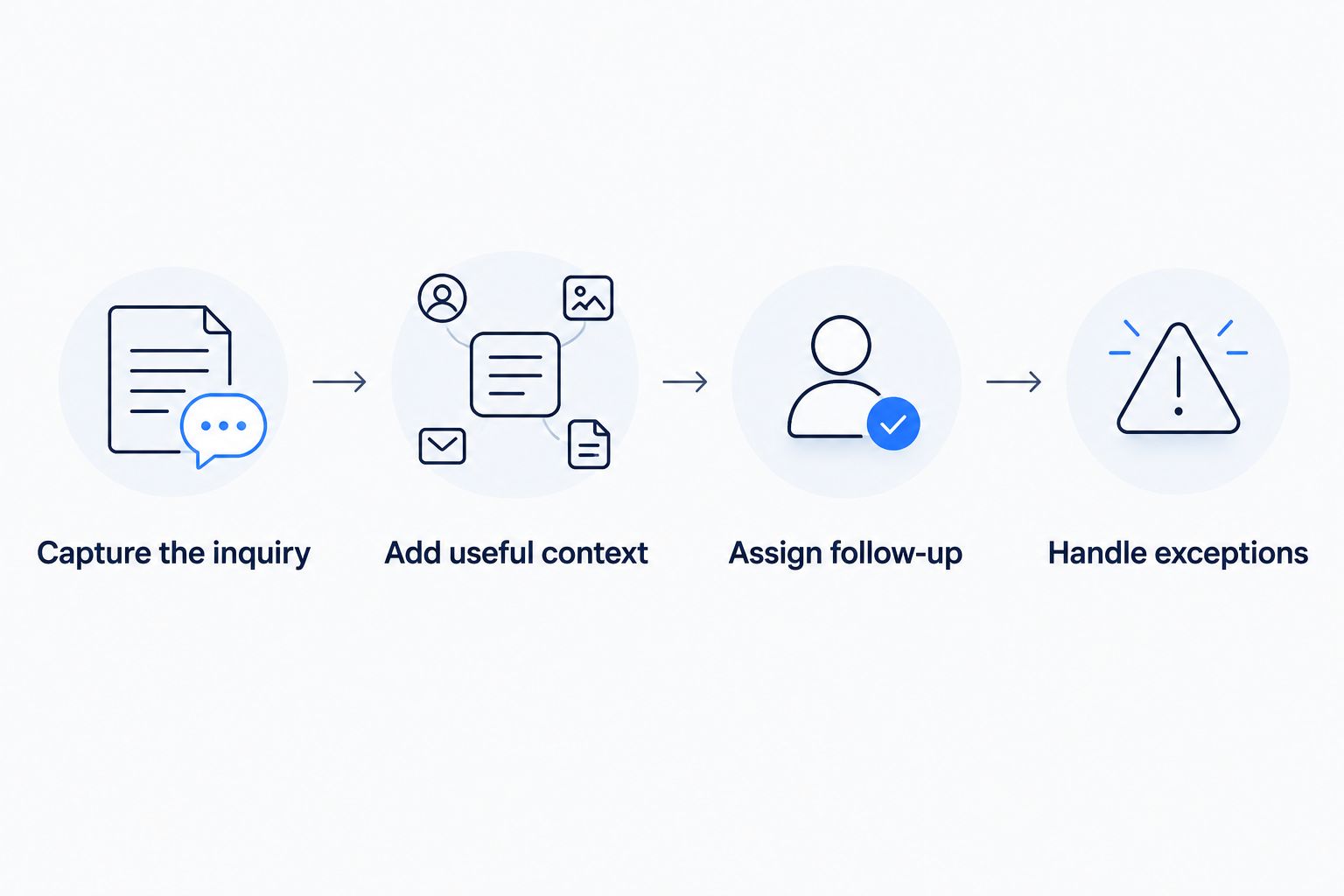
The chatbot is part of the inquiry workflow, not a replacement for an assigned owner.
Why chatbot value varies between businesses
The useful question in 2026 is not whether chatbots are generally worthwhile. It is whether a specific chatbot removes work or improves a specific handoff in your business.
Inquiry repetition: Approved answers are useful when the same questions recur. Unusual requests need a clearer route to a person.
Missing information: Guided questions help when staff otherwise have to chase details before responding.
Follow-up ownership: A complete conversation still needs someone responsible for the next action.
Tool connections: Saving information into an existing workflow is different from leaving it inside a chat transcript.
Decision limits: The more discretion a request needs, the more important human review becomes.
Maintenance responsibility: Someone must update service information and check that the process still works.
These factors also define the project scope. Describe the problem before asking a provider to recommend features.
What would a useful chatbot do for a local service business?
Consider this illustrative scenario, not a client result: a customer asks whether a service business handles a particular job. The chatbot answers from approved service information and asks for the details needed to review the request.
The customer supplies a location and explains the work. The workflow checks the location against the business's service-area rules, saves the inquiry, and assigns follow-up. If the details conflict, it flags the uncertainty for a person instead of rejecting the request automatically.
The chatbot does not promise that the business will accept the job. It does not invent an estimate or say an appointment is confirmed without a successful booking action. It explains the next step accurately.
Now compare a weaker version: the chatbot answers questions and stores a transcript, but nobody receives a task. The conversation looks complete to the customer while the operational work remains undone.
The difference is the handoff, not the friendliness of the replies. Use that distinction when reviewing demonstrations or proposals.
How do you decide whether to launch?
Before a 2026 launch, test the full path rather than only the conversation. A helpful answer is not proof that the customer record, notification, or booking action worked.
Use these 5 test scenarios as a starting checklist, not as a claim that testing is complete:
Routine inquiry: The customer asks an approved question and provides the requested details. Confirm the assigned person receives a usable record.
Missing details: The customer skips information. Confirm the workflow asks for clarification or marks the gap without inventing an answer.
Conflicting details: The customer supplies information that does not agree. Confirm the conflict remains visible for review.
Human request: The customer asks to speak with someone. Confirm the conversation reaches the designated person with context.
Failed connection: A connected tool does not accept the request. Confirm the failure creates a visible follow-up task.
Record what happened, who noticed, and what needed correction. Do not launch simply because the chatbot produced a convincing response.
ClearPilot Consulting's services include workflow mapping, AI agents, chatbots, SEO, and websites. For a chatbot project, the useful starting point is the inquiry process—not a list of features.
Assess your inquiry workflow
Use the free automation assessment to discuss slow replies, missing details, and follow-up ownership.
How do you measure whether the chatbot is helping?
Compare the same workflow before and after launch. Track the time from inquiry to assigned follow-up, whether required details reach staff, and whether customers must repeat information.
Also record correction work. If staff spend time fixing records, answering complaints about incorrect replies, or searching for missing conversations, include that work in the assessment.
Use 3 review categories: useful handoffs, staff effort, and exceptions. Define each category before evaluating results so a busy chat dashboard does not become your measure of success.
For your 2026 review, separate customer activity from business outcomes. A conversation count tells you that people used the chatbot. It does not establish that the business received better-qualified inquiries or completed more follow-up.
Is a chatbot better than fixing your website form?
A chatbot is better when conversational clarification solves a real intake problem. A form is the better starting point when customers already know what they need and the failure happens after submission.
Check whether your website explains the service clearly before adding another interface. SEO and website work can support discovery and understanding; the chatbot still needs a reliable process for handling the resulting inquiries.
Can a chatbot replace your front desk?
A chatbot should not replace responsibility for customer follow-up. It can handle a defined part of the work while a person remains accountable for decisions and exceptions.
Start by listing tasks rather than replacing a role. Answering an approved question, collecting job details, confirming an action, and resolving a complaint are different responsibilities with different limits.
FAQ
Is an AI chatbot worth it for a small business in 2026?
An AI chatbot is worth it when recurring inquiries need answers, useful detail collection, and a clear follow-up path. Fix missing ownership or broken booking processes before adding a chatbot.
What's the best first job for a small-business chatbot?
A useful first job is a narrowly defined inquiry workflow, such as answering approved service questions and collecting details for follow-up. Keep commitments and unusual requests with a person.
Is a chatbot better than a contact form?
A chatbot is better when customers need conversational clarification before submitting a request. A contact form is simpler when the required information is predictable and the follow-up process already works.
Can an AI chatbot book appointments for my business?
Appointment booking requires an explicit connection to the scheduling process and rules for permitted actions. The chatbot should not claim a booking is confirmed unless the booking action succeeds.
What does inbound lead enrichment mean?
Inbound lead enrichment means adding useful business details to incoming leads and routing follow-up. It does not mean researching outbound prospect lists, and uncertain details should remain flagged for review.
Who should maintain a small-business chatbot?
Assign someone responsibility for approved answers, workflow checks, and exception handling. Update the chatbot when service information or the underlying process changes.
How do I know whether my chatbot is working?
Check whether inquiries reach the right person with usable information and less avoidable rework. Review failed handoffs and corrections rather than treating conversation volume as proof of value.
One last thing
Read the notification your employee receives, not just the conversation your customer sees. If the notification omits the request, hides uncertainty, or leaves ownership unclear, the workflow is not ready.
Before approving a chatbot, ask to see that final record and the failure path. ClearPilot Consulting's free automation assessment is a relevant next step when you need to identify where inquiry handling breaks before deciding what to build.