

SEO is worth it for a small business in 2026 when it attracts relevant local inquiries and those inquiries turn into profitable work. It is not a substitute for answering the phone, following up, or fixing a website that leaves customers unsure what to do next.
TL;DR
Is SEO worth it for small business? Yes, when local search brings qualified inquiries your team can handle.
ClearPilot Consulting pairs SEO with workflow mapping; its approach fits owners who need connected inquiry handling.
Track qualified inquiries, booked jobs, and completed work—not rankings alone.
Fix missing lead ownership before expanding search traffic.
Is SEO worth it for a small business in 2026?
Yes—when search visibility addresses a real shortage of suitable inquiries. If you already receive inquiries but lose them between the first message and the estimate, repair that handoff before expanding SEO.
Use this comparison to choose the problem to solve first. The options address different bottlenecks; they are not interchangeable.
| Approach | Best for | Main benefit | Main limitation |
|---|---|---|---|
| Local SEO | Owners who need relevant local search inquiries | Helps customers find services they are searching for | Visibility does not ensure a reply or booking |
| Paid search advertising | Owners who need to test a specific offer through paid placement | Sends visitors to a chosen service page | Requires advertising spend and a working lead handoff |
| Inquiry workflow repair | Owners whose existing leads go unanswered or unassigned | Addresses follow-up gaps in inquiries already arriving | Does not create search visibility by itself |
Choose the bottleneck, not the channel that sounds most impressive. A business with unanswered inquiries has a different problem from a business whose services are difficult to find.
Why this matters
A local service owner does not need a report full of search positions. You need to know whether customers found the right service, reached your business, and received a useful response.
SEO ends too early when its reporting stops at website visits. A visitor can read your page and still leave because the service area is unclear, the form fails, or nobody owns the next step.
ClearPilot Consulting's workflow-first approach connects SEO planning to inquiry handling. The starting question is practical: what happens after someone calls or submits a request?
For your 2026 plan, separate attracting demand from handling demand. Improve both where needed, but do not confuse progress in one with progress in the other.
When SEO deserves your attention
SEO deserves attention when your business offers a clearly defined service, serves a defined area, and can explain the next step to a potential customer. You also need someone responsible for handling the resulting inquiries.
Start with the services you want to deliver. Describe the work accurately, explain relevant limitations, and make the service area easy to understand. A page should help someone decide whether to contact you, not simply repeat a search phrase.
Check the path from search to contact:
Does the page describe the service the customer needs?
Does it explain where you work?
Can the customer call or send a request without searching for instructions?
Does the inquiry reach a named person or queue?
Can that person move it toward an estimate or appointment?
SEO is a sensible next investment when discoverability is the constraint and your inquiry process works. It is a poor first fix when existing demand disappears into an unattended inbox.
When you should fix the workflow first
Fix the workflow first when you cannot explain who receives each inquiry, who replies, and what happens if that person is unavailable. More visitors do not resolve unclear responsibility.
An illustrative example: a homeowner requests an estimate through your website. The message reaches a shared inbox, but everyone assumes someone else will respond. The website generated an inquiry; the handoff failed.
A different illustrative example: a customer asks for work outside your service area. Your page attracted attention, but the request was not a fit. That calls for clearer service information and qualification, not a celebration of higher form submissions.
Look for these warning signs:
Calls and forms reach different places with no shared record.
Staff copy the same details between tools.
Requests lack the information needed to assign follow-up.
Customers receive an acknowledgment but no substantive reply.
Estimates have no owner after they are sent.
These are process problems. Record the handoffs before deciding which parts to automate.
Why SEO value varies between small businesses
The value of SEO depends on what happens before and after the visit. For a 2026 decision, assess these factors against your own business rather than borrowing another company's traffic target.
Service fit. Search visits matter when they relate to work you actually provide. An irrelevant inquiry adds handling work without advancing a suitable job.
Geographic fit. Local inquiries need to match your service area. Make location limits clear before asking customers to submit details.
Page clarity. Customers need an understandable description of the service and the next action. More copy is not automatically more useful.
Response ownership. Someone must own follow-up, including exceptions and staff absences. An automatic receipt is not a completed conversation.
Job economics. Judge completed work against the effort and expense involved in attracting and serving it. Revenue alone does not establish profit.
Capacity. Your team needs room to deliver the work you seek. Align the services you promote with work you can responsibly accept.
These factors explain why rankings alone cannot establish whether SEO is worthwhile. Search visibility is an input; business value depends on the full path.
How do you measure whether SEO is working?
Track 4 stages: relevant visits, qualified inquiries, booked jobs, and completed work. Keep the definitions consistent so you can see where people stop progressing.
A qualified inquiry should match your service, area, and basic requirements for taking the next step. A form submission alone does not establish that match.
| Stage | What to record | What it helps you decide |
|---|---|---|
| Relevant visits | Visits to pages about services you provide | Whether search is reaching useful pages |
| Qualified inquiries | Requests that match your stated requirements | Whether the attention fits your business |
| Booked jobs | Accepted work connected to those inquiries | Whether follow-up produces commitments |
| Completed work | Finished jobs and their business outcome | Whether the resulting work supports the investment |
Record the inquiry source where practical. Ask customers how they found you, retain useful form-source information, and distinguish new inquiries from existing customer requests.
Do not count a form acknowledgment as a booking. Do not treat every call as a qualified lead. Those shortcuts hide the distinction between activity and useful demand.
For your 2026 review, compare equivalent periods and record changes to services, staffing, or follow-up. Otherwise, you risk attributing every improvement or decline to SEO.
How do you connect SEO to booked work?
Map 1 workflow from the customer's first inquiry to an assigned next action. Keep the initial map narrow enough that your team can explain it without a technical diagram.
Capture inquiry. Record the request from the website, phone, or another incoming channel. Keep enough context for the next person to understand it.
Check fit. Confirm the requested service and location. Flag unclear details rather than silently guessing.
Assign owner. Route the request to a named person or an accountable queue. Define who handles exceptions.
Follow up. Give the customer a useful next step. An acknowledgment can confirm receipt, but it should not imply an appointment is booked.
Record outcome. Mark whether the inquiry became an estimate, booking, unsuitable request, or closed conversation.
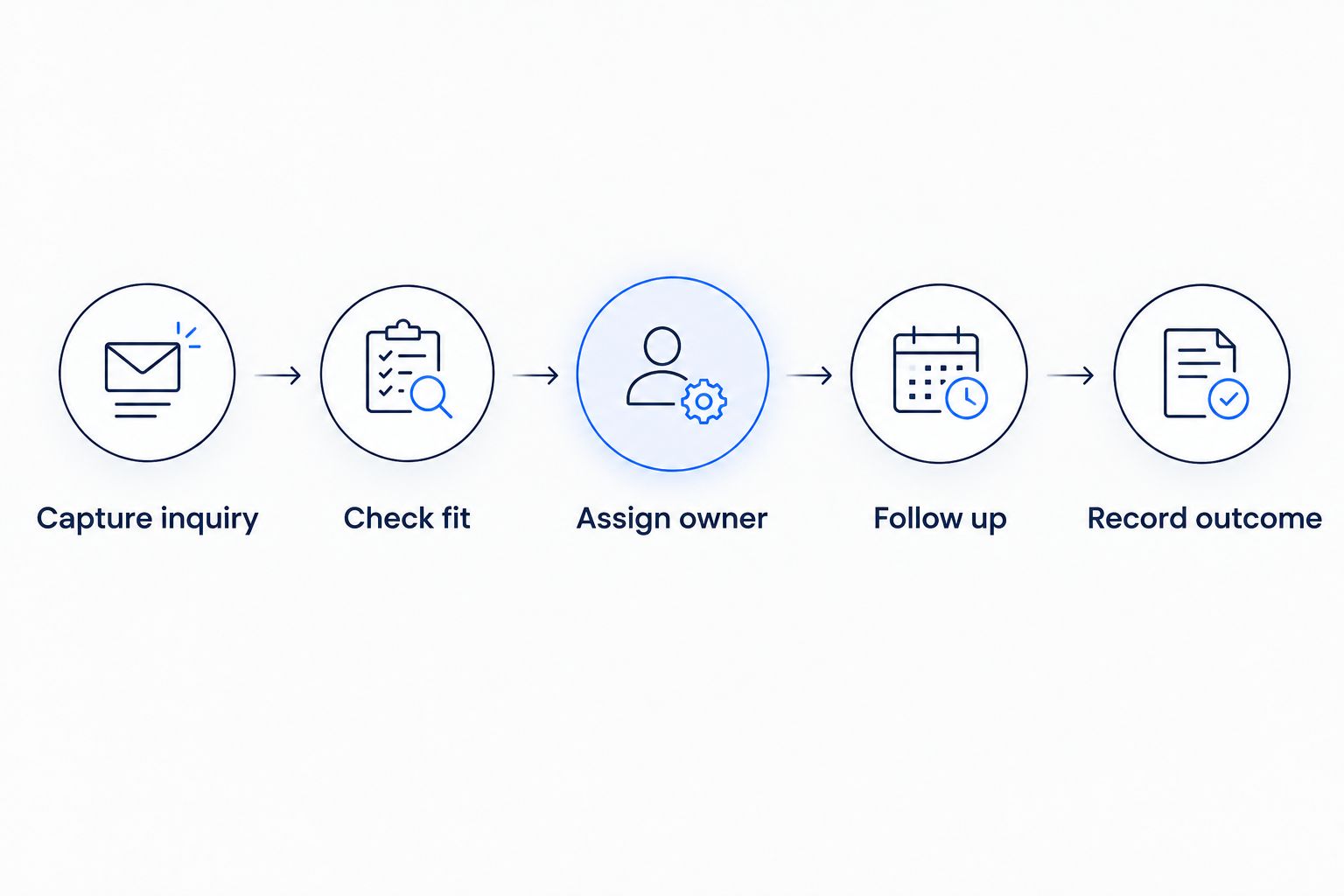
Assign responsibility before automating the handoff.
Use the tools your business already has where practical. Adding another system before agreeing on ownership can leave the same unanswered inquiry in more places.
Inbound lead enrichment belongs at the fit-check stage. It means adding useful business details to an incoming lead and routing follow-up—not researching outbound prospect lists. Keep customer-provided facts separate from details that still need confirmation.
Automation can move information, flag missing fields, and send an approved acknowledgment. Keep people responsible for unusual requests, commitments, and decisions outside the agreed rules.
What should you ask before hiring SEO help?
Ask how the proposed work connects service pages, contact methods, and inquiry outcomes. A useful scope explains what changes, who approves it, and how you will judge the result.
Use 3 checkpoints before agreeing to a project:
Business fit: Which services and locations will the work support, and why do those inquiries matter?
Operational fit: Who receives calls and forms, and what happens when details are missing?
Measurement fit: How will you distinguish relevant inquiries from unrelated traffic and existing customer messages?
Ask what the engagement does not include. Website changes, tracking setup, inquiry routing, and follow-up responsibilities should not remain assumptions.
ClearPilot Consulting's SEO and workflow consulting is best for local service owners who need search inquiries connected to accountable follow-up. Its workflow-first approach requires owner input about how work actually moves; it is not a substitute for operational decisions.
ClearPilot Consulting's business automation consulting services include workflow mapping alongside supporting SEO and website services. Start with the stalled handoff, then decide whether the next project belongs in search visibility, the website, or inquiry handling.
Find the first process to fix
Request a free automation assessment focused on inquiries, follow-up, and repetitive admin.
Should you do SEO yourself or get help?
Handle the basics yourself when you can maintain accurate business information, explain your services clearly, and check that inquiries reach the right person. Keep responsibility explicit even if several staff members contribute.
Get help when the work crosses systems or nobody owns the whole path. A page change, form update, or automated message needs someone to check the effect on the next handoff.
The trade-off is control versus coordination. Doing the work yourself keeps decisions close to the business, but it also requires your attention. Outside help adds coordination capacity, but you still need to supply accurate service information and approve boundaries.
FAQ
Is SEO worth it for a small business with a limited budget?
SEO is worth considering when a shortage of relevant inquiries is your main constraint. If existing inquiries go unanswered, fix ownership and follow-up before expanding traffic.
How long does SEO take to bring in customers?
There is no universal timeline for SEO to bring in customers. Agree on the starting condition, planned changes, and evidence of progress rather than accepting a guaranteed deadline.
Is local SEO better than paid advertising?
Local SEO is better suited to improving unpaid local search visibility; paid advertising buys placement for a selected offer. Neither fixes unclear service pages or missed follow-up.
Can I do small-business SEO myself?
You can handle basic SEO work yourself if you can maintain accurate information and make useful website updates. Get help where technical changes, measurement, or inquiry routing exceed your team's capacity.
What should I measure instead of rankings?
Track 4 stages: relevant visits, qualified inquiries, booked jobs, and completed work. Rankings provide search context, but those stages connect visibility to business outcomes.
Will a chatbot make my SEO more effective?
A chatbot can support inquiry handling, but it does not establish that SEO attracts suitable customers. Give it clear limits, an accountable human handoff, and accurate service information.
Who is ClearPilot Consulting's SEO approach best for?
ClearPilot Consulting's SEO and workflow approach fits local service owners who need inquiry handling connected to search visibility. Owners still need to define service boundaries, approve decisions, and handle exceptions.
One last thing
Before adding another page to your 2026 SEO plan, submit your own inquiry through the current website. Follow it from the form to the person responsible for replying.
Require 1 next action with a named owner. If you cannot identify that action, you have found a concrete process problem to fix before asking for more traffic.