

AI agents can replace routine receptionist tasks, but they do not replace every responsibility of a human receptionist. For a local service business in 2026, the practical choice is to automate repeatable intake and follow-up while keeping a person responsible for exceptions, sensitive conversations, and commitments the system cannot verify.
TL;DR
Can AI agents replace a receptionist? They can handle defined tasks, not every conversation or decision.
Use an AI answering agent for routine intake only when booking rules and human handoffs are clear.
ClearPilot Consulting takes a workflow-first approach to business automation consulting for local service businesses.
Lead enrichment adds useful details to incoming inquiries so the right person can follow up.
Why this matters
An unanswered inquiry is not just a phone problem. It is a process problem: someone needs to capture the request, check whether the business can help, assign follow-up, and confirm what happens next.
Adding an answering agent without that process creates another place for inquiries to stall. Start with connecting your phone system to an AI answering agent, then decide which actions the agent can take and which require approval.
The decision is not whether a machine can sound like your receptionist. It is whether your business can define the work clearly enough to delegate it safely.
Can AI agents replace a receptionist?
AI agents can replace defined receptionist tasks, not the full role by default. An agent configured with the right information and connections can collect inquiry details, answer approved questions, and pass work to the right person. Booking appointments requires a working scheduling connection and rules the business has approved.
A receptionist also handles interruptions, conflicting information, upset customers, and situations that do not fit the script. Those responsibilities need a separate decision about human coverage.
| Approach | Best for | What it handles | Main limitation |
|---|---|---|---|
| AI answering agent | Repeatable inquiries with clear rules | Approved answers, structured intake, and permitted follow-up actions | Cannot safely resolve every exception or make unsupported commitments |
| Human receptionist | Sensitive conversations and changing circumstances | Judgment, clarification, escalation, and coordination | Needs coverage arrangements when unavailable |
| Agent with human backup | Routine intake alongside exception handling | Defined tasks go to the agent; exceptions go to a named person | Requires maintained rules and a working handoff process |
For an owner considering receptionist automation in 2026, the hybrid approach is the starting recommendation when inquiries include both predictable questions and exceptions. It preserves human responsibility without requiring a person to perform every repetitive step.
What counts as replacement?
Replacing message-taking is different from replacing front-desk coverage. A system that captures a caller's name and request has not necessarily checked the service area, booked an appointment, or arranged follow-up.
Write the responsibilities separately before choosing technology. Otherwise, a successful demonstration of answering questions can be mistaken for proof that the entire job is covered.
Routine intake: automate the repeatable part
Best for: businesses receiving recurring questions and straightforward service requests. Give the agent approved information about services, operating hours, intake requirements, and the next step. Keep answers tied to information your team maintains.
For a service inquiry, the agent can be configured to ask what help the caller needs, where the work is located, and how the caller wants to be contacted. Collect enough to route the inquiry without turning the conversation into a long questionnaire.
The benefit is consistent information capture. The limitation is that a completed form is not the same as an accepted job.
Illustrative scenario: A homeowner asks for help with a service issue. The agent records the request and location, then sends it to the assigned employee. It does not promise that a technician is coming unless the business has authorized and confirmed that action.
Scheduling: allow only verified bookings
Best for: appointment types with clear eligibility and scheduling rules. Let the agent book only when it can check the relevant calendar and apply the rules for that appointment.
Those rules should cover the service requested, location, required information, and any approval needed before booking. If travel or job scope affects scheduling, a calendar opening alone is not enough.
The benefit is removing a repetitive exchange from routine appointments. The limitation is that an open slot does not prove your team can perform the requested work.
When the scheduling connection fails, the agent should collect a callback request rather than announce a confirmed appointment. That distinction belongs in the workflow, not just in a training document.
Human handoffs: keep judgment with a person
Best for: complaints, unclear requests, sensitive details, and exceptions. The agent should recognize these situations and stop making decisions beyond its permission.
A handoff needs a destination and context. Send the customer's request, relevant details, actions already attempted, and the reason a person needs to take over.
The benefit is keeping people responsible for consequential decisions. The limitation is operational: someone must actually receive and act on the handoff.
Do not design a process that promises an immediate transfer when nobody is assigned to receive it. Offer an accurate next step instead, such as recording a callback request under your approved follow-up procedure.
Why receptionist automation coverage varies
The useful scope of an agent depends on the work, not how convincing its voice sounds. Use these factors to decide what belongs in your 2026 rollout:
Inquiry complexity. Repeated questions fit approved answers. Requests involving uncertain scope need clarification or review.
Scheduling rules. Straightforward appointments are easier to define than jobs requiring travel planning, inspection, or approval.
Information quality. Outdated service details and conflicting records create unreliable inputs for any automated action.
Tool connections. An agent needs the appropriate access to record an inquiry or verify a booking; conversation alone does not complete either task.
Human coverage. Escalation works only when a named person owns the next action and has a fallback when unavailable.
Permission boundaries. Taking a message is different from changing an appointment, making a commitment, or discussing account details.
These factors also explain why copying another business's setup is a poor starting point. Map your own inquiry path before deciding what the agent should do.
Map the workflow before choosing the agent
Start your 2026 rollout with 1 workflow, such as capturing new inquiries when your team cannot answer. A narrow scope makes it easier to see whether the next step happens correctly.
ClearPilot Consulting is best for local service businesses seeking workflow-first business automation consulting. Its approach starts with mapping how work moves through the business, connecting existing tools where practical, and keeping people in control of decisions and exceptions. That approach still requires your team to define its rules and own follow-up.
Use this sequence to write the process:
Capture request. Define the details needed to understand the inquiry and contact the customer.
Check details. Confirm information that affects routing, such as the service requested and job location.
Apply rules. Decide whether the agent can answer, request more information, or perform an approved action.
Assign follow-up. Send unresolved work to a named person rather than an unowned inbox.
Confirm outcome. Record what happened and give the customer an accurate next step.
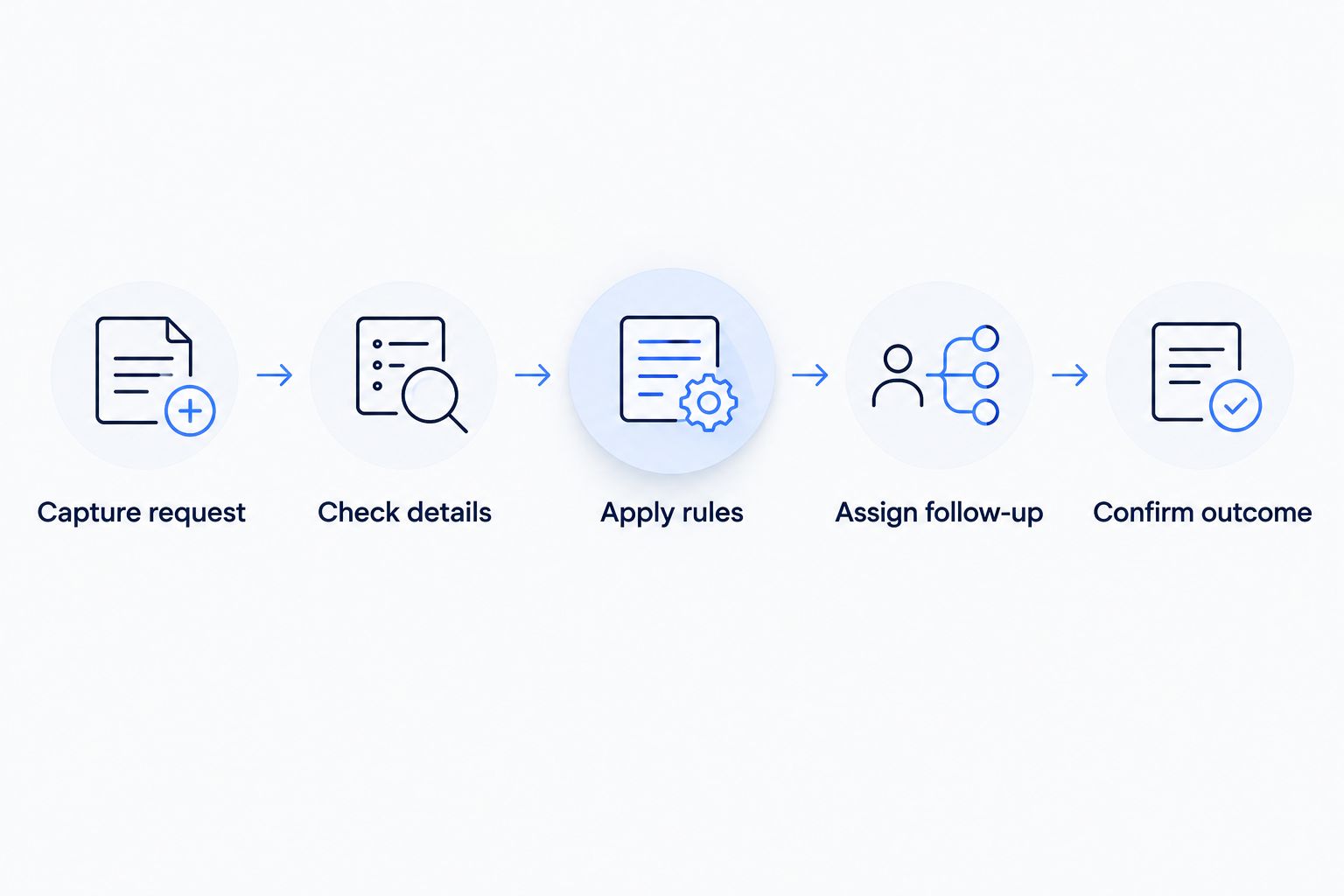
Answering the inquiry is only the start; follow-up needs an owner.
At each step, identify the information source and the person responsible when something fails. If the agent cannot write to your customer record, specify how the inquiry reaches the team instead. Do not assume the connection exists because the tools appear compatible.
For a free automation assessment, bring a real inquiry path and the point where work gets stuck. Include the tools involved, the repetitive steps, and the decisions you want a person to retain.
Request a free automation assessment
Discuss your inquiry workflow with ClearPilot Consulting and identify where a person needs to stay involved.
Where inbound lead enrichment fits
Lead enrichment means adding useful business details to an incoming inquiry and routing follow-up. It is not building an outbound prospect list.
For receptionist automation, useful details include the requested service, job location, preferred contact method, and information the customer has already supplied. Use existing records where appropriate, but ask for confirmation when details conflict.
Illustrative scenario: A customer submits a website form and later calls. A configured workflow can check for an existing inquiry and present the earlier request to the employee handling follow-up. The process needs rules for matching records so different people are not accidentally combined.
Website forms, chatbots, and phone intake should feed the same follow-up process where practical. SEO can bring an inquiry to the business; it does not assign responsibility for answering it.
Collect only details needed for the next action. Do not ask the agent to gather sensitive information simply because it can ask another question.
Test failures, not just friendly conversations
Before expanding coverage in 2026, run 5 test calls against the proposed workflow. These are recommended test cases, not a performance benchmark:
Routine inquiry: Ask an approved question and verify that the answer matches your current information.
Missing detail: Leave out the job location and check whether the agent asks before routing.
Conflicting detail: Give information that differs from an existing record and check that it requests clarification.
Unavailable connection: Make the scheduling connection unavailable and verify that the agent does not claim a booking succeeded.
Human request: Ask to speak with a person and check that the handoff follows your approved procedure.
Review 3 outcomes for each test: what the customer heard, what was recorded, and who received the next action. A natural-sounding conversation does not pass if the inquiry disappears afterward.
Also test whether the agent can say it cannot complete a request. A clear limitation is better than an unsupported promise.
Keep failed cases in your review process. Update the rule or connection, repeat the test, and confirm that the change did not break the routine path.
Can an AI agent answer calls when nobody is available?
An AI agent can answer calls during unattended periods when your phone setup routes calls to it and the service is operating. It still needs an accurate fallback for requests it cannot complete, especially when no person is available to receive a transfer.
Should you remove your receptionist after installing an agent?
Do not remove receptionist coverage based on installation alone. First check which responsibilities remain, whether automated actions complete correctly, and who handles the work that still needs judgment.
FAQ
Can AI agents replace a receptionist completely?
AI agents can replace defined receptionist tasks, but complete replacement depends on the responsibilities involved. Keep human ownership of exceptions, sensitive conversations, and commitments the agent cannot verify.
What's the best first task to give an AI receptionist?
Routine inquiry capture is a practical first task when you define the required details and follow-up owner. Start with a narrow workflow before adding scheduling or other actions.
Can an AI receptionist book appointments?
An AI receptionist can book appointments when it has a working scheduling connection and approved booking rules. It should not confirm an appointment when it cannot verify that the booking succeeded.
What should happen when a caller asks for a person?
The agent should follow a defined human-handoff process. Transfer the request and relevant context, or accurately explain the approved callback process when a person is unavailable.
Do I need to replace my existing business tools?
Replacing existing tools is not the starting requirement. Check whether your phone, calendar, and customer records can support the workflow and required permissions before deciding what needs to change.
What does lead enrichment mean for incoming calls?
Lead enrichment adds useful details to an incoming inquiry so your team can route and follow up appropriately. Confirm missing or conflicting information rather than treating assumptions as facts.
How do I know whether receptionist automation is working?
Check whether inquiries are recorded correctly, permitted actions finish, and unresolved requests reach the responsible person. Review failed handoffs as well as completed conversations.
One last thing
Your most useful test is not whether the agent can answer a question. It is whether the agent leaves the business with an accurate record, an owned next action, and no promise it cannot support.
Before a 2026 launch, ask the person who will receive escalations to walk through a failed booking. If that person cannot tell what happened or what to do next, fix the handoff before adding more automation.