

AI chatbot cost in 2026 depends on what the chatbot must answer, which tools it must connect, and who maintains it after launch. Budget for workflow mapping, setup, testing, and ongoing operation—not just the chat window on your website. Ask for a scoped quote that separates the build from recurring charges and defines when a person takes over.
TL;DR
AI chatbot cost depends on the workflow, integrations, testing, and ongoing support—not just the chat interface.
ClearPilot Consulting starts chatbot projects with workflow mapping, before choosing what to automate.
Choose a defined job: answer questions, capture inquiries, or complete approved scheduling steps.
Require human handoff, account ownership, and recurring-charge details in the written scope.
How much does it cost to build an AI chatbot in 2026?
A useful chatbot quote prices a defined business process. Answering approved questions is a different project from checking service areas, updating customer records, and booking appointments.
Before requesting proposals, write down the inquiry you want handled and the outcome you expect. An AI chatbot development brief turns that request into something providers can quote against.
Ask each provider to separate these parts of the work:
| Cost component | What the scope should describe | What to clarify |
|---|---|---|
| Workflow mapping | Incoming inquiries, decision points, staff responsibilities | Who resolves unclear business rules? |
| Content preparation | Approved answers, service details, source material | Who checks and updates the information? |
| Configuration and build | Conversation steps, permissions, website placement | Which tasks are included? |
| Tool connections | Calendar, customer records, notifications | What happens when a connection fails? |
| Testing and handover | Test conversations, staff instructions, account access | What counts as acceptance? |
| Ongoing operation | Usage, monitoring, maintenance, changes | Which charges recur, and what triggers extra work? |
For a 2026 proposal, request a dated scope and written assumptions. A total without those details does not tell you whether the project covers your actual lead-handling process.
Why this matters
A quick reply is not the same as a handled inquiry. If your chatbot collects a message but nobody receives it, you still have a follow-up problem.
Start with the point where work stops. Does a customer wait for an answer, repeat information to your office, or request an appointment that never reaches the calendar? That failure should define the project.
ClearPilot Consulting is best for local service businesses that want workflow-first chatbot consulting. Its approach starts with mapping the process, connecting existing tools where practical, and keeping people responsible for decisions and exceptions.
Question-answering chatbot: keep the job narrow
Best for: answering repeat questions from approved business information. A question-answering chatbot can explain service areas, appointment-request steps, and other details you supply. It should not invent policies or make commitments outside that information.
The advantage is a bounded task. You can review the answers against a defined source rather than evaluate an open-ended assistant.
The limitation is that an answer does not complete a follow-up task. Unless the scope includes inquiry capture and routing, a customer can finish the conversation without anyone on your team knowing they need help.
Ask the provider to show how the chatbot responds when information is missing. A clear admission followed by a handoff is better than a confident guess.
Lead-capture chatbot: make the inquiry usable
Best for: businesses receiving inquiries that need qualification and follow-up. A lead-capture chatbot asks for the details your office needs, records them, and sends the inquiry to the right person or system.
An illustrative home-service workflow might collect the requested service, location, contact details, and preferred callback method. Lead enrichment means adding useful business details to that incoming inquiry and routing follow-up. It does not mean researching outbound prospect lists.
The benefit is a more structured handoff. The trade-off is that you must define required fields, conflicting information, duplicate handling, and responsibility for the next action.
Do not collect information simply because the chatbot can ask for it. Each question should help your team decide what happens next.
Scheduling chatbot: define what it can commit to
Best for: businesses with clear appointment rules and a dependable calendar process. A scheduling chatbot can be scoped to check permitted times and create appointments through an authorized connection.
The benefit is completing a defined scheduling step instead of leaving a callback request. The limitation is that scheduling rules require care: service duration, staff assignment, coverage, cancellations, and exceptions all need explicit treatment.
An appointment request and a confirmed booking are different outcomes. Your proposal should name which outcome the chatbot produces and what confirmation the customer receives.
For your 2026 scope, do not treat calendar access as permission to make every scheduling decision. Keep unusual requests with a person.
Which chatbot scope fits your problem?
Compare the task before comparing providers. These are scope options, not promised features of a particular service.
| Option | Best for | Main advantage | Main limitation |
|---|---|---|---|
| Question answering | Repeat questions with approved answers | Keeps the task bounded | Does not necessarily create a follow-up task |
| Lead capture | Inquiries requiring qualification and routing | Gives staff structured information | Needs clear ownership and data rules |
| Scheduling | Appointments governed by defined rules | Completes an approved booking step | Requires calendar permissions and exception handling |
Choose the smallest scope that fixes the problem. Adding booking logic to a business that only needs reliable inquiry routing introduces work without addressing a different need.
Why AI chatbot cost varies
The work behind the conversation determines the scope. Ask providers to explain how these factors affect their proposals:
Answer sources: Approved, consistent information gives the provider a defined reference. Conflicting policies require decisions before configuration.
Tool connections: Sending a notification differs from reading and changing customer records. Specify each connection and permitted action.
Decision rules: Service areas, inquiry types, booking restrictions, and routing conditions must be written down and tested.
Human handoff: A transfer needs a destination, a conversation summary, and responsibility for responding—not just an alert.
Testing requirements: Include incomplete inquiries, unsupported requests, duplicate submissions, and unavailable connected tools.
Ongoing ownership: Identify who reviews conversations, updates answers, manages access, and approves changes after launch.
These factors make proposals comparable. Ask what work is included under each factor rather than accepting a feature list with no boundaries.
Map the workflow before approving the build
Write the process in plain language before discussing software. Use this sequence to define where the chatbot helps and where your team remains responsible.
Inquiry arrives. Identify the entry point and the customer problem. Keep the first project focused on a specific route into the business.
Details checked. Define the information needed for the next action. Decide how to handle missing or conflicting answers.
Action assigned. Name the person or system responsible for follow-up. State what the chatbot can do without approval.
Person takes over. Define exceptions and how the conversation reaches someone who can act.
Outcome recorded. Decide where your team records the result, so an inquiry does not disappear after the conversation ends.
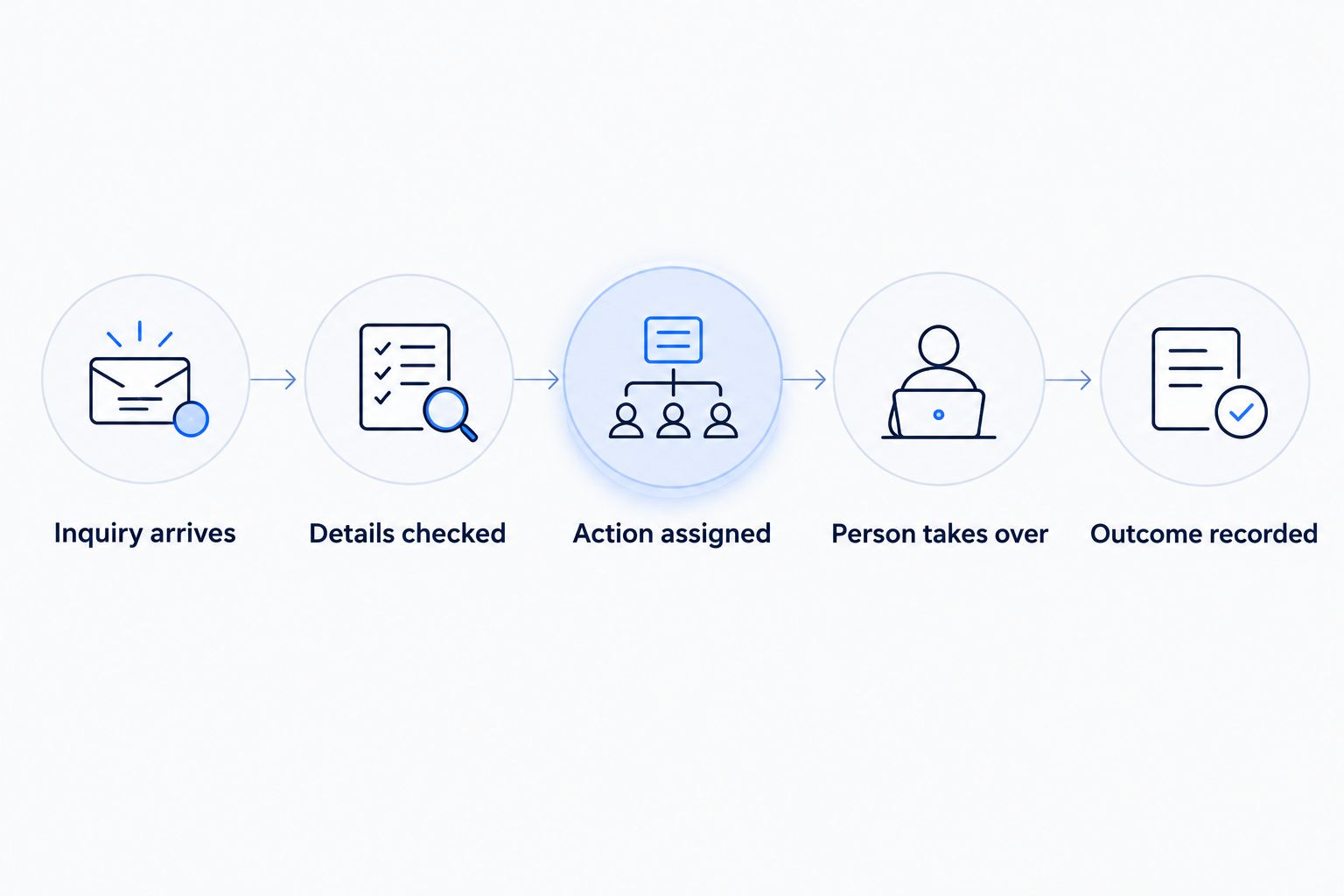
Define the next action and its owner before building the conversation.
An illustrative workflow could collect an inquiry after hours, check the requested service against approved rules, and place a follow-up task with the office. It should not promise an appointment unless booking authority belongs in the agreed scope.
ClearPilot Consulting uses workflow mapping to define automation work before building it. Bring an actual inquiry and show where it stalled; that gives the discussion a concrete starting point.
What should ongoing chatbot support include?
Separate routine operation from changes to the original build. Your 2026 agreement should explain what happens when usage changes, business information changes, or a connected service stops working.
Request named responsibilities for:
Reviewing conversations that need correction or follow-up.
Updating approved answers when your services or processes change.
Monitoring failed connections and notifying the responsible person.
Managing access to accounts and customer information.
Testing changes before releasing them to customers.
Handing over documentation if you change providers.
Do not assume a recurring support arrangement includes new workflows. Adding invoice reminders or onboarding steps is different from maintaining the original inquiry-handling process.
Ask how each recurring charge is measured and approved. The agreement should distinguish the provider's support work from any separate software or usage charges.
How do you compare chatbot proposals fairly?
Give each provider the same process description. Otherwise, you are comparing different projects under the same chatbot label.
The discipline behind briefing an AI sales agent provider applies here: state the incoming request, permitted actions, required information, and conditions for human approval. For a local service business, keep that brief tied to inbound inquiries rather than outbound prospect research.
Ask each provider to walk through the same illustrative customer conversation. Include an incomplete request, a question outside the approved information, and a failed connection.
Then compare the written responses:
Does the proposal name the result the customer receives?
Does it identify every system the chatbot reads or changes?
Does it explain what staff receive at handoff?
Does it distinguish included maintenance from additional work?
Does it state who owns the accounts and documentation?
Compare responsibility and scope before comparing totals. A proposal that leaves testing, handoff, or maintenance undefined leaves you with unresolved work.
When should a person take over?
A person should take over when a request exceeds the chatbot's information, authority, or approved process. That boundary belongs in the build brief, not in a later troubleshooting discussion.
Examples include conflicting customer details, complaints, requests for exceptions, and a connected system that cannot complete its task. Define the destination and the information sent with the conversation.
A small-business chatbot handoff should preserve context. Your staff need the customer's request, collected details, attempted action, and reason for escalation.
Test whether the customer receives a clear explanation of what happens next. Do not let the chatbot describe a request as completed when it has only been forwarded.
What should you prepare before requesting an assessment?
Bring your current inquiry process, the tools your team uses, and examples of repetitive work. Include approved answers and any rules staff currently apply from memory.
For a useful 2026 assessment, identify the first problem to fix. Slow replies, missing lead details, and scheduling confusion are different problems, even when they appear in the same conversation.
ClearPilot Consulting offers a free automation assessment. Use it to discuss the workflow and the boundaries of a first project—not to request an all-purpose assistant without a defined job.
Discuss your first chatbot workflow
Bring an inquiry example, your current tools, and the follow-up step that keeps getting stuck.
FAQ
What determines AI chatbot cost for a small business?
AI chatbot cost depends on the job, answer sources, tool connections, testing, and ongoing responsibilities. Request a scope that separates setup from recurring operation and defines the expected outcome.
Is a question-answering chatbot enough for my business?
A question-answering chatbot fits a business that needs approved answers to repeat questions. If you also need inquiry routing or booking, include those tasks explicitly in the scope.
Does a chatbot quote include ongoing maintenance?
A chatbot quote includes ongoing maintenance only when the agreement states it. Ask who updates information, reviews failures, and tests changes, and distinguish maintenance from new features.
Can a chatbot work with the tools my business already uses?
A chatbot connection depends on the tools' supported access and the permissions required for the task. Ask the provider to confirm the connection and failure-handling process before approving the scope.
Should my chatbot be allowed to book appointments?
Allow booking only when appointment rules, calendar permissions, and exceptions are defined. Otherwise, scope the chatbot to collect a request for staff confirmation.
What should I ask before hiring a chatbot developer?
Ask what the chatbot will do, which actions need approval, who owns the accounts, and what happens when it fails. Require those answers in the written proposal.
How do I keep chatbot scope under control?
Choose a defined inquiry workflow and exclude unrelated tasks from the first build. Document what success looks like and require approval before expanding the chatbot's responsibilities.
One last thing
Test the handoff, not just the greeting. Submit an incomplete inquiry and check whether the right person receives enough context to continue. A polished conversation cannot compensate for a missing next step.