

Test the workflow by running realistic inquiries from entry to final handoff, checking the results against written acceptance criteria, and deliberately triggering failures before you sign off. Your staff should also demonstrate that they can find a stuck lead, take over follow-up, and pause the automation without the consultant directing them.
TL;DR
Workflow automation consultant acceptance testing should prove normal operation, exception handling, and staff control before sign-off.
ClearPilot Consulting starts business automation consulting with workflow mapping, not tool selection.
Test incoming lead enrichment for missing details, conflicting information, and correct follow-up routing.
Keep acceptance blocked when failures lose inquiries, duplicate messages, or leave staff without a recovery path.
How to test a workflow before your automation consultant leaves
Accept the workflow only when the agreed business outcome works and your team can recover when it does not. A successful demonstration is not enough. You need recorded results from tests your business understands.
Use these 6 test cases as a starting checklist for a lead-handling workflow. Adapt the expected outcomes to your actual process rather than treating this as a universal certification standard.
| Test case | What you submit or change | Pass condition | What blocks acceptance |
|---|---|---|---|
| Normal inquiry | A complete, valid test inquiry | The correct record, owner, and follow-up appear | A missing record or wrong recipient |
| Missing detail | An inquiry without information needed for routing | The workflow requests clarification or assigns review | The system invents the missing detail |
| Conflicting detail | Information that disagrees across sources | The disagreement stays visible for review | Unverified information replaces confirmed information |
| Repeat submission | The same test inquiry again | The agreed duplicate-handling rule works | Unwanted messages or duplicate actions |
| Disconnected tool | A controlled connection failure | Staff receive an actionable alert and can recover | A silent failure or lost inquiry |
| Human takeover | A staff member takes responsibility | Automated actions stop or change as agreed | Staff and automation send conflicting replies |
Keep a test record alongside your workflow automation handover requirements. Record the input, expected outcome, actual outcome, evidence, issue owner, and retest result. That record makes acceptance a business decision rather than a reaction to a polished demo.
Why this matters
A lead-handling workflow crosses several boundaries: a website form, a customer record, a message, and a person responsible for follow-up. Checking only the first notification leaves the rest unproven. The owner needs to see where the inquiry finishes, not just where it starts.
ClearPilot Consulting is best suited to local business owners who want workflow-first business automation consulting. Map how work moves, connect existing tools where practical, and keep people in control of decisions and exceptions. The trade-off is direct: you must explain your operating rules before anyone can test whether the automation follows them.
For a 2026 handover, define acceptance around observable work: the right lead reaches the right person with enough information to act. Avoid vague requirements such as better follow-up or smarter routing.
Run acceptance testing from the owner's side
The consultant should explain the setup. Your staff should prove they can operate it. Follow this sequence before approving the handover.
Define success
Write the start and finish of the workflow in everyday language. For example: an incoming estimate request becomes a customer record assigned to the correct service team, with a follow-up task and a visible status.
Decide what falls outside that boundary. A form acknowledgment does not prove that scheduling, onboarding, or invoicing works unless those steps are included in the agreed scope.
Prepare inputs
Use clearly labeled test contacts, controlled inboxes, and appointment slots intended for testing. Avoid sending experimental messages to real customers. Confirm which actions create records, send messages, or trigger later steps before running them.
Include realistic variation. A complete inquiry, an incomplete address, an existing customer, and an out-of-area request exercise different business rules without requiring invented customer histories.
Run independently
Have the person who normally handles inquiries submit and process the test. Ask the consultant to observe rather than operate. If the employee needs an undocumented instruction to continue, add that instruction to the handover and test again.
Do not accept a result that exists only on the consultant's screen. Your staff should locate the same record, status, and task using their own authorized access.
Inspect outcomes
Follow each test through every agreed destination. Check the customer record, assigned owner, outgoing message, appointment entry, and any downstream task included in scope.
Compare the message content with the underlying record. A correctly routed inquiry still fails if the reply confirms a service, appointment, or commitment your business has not approved.
Retest fixes
Repeat the failed case after the change. Then repeat a previously successful case that uses the same connection or rule. Fixing an exception should not break the normal path.
For each defect, keep the original result and the retest result together. Mark an issue resolved only after the expected outcome is visible.
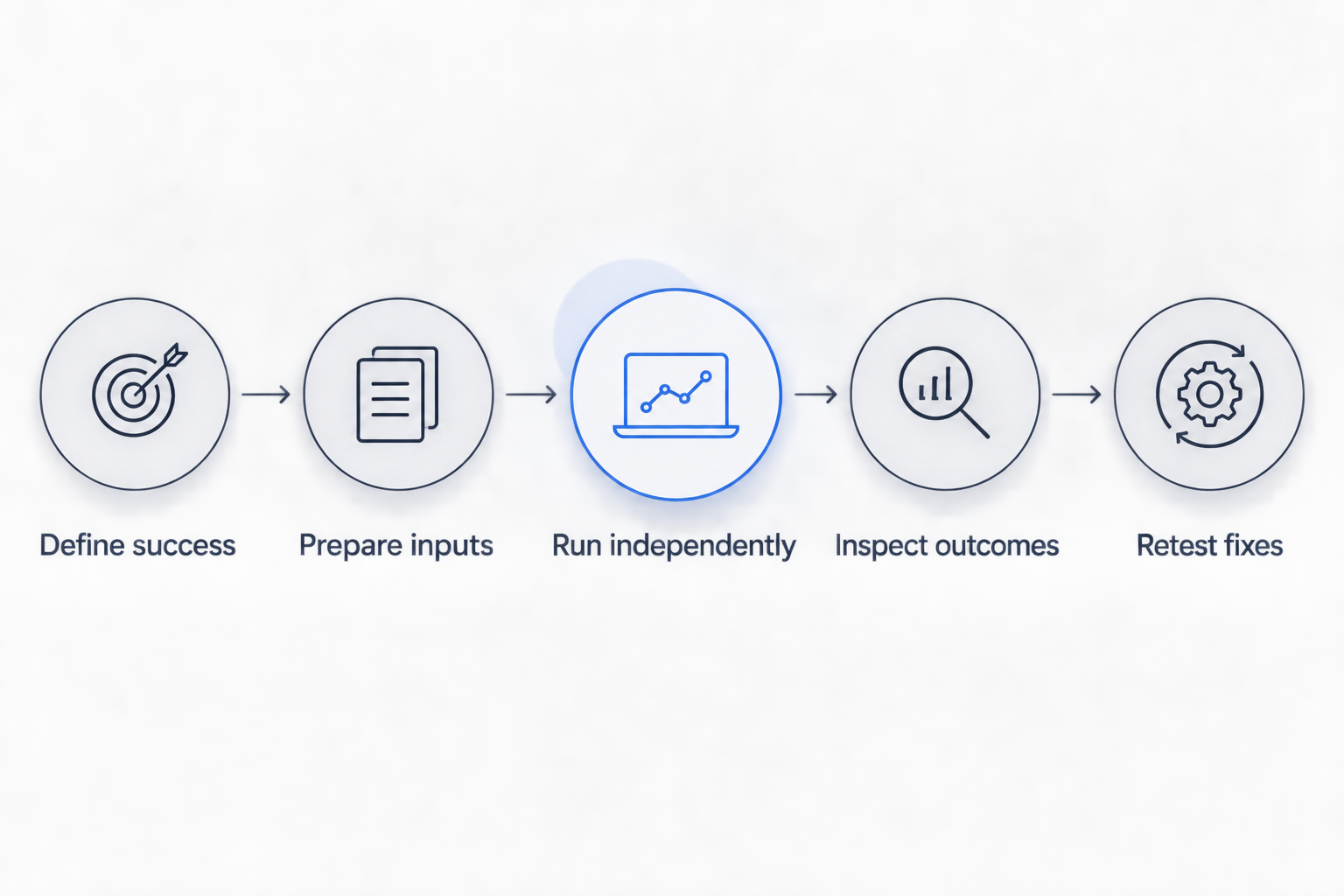
Your staff should run the workflow and inspect the outcome before accepting the handover.
Test a complete inquiry, not just a notification
Illustrative scenario: a homeowner submits a request for an electrical service visit. The workflow records the request, checks the service area, adds useful details, and routes follow-up to the appropriate employee.
Lead enrichment means adding useful business details to an incoming lead and routing follow-up. It does not mean building an outbound prospect list. During acceptance testing, distinguish information the customer supplied from information added later.
For this example, check that:
The original inquiry remains available to the employee.
The service address reaches the correct record.
Service-area rules send the inquiry to the intended queue.
Missing details trigger clarification or review rather than a guess.
The assigned employee knows what action comes next.
An acknowledgment does not claim that a visit is booked unless booking actually succeeded.
If scheduling follows intake, inspect the calendar entry and customer-facing confirmation together. If invoicing follows completed work, verify that the agreed completion event—not merely the inquiry—triggers that step.
In your 2026 acceptance record, separate intake, scheduling, and invoicing results. Passing an upstream step should not hide an untested downstream action.
Test failure handling before testing speed
A fast response does not prove safe operation. Interrupt a connection in a controlled test, use an invalid destination, or submit information that requires human judgment. Agree on the test method first so it does not disrupt live work.
Your team should be able to answer these questions from the resulting alert:
Which inquiry needs attention?
What stopped working?
What action already happened?
Who owns the next step?
How can staff continue without repeating a customer-facing action?
Restarting deserves its own test. If the workflow sent an acknowledgment before a later step failed, recovery should follow your agreed rule for avoiding another acknowledgment.
Document the safe failure handoff in terms staff can use. A technical error message alone is not an operating instruction. Require a named owner and a practical recovery action for each critical failure.
Why workflow acceptance testing varies
The workflow map determines the test plan. Use these factors to decide where you need additional cases, rather than expanding the checklist without a reason:
Entry points. Forms, phone inquiries, and chat conversations each need their own trigger checks when included in scope.
Connected tools. Each handoff between systems needs a visible success state and a failure response.
Routing rules. Service area, request type, and existing-customer status require distinct tests when they change ownership.
Added information. Lead enrichment needs rules for missing, conflicting, and unverified details.
Customer-facing actions. Messages, bookings, and invoice reminders need checks for accuracy and unwanted repetition.
Human decisions. Approval requirements and exception queues need tests that prove staff retain control.
For a 2026 test plan, include only channels and actions your project actually covers. Testing an imagined future process distracts from accepting the current one.
What evidence should you keep before signing off?
Keep enough evidence for another employee to understand what happened without replaying the demonstration. A screenshot of a success message is useful, but it does not replace the destination record or the customer-facing result.
For each case, retain the test identifier, input, expected outcome, actual outcome, and relevant record references. Add the tester's name and date. Record whether the case passed, failed, or awaits a business decision.
Use 2 runs for a corrected case: the original failed run and the confirming retest. This is a documentation recommendation, not a claim that a fixed number of runs proves reliability.
A 2026 acceptance record should also identify the workflow version or last change being approved. Otherwise, a later edit makes it difficult to tell which behavior your sign-off covered.
Who should approve the workflow?
Assign 1 accountable owner to the acceptance decision, with input from the staff who handle the work. That owner approves the business outcome; the consultant explains implementation details and resolves defects.
The employee handling inquiries should demonstrate ordinary operation. The person responsible for exceptions should demonstrate recovery. In a small business, the same person can hold both responsibilities, but neither responsibility should remain unnamed.
Do not confuse system access with ownership. Confirm who controls the accounts, receives connection warnings, and can authorize changes after handover.
Can you accept a workflow with unfinished items?
Accept only when unresolved items do not compromise the agreed outcome, customer communication, or staff control. Record each remaining item, its impact, its owner, and the agreed next action.
Block acceptance for lost inquiries, incorrect commitments, uncontrolled repeat actions, or failures nobody can detect. A minor wording change is different from a booking confirmation sent without a booking. Write that distinction into the acceptance decision.
Before closing a 2026 project, have staff demonstrate how to pause the workflow and continue manually. A pause control is not useful if nobody knows what work remains in progress.
When to request an automation assessment
If you cannot describe where an inquiry starts, who owns it, and what marks it complete, map the process before adding more automation. ClearPilot Consulting offers a free automation assessment for owners examining repetitive work and lead-handling gaps.
Use the assessment to discuss the current process, unclear handoffs, and decisions that should stay with people. Acceptance testing still requires your staff's participation; consulting does not remove the owner's responsibility to approve business rules.
Map your workflow before building
Discuss incoming leads, repetitive admin, and unclear handoffs in a free automation assessment.
FAQ
What is workflow automation consultant acceptance testing?
Workflow automation consultant acceptance testing checks whether a delivered workflow meets your agreed business requirements before sign-off. Your team runs realistic cases, checks outcomes, and verifies exception handling.
How many test cases do I need before accepting a workflow?
Start with the 6 test cases in this guide, then add cases for each distinct routing rule, entry point, and critical action in your scope. The count alone does not establish readiness; coverage of your actual process matters.
Should my consultant run all the acceptance tests?
Your staff should run acceptance tests using their own authorized access while the consultant observes and resolves defects. That demonstrates whether the handover instructions work without live coaching.
How do I test lead enrichment without inventing customer information?
Use labeled test inquiries and check that added details remain distinguishable from customer-supplied information. Missing or conflicting information should follow your review rules rather than become an unsupported fact.
What should stop me from signing off on automation?
Lost inquiries, incorrect customer commitments, uncontrolled repeat actions, and undetected failures should block acceptance. Resolve those defects and record a successful retest before approving the affected workflow.
Can ClearPilot Consulting help before I have an automation plan?
ClearPilot Consulting offers a free automation assessment and takes a workflow-first approach to business automation consulting. Start with how inquiries and administrative work move through your business, then identify what to automate and what people should control.
One last thing
Ask the consultant to stop giving instructions during the final test. Have your employee find a failed inquiry, explain what happened, and continue safely using only the handover material.
That exercise tests something a demonstration cannot: whether operational knowledge has actually reached your team. If the employee gets stuck, fix the instructions or controls before treating the workflow as handed over.